

Choosing the right packaging vendor is one of the most consequential procurement decisions a manufacturing operation can make. The wrong partner doesn't just deliver subpar boxes—it creates cascading failures across your supply chain, from damaged goods and regulatory fines to lost retail contracts and brand erosion.
With the global packaging market valued at over $1.1 trillion in 2025 and projected to grow at a 4.21% CAGR through 2034, the vendor landscape is enormous and increasingly complex. This guide breaks down the ten factors that separate reliable packaging partners from costly mistakes.
1. Material Quality and Durability
Material quality is the foundation of every packaging decision. High-quality materials ensure durability, consistent printability, and an appealing finish that reflects your brand standards. A vendor should offer a range of material options tailored to different product requirements—from lightweight kraft paper for simple goods to heavy-duty corrugated solutions for fragile or high-value items.
During evaluation, request material specification sheets, third-party test reports, and sample runs. Examine burst strength, compression resistance, and moisture tolerance. Ask specifically about raw material sourcing, because volatility in raw material prices for paper, plastics, and metals can significantly impact your production costs over the life of a contract.
2. Total Cost of Ownership—Not Just Unit Price
It's tempting to choose the lowest-bidding vendor, but the era of simply hunting for the lowest price per unit is over. Smart manufacturers evaluate total cost of ownership (TCO), which encompasses material costs, shipping and handling expenses, damage rates, replacement frequency, and long-term lifecycle value.
Higher upfront costs from a premium vendor might actually lead to lower long-term expenses due to reduced damage rates and less frequent replacements. Request detailed cost breakdowns from every vendor under consideration. Factor in reusable and durable packaging options that can significantly reduce per-cycle costs over time, especially in closed-loop supply chains.
3. Regulatory Compliance and Certification
Ensuring that your packaging meets all regulatory compliance and industry standards is non-negotiable. In the United States, packaging regulations are tightening dramatically in 2025–2026 around three pillars: high recyclability, material safety, and zero chemical risks. State-level Extended Producer Responsibility (EPR) laws in Maine, Oregon, and California are shifting recycling costs onto producers and importers.
Evaluate whether a vendor holds relevant certifications—ISO 9001 for quality management, ISO 14001 for environmental management, FSC certification for paper sourcing, or FDA compliance for food-contact materials. For international suppliers, cross-reference claims against third-party verification from organizations like SGS or Bureau Veritas. Never accept unverified compliance certificates; always request full, unredacted lab reports from accredited testing facilities.
4. Production Capacity and Scalability
A vendor may produce excellent samples but fail when volume demands spike. Assess current production capacity, shift flexibility, and the vendor's track record of scaling during peak periods. Key questions include: What is the maximum monthly output? What is the typical lead time at various order volumes? Can the vendor ramp production by 30–50% within a defined timeframe?
Smaller suppliers may deliver rapid responses but can have scalability limitations that become apparent only under pressure. For manufacturing operations with seasonal demand or growth trajectories, selecting a vendor with demonstrated capacity headroom is essential.
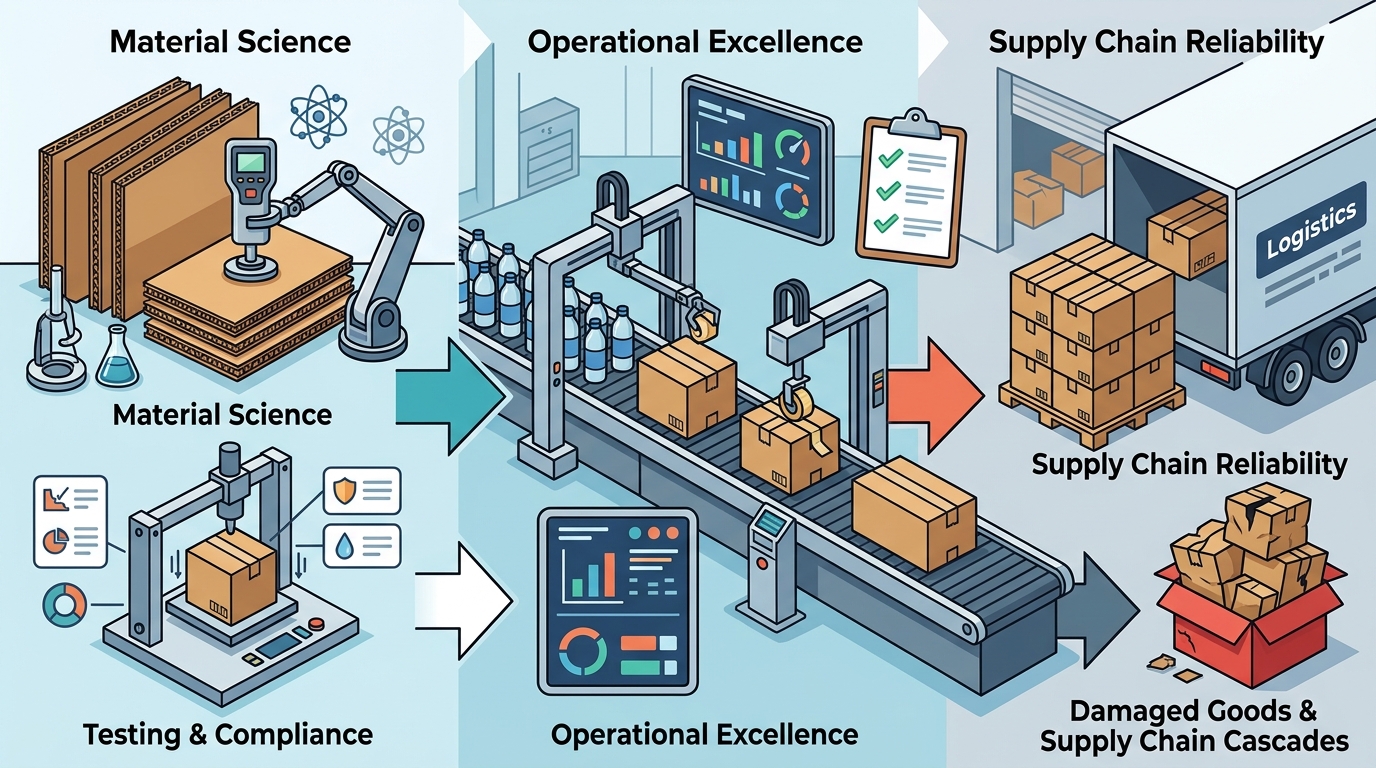
5. On-Time Delivery and Supply Chain Reliability
Delivery performance is one of the four pillars of any robust vendor rating system, alongside quality, cost, and compliance. Require evidence of on-time delivery rates—top-tier vendors maintain 95% or higher—and measure punctuality, completeness, and accuracy of shipments as separate metrics.
Evaluate the vendor's logistics network. How many distribution centers do they operate? Do they maintain safety stock or offer vendor-managed inventory (VMI) solutions? A vendor who provides flexibility in inventory management with alternative storage sites can buffer your operations against disruptions from raw material shortages or transportation delays.
6. Sustainability Credentials and Environmental Practices
Sustainability is one of the most powerful drivers in the commercial packaging market today. Consumer preferences have shifted dramatically—research indicates that 82% of consumers prefer sustainable packaging, and half of U.S. consumers are willing to pay more for it. Meanwhile, regulations around recyclability, compostability, and labeling accuracy continue to tighten globally.
Evaluate vendors on measurable sustainability metrics: percentage of recycled content used, carbon footprint per unit, waste diversion rates, and participation in circular economy programs. Be wary of greenwashing. Sustainability claims are increasingly scrutinized by regulators, auditors, and consumers, so look for substance behind every marketing message. Certifications from the Biodegradable Products Institute (BPI) or Forest Stewardship Council (FSC) provide verified third-party validation.
7. Customization and Design Engineering Support
The best packaging vendors function as design partners, not just order fulfillment operations. Customization capability allows your business to brand products effectively, optimize packaging for specific product geometries, and reduce material waste through right-sized solutions.
Top-tier vendors provide additional services that enhance value beyond the physical product—including packaging design consultation, prototype development, structural engineering, and packaging system evaluations. Some also offer cleaning, repair, lease, and rental services, extending the lifecycle of packaging materials and providing cost flexibility. Evaluate whether the vendor can support digital printing for short runs, embossing, and unique structural designs that differentiate your products at shelf.
8. Industry-Specific Experience
Experienced vendors offer tailored solutions that address particular challenges across diverse industries. Whether it's shock-proof packaging for delicate electronics, sterile contaminant-free packaging for medical devices, or temperature-controlled solutions for pharmaceuticals, a vendor with relevant sector expertise can deliver optimized results that newer market players cannot match.
Ask for case studies, reference accounts in your industry vertical, and examples of how the vendor has solved problems similar to yours. A vendor with comprehensive industry experience typically provides enhanced product safety, better regulatory compliance, and more efficient packaging operations aligned with your strategic goals.
9. Technology and Innovation Capability
The packaging industry is undergoing rapid technological transformation. Smart packaging incorporating QR codes, RFID tags, and IoT sensors now provides real-time data on product freshness, location tracking, and supply chain visibility. Digital printing technology enables small-batch customization that was previously cost-prohibitive.
Evaluate whether your prospective vendor invests in innovation. A packaging supplier who can recommend alternative materials or design changes can help your business innovate its packaging and reduce costs simultaneously. Over 40% of companies plan to adopt innovative and sustainable packaging techniques by 2025, so vendors that lag in technology adoption will increasingly become competitive liabilities.
10. Communication Quality and Customer Support
Communication quality should be assessed as an operational risk indicator, not a soft service attribute. Responsive, proactive communication reduces internal decision friction and supports long-term cooperation. Evaluate response times during the RFQ process—they're a reliable predictor of post-contract responsiveness.
Exceptional customer service means the vendor is responsive, communicative, and willing to provide support throughout the ordering process, including design consultations, issue resolution, and proactive updates on order status or potential delays. Establish clear escalation paths and service-level agreements (SLAs) before signing any contract.
Building Your Vendor Evaluation Scorecard
A structured evaluation framework eliminates cognitive biases—recency bias, halo effects, and stakeholder politics—that undermine procurement decisions. Most vendor rating systems measure performance across four key areas: quality, delivery, cost, and compliance, with each supplier receiving scores that combine into an overall rating.
Best practices for your scorecard include:
- Separate qualification from differentiation criteria. Qualification criteria (certifications, minimum capacity, regulatory compliance) are pass/fail gates. Differentiation criteria (innovation, customization depth, sustainability leadership) are scored and weighted.
- Require evidence for every score. Document the rationale—reference feedback, audit results, sample test data—so evaluations are defensible and repeatable.
- Weight criteria by strategic priority. A food manufacturer may weight compliance and material safety at 30%, while an electronics company weights protective performance and customization at 25% each.
- Review and recalibrate annually. Update criteria and weights when strategic priorities shift or regulatory landscapes change.
Key Takeaways
- Evaluate total cost of ownership, not just unit pricing—factor in damage rates, replacement frequency, and lifecycle value.
- Verify regulatory compliance independently through third-party audits and accredited lab reports rather than trusting vendor-supplied certificates alone.
- Prioritize vendors with demonstrated scalability, maintaining 95%+ on-time delivery even during demand spikes.
- Demand measurable sustainability metrics and third-party certifications to avoid greenwashing risks.
- Use a structured, weighted scorecard to eliminate bias and ensure consistent evaluation across your procurement team.
- Treat communication quality as an operational risk metric, not a secondary consideration.
Frequently Asked Questions
What is the most important factor when evaluating a packaging vendor?
There is no single most important factor—it depends on your industry and strategic priorities. However, most procurement frameworks start with regulatory compliance as a pass/fail gate, then score vendors on quality, delivery reliability, cost competitiveness, and innovation capability using weighted criteria.
How often should we re-evaluate our packaging vendors?
Most organizations update vendor ratings quarterly for strategic suppliers and semi-annually for non-critical suppliers. Annual comprehensive reviews using the same core criteria applied during initial evaluation help ensure performance stays aligned with expectations.
What certifications should a packaging vendor have?
At minimum, look for ISO 9001 (quality management). Depending on your industry, you may also require ISO 14001 (environmental management), FSC certification (sustainable paper sourcing), FDA compliance (food-contact materials), or industry-specific standards like EN 13432 for compostable packaging in European markets.
How do we avoid greenwashing when evaluating sustainable packaging vendors?
Request verified third-party certifications such as BPI or FSC rather than relying on vendor marketing claims. Ask for specific metrics—recycled content percentages, carbon footprint data, and waste diversion rates. Cross-check claims against reports from independent auditors like SGS or Bureau Veritas.
Should we use a single packaging vendor or diversify our supplier base?
Diversification reduces supply risk but increases procurement complexity. A common approach is to use a primary vendor for 60–70% of volume while maintaining one or two qualified secondary vendors for redundancy. Assess risks associated with different suppliers including supply risk, geopolitical risk, and financial stability before deciding.