
Your packaging line is the last mile of production—and often the first place margin disappears. Untracked micro-stops, slow changeovers, and poorly matched materials quietly siphon capacity you've already paid for. The strategies below move beyond generic advice and target the specific levers food manufacturers can pull today to reclaim lost output, reduce material costs, and meet tightening sustainability mandates.
Why Packaging Line Performance Deserves Executive Attention
Every percentage point of Overall Equipment Effectiveness (OEE) improvement on a high-volume food line can translate to millions of dollars in annual throughput gains. Yet many facilities operate well below their equipment's potential because they lack visibility into where losses actually occur. One widely cited case study describes a snack food manufacturer that ran its flagship packaging line at just 67% OEE for three years—only to discover that 18% of capacity was lost to unplanned maintenance, 9% to extended changeovers, and 6% to minor stoppages nobody tracked. Targeted improvements pushed OEE to 82% in eight months, the equivalent of gaining an extra shift per week without new equipment.
Most food processing facilities can improve OEE by 10–15 percentage points within 12–18 months with focused effort. The seven strategies below show you where to start.
Strategy 1: Establish a Data-Driven Baseline Before Changing Anything
You cannot improve what you do not measure. Before investing in new equipment or rearranging the floor, capture your current state with hard numbers.
- Log every stop with reason codes. Minor stoppages—jams, sensor trips, material feed hiccups—are often untracked but can consume 5–15% of total capacity.
- Benchmark against industry norms. Typical food packaging lines operate at 60–70% OEE; top performers reach 85% or higher. Knowing where you sit immediately clarifies the prize.
- Use Value Stream Mapping (VSM). VSM helps identify bottlenecks and waste in transport, waiting, and excess buffering—problems that analytics dashboards alone may miss.
Collect at least five consistent readings for each metric before declaring a baseline reliable. This prevents one-off good or bad shifts from skewing targets.
Strategy 2: Attack Changeover Time with SMED Principles
Changeovers are one of the biggest hidden time-sinks on any food packaging line. The Single-Minute Exchange of Die (SMED) methodology separates tasks into two categories: internal tasks that must be performed while the line is stopped, and external tasks that can happen while the line is still running. The goal is to convert as many internal tasks to external as possible, then streamline whatever remains.
Most changeovers have 30–50% reduction potential when SMED is applied rigorously. Practical moves include pre-staging the next film roll or container format on a shadow board, using quick-release clamps instead of bolted format parts, and colour-coding change parts so operators never waste time searching.
Product and packaging standardization also plays a role. The more SKU formats you can consolidate, the fewer changeovers your line requires—and the more productive time becomes available.
Strategy 3: Redesign Material Flow and Floor Layout
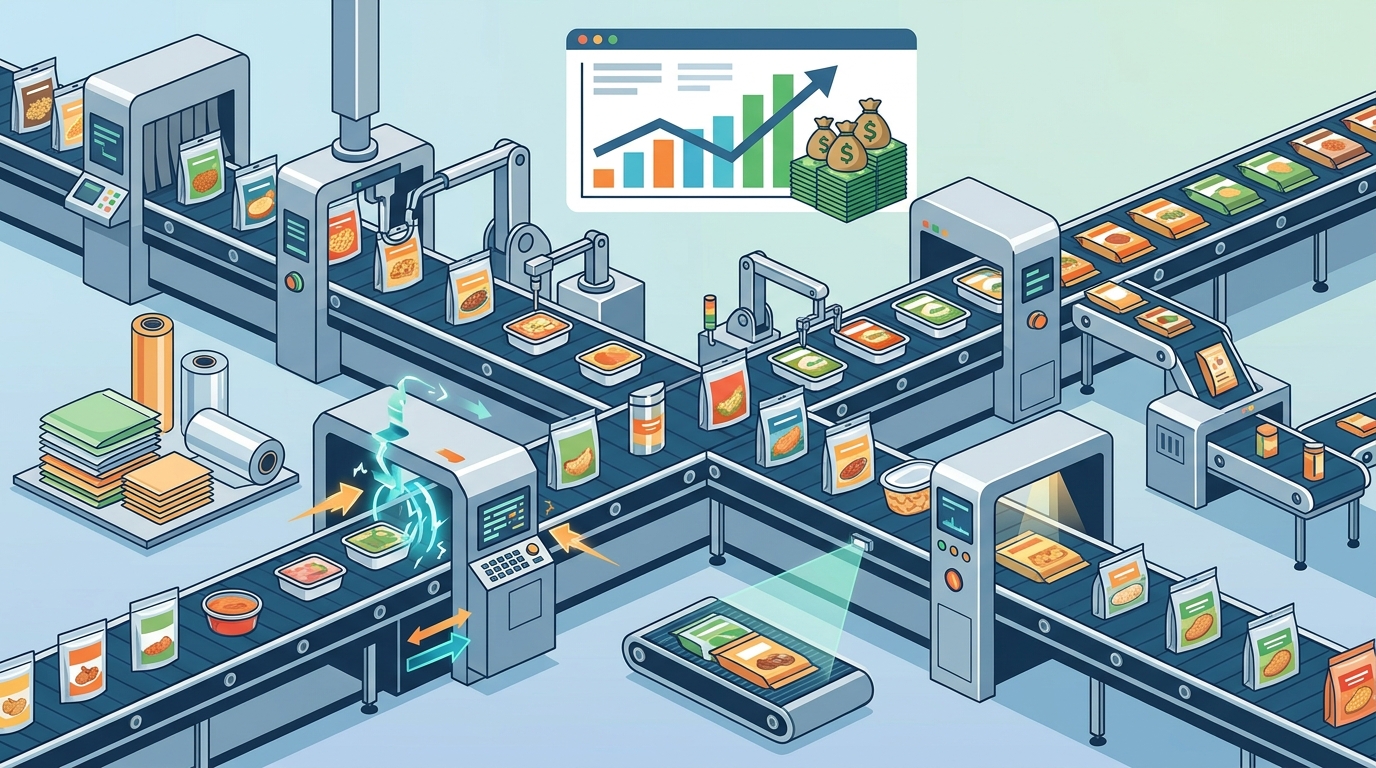
Roughly 75% of bottlenecks on food processing and packaging lines originate from process design rather than equipment capability. Focusing on layout, scheduling, and workflow often yields bigger gains than buying new machines.
How to Diagnose Flow Problems
- Spaghetti diagrams: Track actual material and operator movement through a full production cycle. These diagrams reveal crisscrossing paths, dead zones, and unnecessary travel that inflate cycle time.
- Measure travel distance and waiting points: Quantify how far materials and people move between stations to spot inefficiencies and cross-contamination risks.
- Rearrange workstations in process order: Straight-line or U-shaped layouts that follow the natural sequence—raw materials → prep → processing → thermal steps → packaging—cut walking distance and handoff errors.
Your packaging system should always be designed to operate efficiently at a rate higher than the upstream delivery of product. A longstanding rule of thumb is that the maximum throughput capacity (Tmax) of your packaging operation should be roughly 20% above the maximum of the operation feeding it. In applications like baking or confectionery, redundant packaging machines or larger buffer and accumulation systems may be necessary to avoid stopping the upstream process.
Strategy 4: Introduce Automation Where ROI Is Proven
Automation is driving measurable productivity gains in food packaging, but the smartest adopters are selective. Labor shortages continue across food and beverage facilities, pushing processors toward operator-free systems and end-of-line automation that reduces both headcount and manual touchpoints.
High-ROI Automation Targets
- Automated depalletizers: These handle diverse container types—glass jars, aluminium cans, specialty formats—without manual intervention, freeing staff for higher-value work such as quality control and process improvement.
- Multihead weighers with optimised feed systems: Better speed and weighing accuracy come from weighers with more buckets, since more combinations are available to hit the target charge weight. Feeding the scale at the proper rate has a direct effect on form-fill-seal machine output.
- Machine vision and AI-driven inspection: AI is increasingly applied via machine vision, automated guided vehicles, autonomous mobile robots, and predictive maintenance across packaging processes.
Predictive maintenance and knowledge transfer have been identified as the two technologies expected to have the strongest positive impact on the packaging industry in the coming years. If you can predict a seal-jaw failure before it happens, you eliminate both the scrap and the unplanned downtime it would create.
Strategy 5: Optimise Packaging Materials for Both Performance and Sustainability
Material selection is no longer just about cost per metre of film. Sustainability regulations—particularly Extended Producer Responsibility (EPR) frameworks—are tying packaging material choices directly to operating costs. Sustainable packaging is associated with lower EPR fees, which is why operators are leaning into recyclable, compostable, and PFAS-free solutions.
Material Optimisation Tactics
- Switch to monomaterials: Moving away from multilayered materials and investing in recyclable monomaterials simplifies the recycling process, making it easier to separate and process packaging in existing systems. Producers in food and beverage are already innovating with monomaterial plastic packaging across a range of formats.
- Right-size film thickness: In one documented case, a preserves manufacturer increased sleeve film thickness by just 20 µm, which eliminated static-related jams on the tamper-proofing machine. The result was 40% fewer line stoppages and net savings of £25,000 per year from reduced film waste alone.
- Explore fibre-based alternatives: Paper-based packaging—wraps, cartons, bags—is valued for versatility, sustainability, and branding potential. Technological advancements have enhanced the durability and functionality of fibre-based materials, making them viable for a growing number of food applications.
The biodegradable packaging market was valued at $495.78 billion in 2024 and is projected to reach $921.95 billion by 2034. Brands that move early on sustainable materials gain both regulatory headroom and consumer goodwill—nearly 70% of consumers say they are willing to pay more for products with sustainable packaging.
Strategy 6: Leverage Smart Packaging Technologies
Smart packaging is evolving from novelty to necessity. Active technologies such as moisture regulators, oxygen scavengers, and modified atmosphere packaging (MAP) extend the shelf life of perishable foods, while intelligent features like freshness indicators and embedded sensors deliver real-time data on temperature, humidity, and location.
These innovations serve dual purposes: they reduce food waste internally by preserving product longer, and they give consumers and retailers confidence in product quality. QR codes and RFID tags further enhance transparency, enabling real-time tracking, anti-counterfeiting measures, and interactive digital experiences directly from the package.
For operations that ship cold-chain products, lightweight Bluetooth Low Energy (BLE) and GPS tracking devices can measure critical metrics like temperature and timestamps while providing real-time updates on the location and condition of reusable packaging containers. The result is improved traceability and resource optimisation throughout the supply chain.
Strategy 7: Build a Culture of Continuous Improvement on the Line
Technology and layout changes deliver one-time gains. Sustaining those gains—and finding the next round—requires embedding improvement into daily operations.
- Daily operator inspections: Brief start-of-shift walkthroughs catch problems before they cause stops. Film path alignment checks, seal-jaw cleanliness, temperature profiles, and seal pressure verification are easy fixes that keep the line running smoothly.
- Structured error logging: When the same error arises twice, take videos of the troubled area and share them with the equipment supplier. Leading machine builders embed error logging into their HMIs specifically for this purpose.
- Cross-functional ownership: Purchasing departments are often an essential part of production performance, since their decisions on packaging material grades and delivery formats directly affect how that material runs on the line.
- Clear, measurable KPIs: Setting clear and measurable KPIs that the packaging line should achieve is crucial for evaluating performance over time and justifying further investment.
Keeping food packaging machines running at high OEE levels takes more than good equipment—it requires structure, training, and teamwork across every shift.
Key Takeaways
- Start with data: log every stop, benchmark your OEE, and use VSM to expose hidden waste before spending capital.
- Changeover reduction via SMED can unlock 30–50% of currently wasted time with minimal investment.
- Layout and flow redesigns often outperform equipment upgrades because most bottlenecks stem from process design, not machine capability.
- Automate selectively—depalletisers, multihead weighers, and predictive maintenance systems offer the fastest payback in food packaging.
- Material choices now carry regulatory weight; monomaterials and fibre-based solutions lower both EPR fees and environmental impact.
- Smart packaging technologies reduce food waste and enhance supply-chain visibility simultaneously.
- Continuous improvement culture—daily inspections, structured error logging, cross-functional KPIs—is what separates one-time fixes from lasting performance gains.
Frequently Asked Questions
What is a good OEE target for a food packaging line?
Typical food packaging lines operate at 60–70% OEE, while world-class operations reach 85% or above. Most facilities can achieve a 10–15 percentage point improvement within 12–18 months of focused effort by addressing unplanned downtime, changeover inefficiencies, and minor stoppages.
How do I find the biggest bottleneck on my packaging line?
Start with a line efficiency audit. Log every stop with reason codes and use tools like spaghetti diagrams and Value Stream Mapping to visualise where time and materials are being lost. About 75% of bottlenecks trace back to process design and layout rather than equipment limitations.
What is SMED and how does it apply to food packaging?
SMED (Single-Minute Exchange of Die) is a lean manufacturing methodology that separates changeover tasks into internal tasks (line must be stopped) and external tasks (can be done while running). Converting internal tasks to external ones and streamlining remaining steps typically cuts changeover time by 30–50%.
How does sustainable packaging affect my bottom line?
Sustainable packaging materials—recyclable monomaterials, fibre-based alternatives, and compostable films—can lower Extended Producer Responsibility fees, reduce waste-disposal costs, and attract eco-conscious consumers. Research shows nearly 70% of consumers are willing to pay more for sustainably packaged products.
What packaging automation should I invest in first?
Focus on areas with the highest labour intensity and error rates. Automated depalletisers, multihead weighers, and AI-driven inspection systems tend to deliver the fastest return. Predictive maintenance platforms are also high-value because they prevent unplanned stops before they happen.
What role does smart packaging play in food safety?
Smart packaging integrates sensors, freshness indicators, and connected technologies like QR codes and RFID tags. These tools enable real-time monitoring of temperature, humidity, and product condition throughout the supply chain, helping ensure food safety and extend shelf life.