Choosing your first filling machine can feel overwhelming. With so many options on the market, from piston fillers to pump fillers to auger systems, it is easy to get lost in specifications before you even know what questions to ask. The good news is that selecting the right machine comes down to a handful of practical factors: your product type, container format, production speed, and budget. In this guide, we break down each step so you can move from confusion to a confident purchase decision, whether you are packaging sauces, cosmetics, powders, or chemicals.
Step 1: Understand Your Product Properties
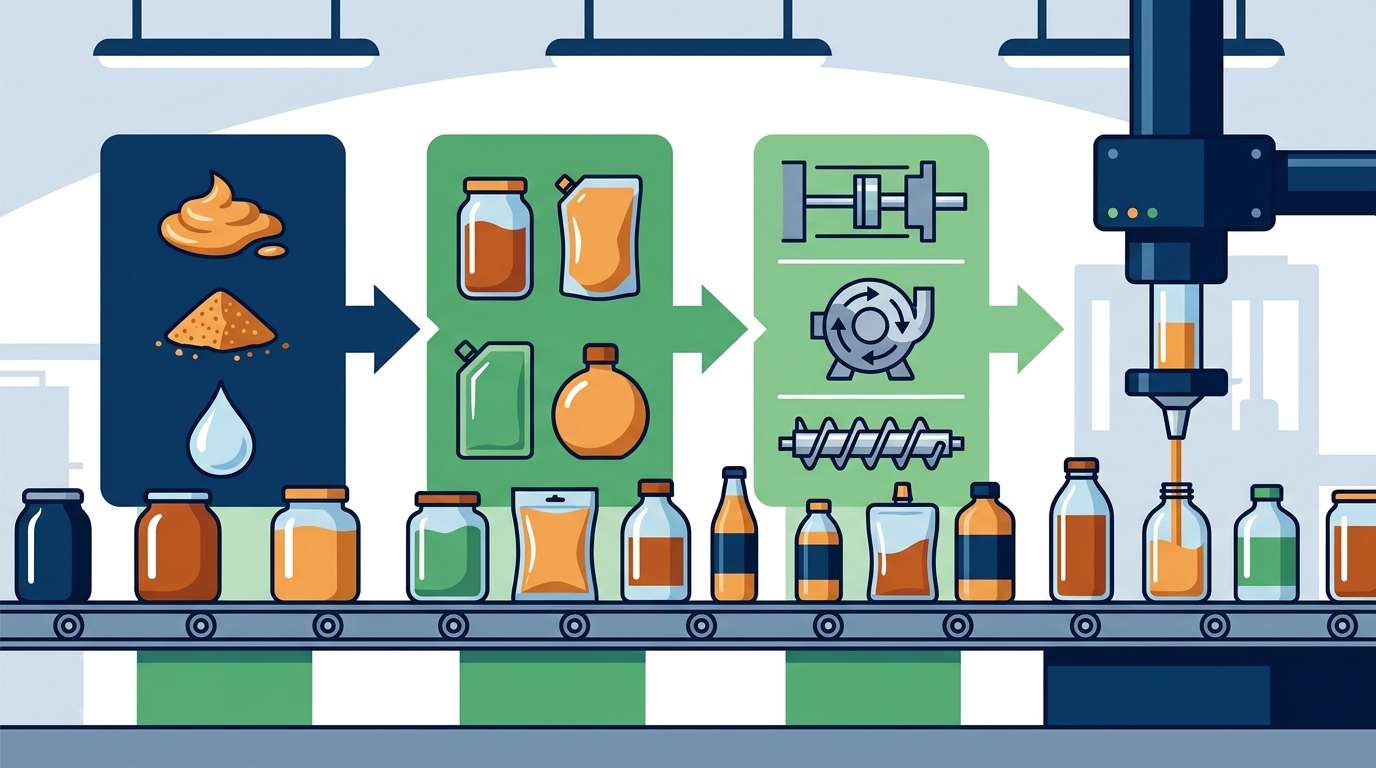
A filling machine is a piece of packaging equipment designed to dispense a precise amount of product into a container. The single most important factor when choosing one is understanding what you are filling. Products generally fall into three categories: thin liquids, viscous liquids, and dry goods.
Thin liquids like water, juice, and cleaning solutions flow freely under gravity. Viscous products such as creams, gels, sauces, and lotions require positive displacement to move them accurately. Dry products, including powders, granules, and snack foods, need volumetric or gravimetric dosing systems.
Getting this classification right at the start eliminates roughly 60% of unsuitable machines from your shortlist. If your product contains particulates, like salsa or trail mix, that further narrows the field to equipment built to handle solids in suspension.
Step 2: Identify Your Container Type
Your container format directly influences which filler you need. Bottles, jars, tubes, pouches, and bags each require different handling and nozzle configurations.
Bottles and Jars
Round, square, and oval bottles made of plastic, glass, or metal are the most common containers on filling lines. Inline fillers with adjustable nozzle spacing work well across multiple bottle shapes. JDA Progress offers inline piston bottle fillers that work with plastic, glass, and metal containers without requiring change parts.
Tubes
For cosmetics, pharmaceuticals, and food pastes packaged in tubes, a dedicated automatic tube filler and sealer handles both the fill and the seal in one operation, saving floor space and labor.
Pouches and Bags
Stand-up pouches and pillow bags are increasingly popular. Vertical form fill seal (VFFS) machines form the bag from a roll of film, fill it, and seal it in a single pass. Explore JDA Progress pouch bagging machines for powder, liquid, and granule applications.
Step 3: Learn the Main Filling Technologies
A filling technology is the mechanical principle a machine uses to measure and dispense product. Below is a quick comparison of the most common types.
| Technology | Best For | Accuracy | Speed Range |
|---|---|---|---|
| Piston Filler | Creams, gels, sauces with particulates | ±0.5% | 10-120 BPM |
| Pump Filler (Lobe/Gear) | Shampoo, lotions, chemicals | ±1% | 10-100 BPM |
| Overflow Filler | Thin, foamy liquids in clear bottles | Level fill | 20-150 BPM |
| Auger Filler | Powders, spices, flour | ±1% | 5-60 BPM |
| Vibratory Weigh Filler | Granules, snacks, candy | ±0.5 g | 5-40 BPM |
JDA Progress manufactures several of these technologies. Their full range of filling machines includes piston fillers, pump fillers, overflow fillers, auger fillers, and weigh fillers, each built for a specific need.
Step 4: Semi-Automatic vs. Automatic Fillers
An automatic filling machine is a system that indexes containers, fills them, and advances them down the line without operator intervention beyond initial setup. A semi-automatic filler requires an operator to place and remove each container manually.
When to Choose Semi-Automatic
Semi-automatic machines suit startups and small-batch producers running fewer than 30 units per minute. They cost less upfront and take up minimal floor space. The PF200 semi-automatic piston filler from JDA Progress, for example, handles liquids, creams, gels, and sauces with simple, affordable pricing.
When to Choose Automatic
If you need sustained throughput above 30 bottles per minute, an inline automatic filler paired with a conveyor system is the better investment. According to the Packaging Machinery Manufacturers Institute (PMMI), automation can reduce labor costs by up to 30% on medium-volume lines.
Step 5: Determine Your Production Speed Needs
Production speed, measured in bottles per minute (BPM), depends on the number of fill heads and the cycle time per fill. More heads mean higher throughput but also higher cost and a larger machine footprint.
Start by calculating your daily demand. If you need 10,000 bottles per 8-hour shift, that is roughly 21 BPM. A 4-head piston filler typically achieves 20-40 BPM, making it a solid match. Scaling up later is possible: JDA Progress inline piston fillers are expandable to 10, 12, or 14 pumps to increase speed as your business grows.
Always factor in downtime for cleaning, changeovers, and maintenance. A realistic efficiency rate for a well-run filling line is about 80-85% of theoretical maximum output, according to ISA (International Society of Automation) benchmarks.
Step 6: Consider Industry Compliance and Materials
Food, beverage, pharmaceutical, and cosmetic products must meet strict regulatory standards. In North America, the FDA's Current Good Manufacturing Practices (cGMP) require equipment surfaces to be non-reactive, easy to clean, and resistant to corrosion.
Look for machines built with 304 stainless steel frames and food-grade contact parts. JDA Progress filling machines feature stainless steel construction, sanitary fittings, and quick-disconnect components for fast cleaning. Their service and support team also provides commissioning and ongoing technical guidance to help you stay compliant.
Key Takeaways
- Classify your product first: thin liquid, viscous liquid, or dry goods. This single step eliminates most unsuitable machines.
- Match the filling technology to the product. Piston fillers excel with thick, particulate-laden products; overflow fillers suit thin liquids in clear bottles.
- Container format matters. Bottles, tubes, and pouches each need different machine configurations.
- Semi-automatic fillers are ideal for startups; automatic fillers pay off at volumes above roughly 30 BPM.
- Always calculate real-world throughput at 80-85% of rated speed to account for cleaning and changeovers.
- Insist on stainless steel construction and food-grade contact parts for any regulated industry.
- Choose a manufacturer like JDA Progress that offers demos, a 1-year warranty, and after-sales support.
Frequently Asked Questions
What type of filling machine do I need for thick products like creams or gels?
A piston filler is the best choice for viscous products. JDA Progress piston filling machines are designed for liquids, creams, gels, sauces, and other viscous materials, delivering consistent volumes with every cycle.
Can one filling machine handle multiple container sizes?
Yes. Most inline fillers feature adjustable nozzle spacing and height controls. The JDA Progress inline piston bottle filler, for instance, works with plastic, glass, and metal containers with no change parts needed.
How accurate are modern filling machines?
Accuracy depends on the technology. Piston fillers typically achieve ±0.5%, while auger fillers like the JDA Progress semi-automatic powder filler average 1% accuracy or better across a wide range of fill weights.
What is the difference between a semi-automatic and automatic filler?
A semi-automatic filler requires an operator to load and remove each container. An automatic filler uses conveyors and sensors to index containers through the fill zone without manual handling, enabling higher sustained throughput.
How do I fill powders into containers?
Auger fillers and vibratory weigh fillers are the two main options. Auger fillers work well for fine powders and can handle fills from 100 mg to 50 lb. Vibratory weigh fillers are ideal for granular products like spices, snack foods, and candy.
Do filling machines come with a warranty?
Reputable manufacturers include warranties. JDA Progress provides a 1-year warranty on all machines and parts, plus unlimited phone technical support.
Can I see the machine run my product before buying?
Many manufacturers offer product demos. JDA Progress provides free product demonstrations so you can verify performance before committing to a purchase.
Where can I get a quote for a filling machine?
You can request a quote from JDA Progress online. Their team will help you select the right machine based on your product, container, and production goals.
Ready to Find Your Filling Machine?
Stop guessing and start filling. JDA Progress Industries has over 35 years of experience helping businesses across food and beverage, cosmetics, and chemical industries choose the right packaging equipment. Request your free quote today and get personalized guidance from a team that knows filling machines inside and out.