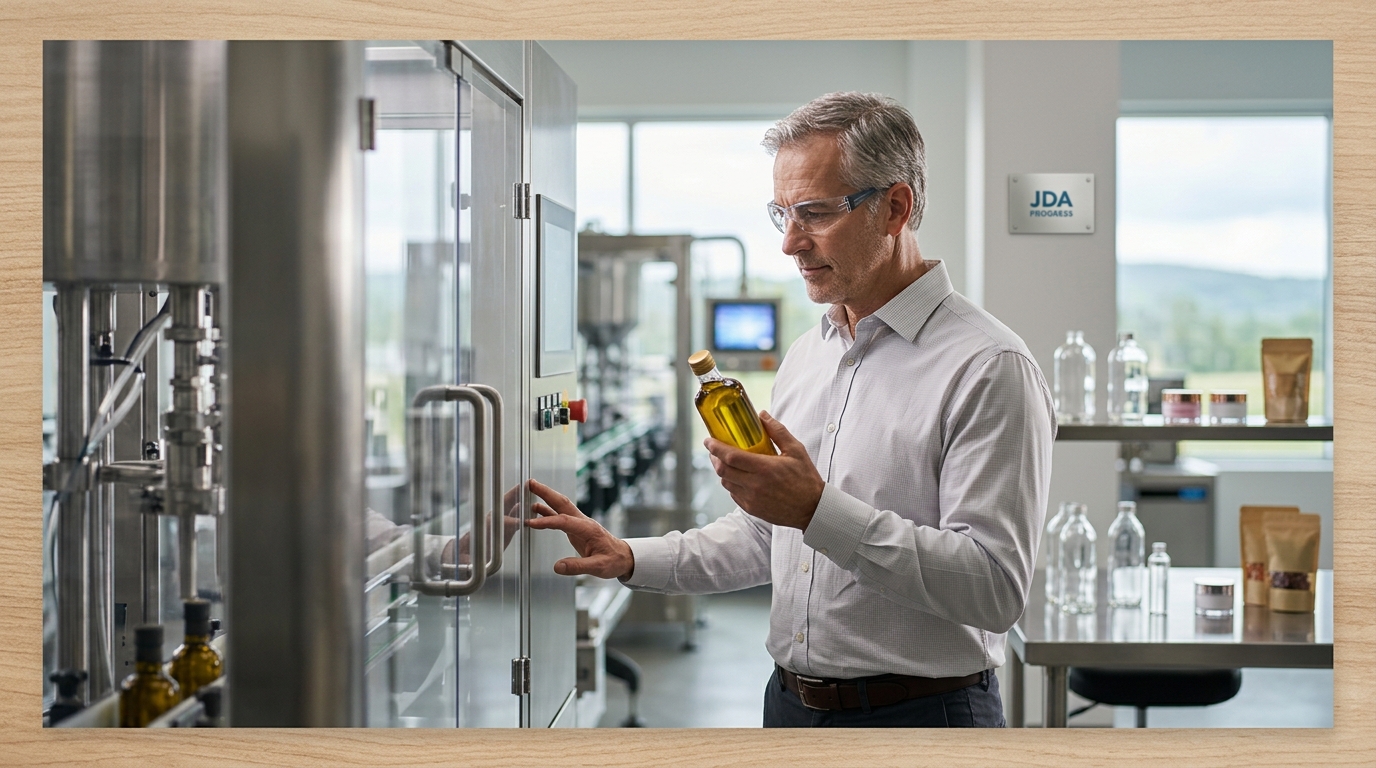
Choosing a filling machine can feel overwhelming, especially if you have never purchased packaging equipment before. The right machine depends on your product type, container format, production speed, and budget. Whether you are filling sauces into bottles, powders into jars, or lotions into tubes, each application demands a specific filling technology. In this guide, we walk you through every decision point so you can confidently select the filling machine that fits your operation. JDA Progress has been helping businesses make this decision for over 35 years.
Understand Your Product Properties
The single most important factor when selecting a filling machine is your product's physical characteristics. A filling machine is a piece of industrial equipment designed to dispense a precise amount of product into a container. Before you browse catalogs, answer these questions:
- Viscosity: Is your product thin like water, or thick like a paste?
- Particulates: Does it contain chunks, seeds, or suspended solids?
- Temperature: Will you fill at high temperatures (e.g., cooked sauces)?
- Foaming tendency: Does the liquid foam when agitated?
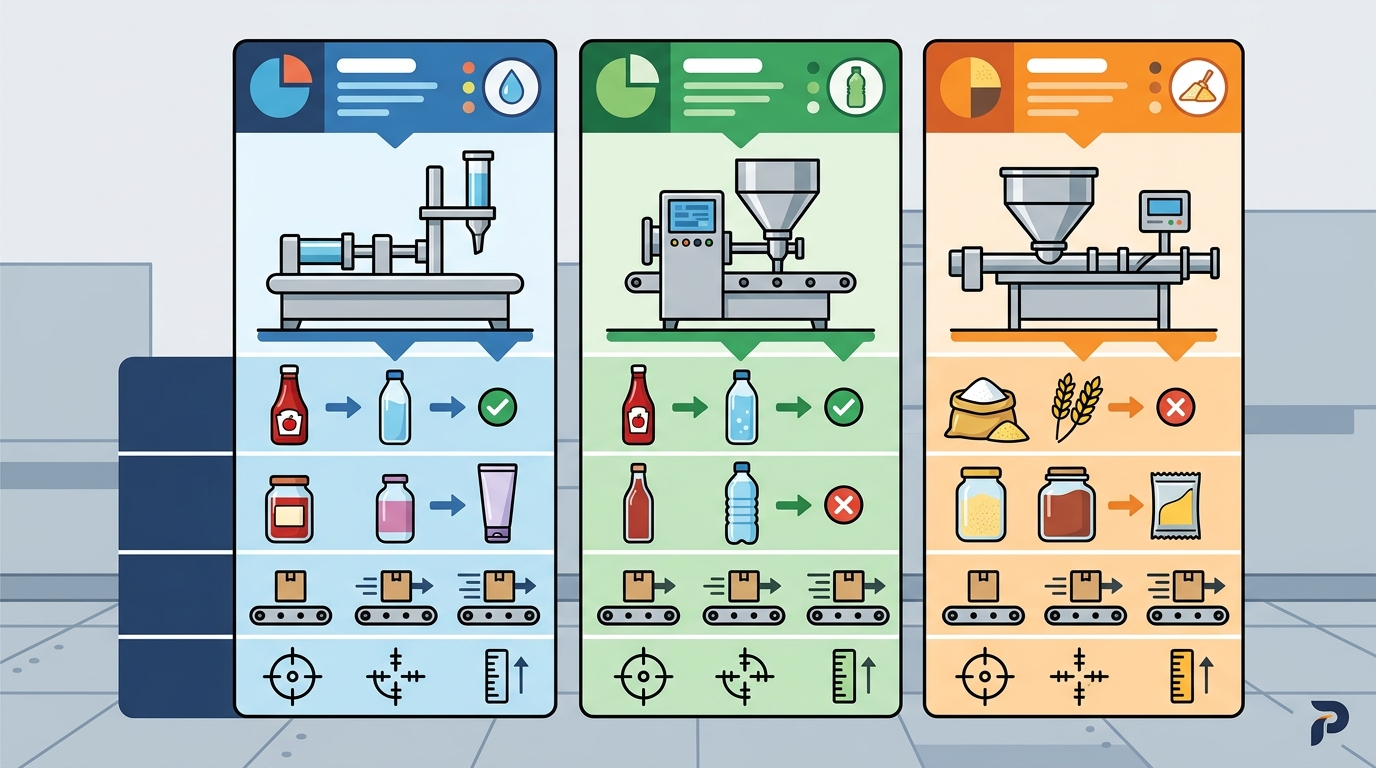
Thin, free-flowing liquids such as shampoo, detergents, and lubricants work well with pressure overflow fillers. Thicker products like creams, gels, and sauces with particulates perform best on piston filling machines. Dry, granular, or powdered products need an entirely different approach, such as an auger powder filler.
Types of Filling Machines Explained
Not all fillers work the same way. Here are the primary filling technologies and the products they handle best.
Piston Fillers
A piston filler is a volumetric filling machine that uses a cylinder-and-piston mechanism to draw and dispense product. It excels at handling viscous liquids and products with particulates. JDA Progress offers both semi-automatic piston fillers and inline piston bottle fillers for higher throughput. These machines deliver precise, consistent fill volumes, reducing product waste.
Pump Fillers
Pump-based fillers use gear or lobe pumps to move product from a holding tank into containers. The lobe pump liquid filler is a portable machine well suited for cosmetics, chemicals, and high-temperature cooked sauces. Pump fillers are versatile and handle a broad viscosity range.
Auger Fillers (Powder)
An auger filler is a machine that uses a rotating screw inside a funnel to dispense dry products by volume. It handles both free-flowing and non-free-flowing powders with accuracies averaging 1% or better. Whether your fill is a 100 mg pharmaceutical dose or a 50 lb bulk bag, auger fillers scale to the task.
Weigh Fillers
For snack foods, spices, candy, granola, pet food, and similar products, a vibratory weigh filler measures by weight rather than volume. This approach is ideal when product density varies between batches.
Match the Machine to Your Container Format
Your container type influences filler selection just as much as the product itself. Bottles, jars, tubes, and pouches each have different requirements.
If you fill bottles or jars, inline fillers with adjustable nozzle spacing work with plastic, glass, and metal containers with no change parts needed. For tubes, the automatic tube filler and sealer fills and seals plastic or metal tubes efficiently on a production line. For pouches and bags, a vertical form fill seal (VFFS) machine forms, fills, seals, and cuts in one continuous motion. JDA Progress offers VFFS baggers and premade pouch baggers for powders, liquids, and granular products.
Semi-Automatic vs. Fully Automatic
Your production volume dictates the automation level you need. Semi-automatic machines require an operator to place and remove containers, making them suitable for startups and small batch runs. Fully automatic machines integrate with conveyors, unscramblers, and cappers for hands-off operation at higher speeds.
Consider these general thresholds:
- Under 30 units per minute: Semi-automatic is often sufficient.
- 30-120+ units per minute: Fully automatic inline systems pay for themselves quickly through labor savings.
JDA Progress provides both levels. Their semi-automatic piston filler, for instance, offers simple, affordable pricing and free product demos. Their inline systems can be expanded up to 10, 12, or 14 fill heads depending on piston size to increase speed.
Filling Machine Comparison Table
| Machine Type | Best For | Automation Level | Viscosity Range |
|---|---|---|---|
| Piston Filler | Creams, gels, sauces with particulates | Semi-auto & automatic | Medium to high |
| Pressure Overflow Filler | Water-like liquids, shampoo, detergents | Automatic | Low to medium |
| Lobe Pump Filler | Cosmetics, chemicals, hot sauces | Semi-automatic | Low to high |
| Auger Filler | Powders (spices, pharmaceuticals, flour) | Semi-auto & automatic | Dry products |
| Vibratory Weigh Filler | Snacks, candy, granola, pet food | Semi-auto & automatic | Granular/solid |
| Tube Filler & Sealer | Cosmetic creams, ointments, adhesives | Automatic | Medium to high |
Think Beyond the Filler
A filling machine rarely works alone. Most production lines also need capping machines, labeling machines, sealers, and conveyors to create a complete bottling line. Planning your full line from the start avoids costly retrofits later.
According to PMMI (The Association for Packaging and Processing Technologies), integrated packaging lines can improve overall equipment effectiveness (OEE) by 10-20% compared to standalone machines. Planning holistically saves both money and floor space.
Key Takeaways
- Start by identifying your product's viscosity, particulates, temperature, and foaming behavior before evaluating any machine.
- Piston fillers handle thick products and particulates; pressure overflow fillers suit thin, water-like liquids.
- Auger fillers and vibratory weigh fillers address dry and granular products with high accuracy.
- Your container type (bottle, jar, tube, pouch) narrows the field significantly.
- Semi-automatic machines suit lower volumes; automatic inline systems scale for high-speed production.
- Plan your entire packaging line (filler, capper, labeler, conveyor) from the start to avoid integration headaches.
- Request a free product demo to see how a machine handles your specific product before purchasing.
Frequently Asked Questions
What type of filling machine do I need for thick liquids?
For thick liquids like creams, gels, and sauces, a piston filling machine is the best choice. Piston fillers use a cylinder mechanism to draw and dispense viscous products accurately. JDA Progress piston fillers handle creams, lotions, gels, and sauces with particulates.
Can one filling machine handle multiple products?
Many filling machines are configurable for different products. For example, an inline piston bottle filler can accommodate various bottle shapes and sizes and can be adjusted for different fill volumes. However, switching between a liquid and a powder typically requires a different machine type entirely.
How accurate are powder filling machines?
Modern auger powder fillers achieve accuracies averaging 1% or better. This level of precision meets most filling application requirements, from small pharmaceutical doses to bulk product fills.
What is the difference between volumetric and gravimetric filling?
Volumetric filling dispenses a set volume of product (e.g., piston and auger fillers). Gravimetric filling dispenses by weight (e.g., vibratory weigh fillers). Gravimetric is preferred when product density varies between batches.
How much does a filling machine cost?
Costs vary widely based on automation level, number of fill heads, and product requirements. Semi-automatic fillers are the most affordable entry point. JDA Progress offers simple, affordable pricing and free product demos so you can evaluate before committing.
Do I need a complete bottling line or just a filler?
If you are producing retail-ready products, you will likely need a capper, labeler, and conveyor in addition to a filler. JDA Progress offers complete bottling line solutions that integrate all these machines into one cohesive system.
How do I know if I need a semi-automatic or automatic machine?
Consider your target output. If you produce fewer than 30 units per minute and have operators available, semi-automatic is cost-effective. For higher throughput or to reduce labor dependency, automatic inline systems are the better investment.
Does JDA Progress offer product demos?
Yes. JDA Progress provides free product demos on their filling machines. You can visit their showroom or request a demo to see how a machine performs with your specific product.
Get Started With the Right Machine
Choosing a filling machine does not have to be complicated. Start with your product, match it to the right technology, and consider your production goals. JDA Progress has over 35 years of experience helping businesses across food and beverage, cosmetics, chemicals, and more find the perfect packaging equipment.
Ready to take the next step? Request a free quote or contact JDA Progress to speak with a packaging specialist who can recommend the ideal filling machine for your product.