Choosing a filling machine can feel overwhelming when you are launching a new product or scaling up production. The type of product you fill, the container you use, and your target output speed all influence which machine is the right fit. With over 35 years of experience, JDA Progress Industries has helped thousands of businesses across food and beverage, cosmetics, and chemical sectors find the perfect filling solution. This guide walks you through every decision point so you can move forward with confidence and get your product on shelves faster.
1. Understand Your Product Characteristics
The single most important factor in selecting a filling machine is your product's physical properties. A filling machine is a piece of industrial equipment designed to dispense a precise amount of product into a container. Before you compare models, answer these questions:
- Viscosity: Is your product thin like water, thick like honey, or somewhere in between?
- Particulates: Does it contain chunks, seeds, or suspended solids?
- Temperature: Will you fill at ambient or elevated temperatures?
- Foaming tendency: Does the liquid foam when agitated?
For example, JDA Progress's PF200 piston filler is designed specifically for liquids, creams, gels, sauces, and other viscous materials. If your product contains particulates like salsa or chunky sauce, a piston mechanism draws it cleanly without crushing solids.
2. Match the Machine to Your Container Type
Container format is a container shape, size, and material that directly determines which filler features you need. Bottles, jars, tubes, pouches, and cans each present different handling requirements.
Bottles and Jars
Most liquid and paste filling machines handle glass, plastic, and metal containers without change parts. JDA Progress inline fillers work with plastic, glass, and metal containers and require no change parts for switching between types.
Tubes
If your product ships in squeeze tubes, you need a dedicated automatic tube filler and sealer. The SUPER-30 from JDA Progress fills and seals both plastic and metal tubes and can be configured for jar or bottle dispensing as well.
Pouches and Bags
For flexible packaging, vertical form fill seal (VFFS) baggers or premade pouch baggers are the right category. JDA Progress offers VFFS and premade pouch baggers for both liquids and powders.
3. Filling Machine Technologies Explained
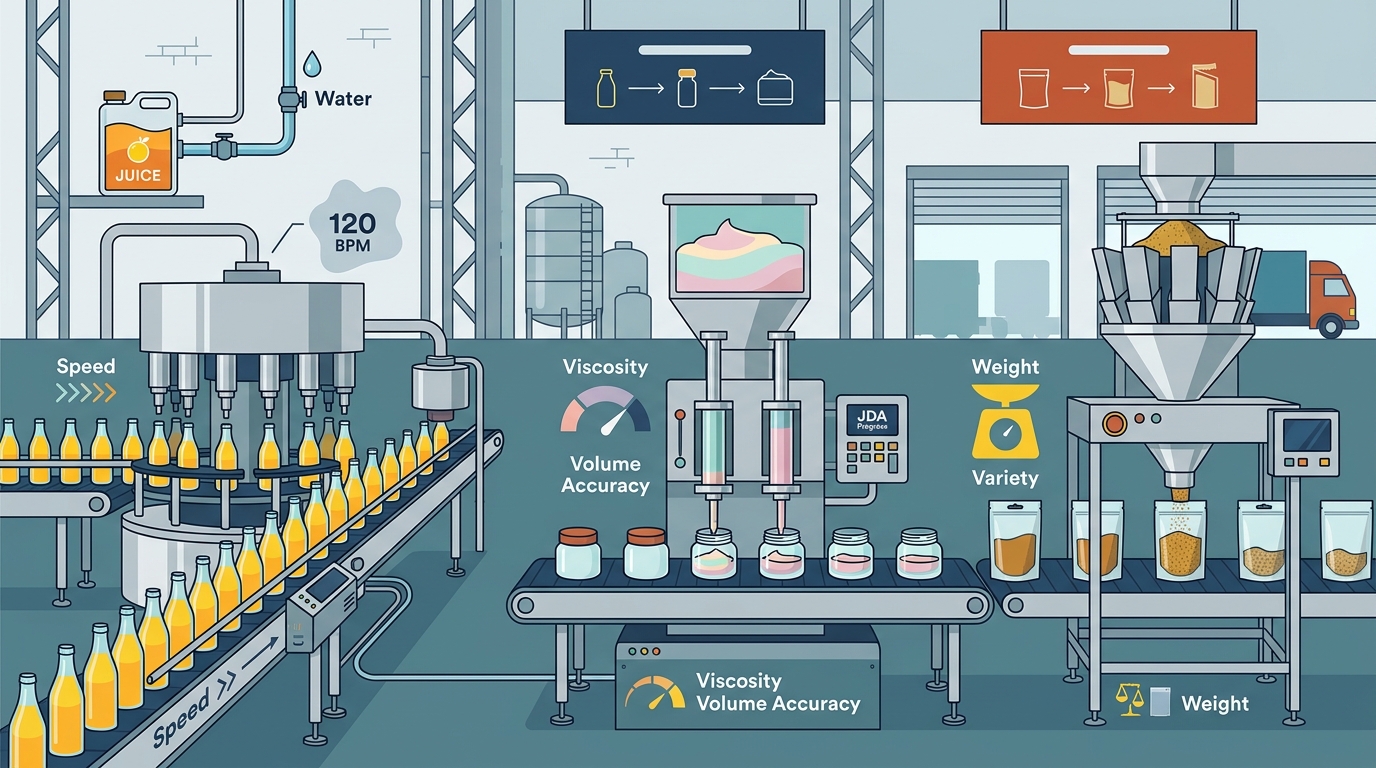
Different filling principles suit different products. Here are the main technologies available:
Piston Fillers
A piston filler is a volumetric machine that uses a cylinder and piston to draw and dispense product. It excels at thick products like creams, lotions, gels, and sauces with particulates. JDA Progress offers both semi-automatic piston fillers and inline automatic piston fillers that deliver precise, consistent fill volumes.
Pump Fillers
Lobe pump and gear pump fillers handle medium-to-high viscosity products. The LP48 lobe pump filler is portable and works well for cosmetics, chemicals, and high-temperature sauces. The LP48-12 inline pump filler is an excellent choice for higher-speed production of sauces, cosmetics, and chemicals.
Auger Fillers
For dry, powdered, or granular products, auger fillers provide accurate volumetric dosing. JDA Progress's semi-automatic auger filler achieves accuracy averaging 1% or better and handles fills from 100 mg pharmaceutical applications up to 50 lb bulk fills.
Weigh Fillers
A weigh filler is a gravimetric machine that fills by target weight rather than volume. The SF vibratory weigh filler is designed for snack foods, spices, candy, pet food, cannabis, and frozen foods with no moving wear parts and zero maintenance required.
4. Semi-Automatic vs. Automatic Filling Machines
Your production volume dictates the level of automation you need. Semi-automatic machines require an operator to place and remove containers manually. They are ideal for startups, small batches, or contract packagers testing new SKUs.
Automatic inline machines integrate with conveyors, use sensors for container gating, and run continuously. JDA Progress's automatic inline powder auger filler, for example, can fill rigid containers at rates up to 60 per minute and integrates with capping and labeling machines for a complete bottling line.
According to PMMI (The Association for Packaging and Processing Technologies), companies typically transition to automatic filling when production exceeds 30 units per minute or when labor costs make manual placement impractical.
5. Filling Machine Comparison Table
| Machine Type | Best For | Automation Level | Typical Products |
|---|---|---|---|
| Piston Filler (PF200) | Viscous liquids, pastes | Semi-automatic | Creams, gels, sauces |
| Inline Piston Filler (PF-14) | High-speed viscous fills | Automatic | Lotions, sauces, chemicals |
| Lobe Pump Filler (LP48) | Medium-high viscosity | Semi-automatic | Cosmetics, hot sauces |
| Inline Pump Filler (LP48-12) | Continuous liquid lines | Automatic | Sauces, cosmetics, chemicals |
| Pressure Overflow Filler | Thin, foamy liquids | Automatic | Shampoo, detergents, water |
| Semi-Auto Auger Filler | Powders, granules | Semi-automatic | Spices, pharmaceuticals |
| Auto Inline Auger Filler | High-speed powder lines | Automatic (up to 60/min) | Powders in rigid containers |
| Vibratory Weigh Filler | Weight-based dry fills | Semi-automatic | Snacks, candy, pet food |
| Tube Filler & Sealer (SUPER-30) | Tube packaging | Automatic | Ointments, toothpaste, creams |
6. Think Beyond the Filler: Complete Line Planning
A filling machine rarely operates alone. Most production lines also require capping, labeling, sealing, and conveying equipment. Planning the full line from the start saves money and avoids bottlenecks.
JDA Progress supplies capping machines, labeling machines, sealers, and conveyors that integrate seamlessly with their fillers. You can also explore complete turnkey bottling lines built to your exact throughput requirements.
When evaluating vendors, look for companies that offer free product demos, a strong warranty, and responsive after-sales support. JDA Progress provides a 1-year warranty on all machines and parts, free product demos, and unlimited telephone support from their head office in Toronto, Canada.
7. Key Takeaways
- Start by profiling your product: viscosity, particulates, temperature, and foaming behavior determine the right filling technology.
- Piston fillers handle thick products with particulates; pump fillers suit medium-to-high viscosity liquids; auger fillers are built for powders and granules.
- Weigh fillers dispense by target weight and are ideal for dry, irregular products like snack foods and spices.
- Semi-automatic machines suit low-volume or startup operations; automatic inline fillers are designed for speeds above 30 units per minute.
- Container type matters: bottles, tubes, and pouches each need purpose-built equipment.
- Plan the full packaging line (filling, capping, labeling, sealing) together to avoid costly integration problems.
- JDA Progress offers free demos, a 1-year warranty, and over 35 years of packaging expertise from their Toronto facility.
8. Frequently Asked Questions
What type of filling machine do I need for thick creams or gels?
A piston filler is the best choice for thick creams, gels, and pastes. The PF200 from JDA Progress is specifically designed for viscous materials including lotions and sauces with particulates.
Can one filling machine handle both liquids and powders?
Generally, no. Liquid fillers and powder auger fillers use fundamentally different dispensing mechanisms. You will need separate machines for each product type.
How fast can an automatic filling machine run?
Speed depends on the machine and product. JDA Progress's automatic inline auger filler can fill up to 60 containers per minute. Inline piston and pump fillers can be expanded with additional nozzles to increase throughput.
Do I need a different machine for glass versus plastic bottles?
Most JDA Progress inline fillers work with plastic, glass, and metal containers without requiring change parts, making it easy to switch between container materials.
What is the difference between volumetric and gravimetric filling?
Volumetric filling dispenses a set volume of product using a piston or auger. Gravimetric filling dispenses product until a target weight is reached. Gravimetric systems like vibratory weigh fillers are preferred for irregularly shaped dry goods.
How accurate are auger filling machines?
JDA Progress's semi-automatic auger filler achieves fill accuracy averaging 1% or better, which meets the requirements of most food, chemical, and pharmaceutical applications.
Does JDA Progress offer product demos before purchase?
Yes. JDA Progress offers free product demos on their filling machines so you can test with your actual product before committing to a purchase.
What warranty comes with JDA Progress filling machines?
All JDA Progress machines and parts come with a 1-year warranty, plus unlimited telephone support and fast parts delivery from their Toronto, Canada facility.
9. Get Started Today
Ready to find the right filling machine for your product? Request a free quote from JDA Progress and their packaging experts will recommend the ideal machine based on your product, container, and production goals. With in-stock equipment for fast delivery and free demos available, you can move from evaluation to production quickly.