Choosing a filling machine is one of the most consequential equipment decisions a manufacturer can make. Whether you produce hot sauces, shampoos, industrial solvents, or powdered supplements, the filler you select will shape your throughput, product quality, waste levels, and long-term profitability. With more than 35 years of experience building packaging lines, JDA Progress has helped hundreds of Canadian and international producers navigate this decision. This guide walks you through every consideration — from product characteristics to total cost of ownership — so you can approach the buying process with confidence.
Step 1 — Profile Your Product First
Before you browse catalogues or request quotes, document the physical characteristics of the product you need to fill. This is universally considered the most important starting point. Key attributes to record include:
- Viscosity — Is your product water-thin, moderately thick like cooking oil, or heavy like peanut butter? Viscosity is typically measured in centipoise (cP). A thin liquid might sit below 100 cP, while a thick paste can exceed 100,000 cP.
- Particulates — Does your product contain suspended solids, chunks, seeds, or fibres? Chunky salsa, for instance, demands a very different filler than filtered juice.
- Foaming tendency — Products that foam easily — such as soaps, certain beverages, and cosmetic lotions — require filling methods that minimise air introduction.
- Temperature sensitivity — Some products must be filled hot (e.g., candle wax, certain sauces) and others must remain cold or at ambient temperature.
- Chemical aggressiveness — Corrosive chemicals or solvents may require special wetted-part materials like PTFE-lined valves or Hastelloy nozzles.
- Shear sensitivity — Emulsions, creams, and biological products can break down if subjected to excessive mechanical force during filling.
Gathering this data upfront prevents the single biggest mistake in filler selection: focusing on speed alone while ignoring the product's behaviour in the machine.
Step 2 — Define Your Container
The container you are filling is equally critical. Different containers — bottles, jars, cans, tubes, pouches, pails, and drums — each present unique feeding, positioning, and filling challenges. Consider the following:
- Opening width — Wide-mouth jars are generally easier to fill with viscous products. Narrow-neck bottles may require specialised nozzles to prevent dripping or splashing.
- Material — Glass containers often require gentler handling and more stable conveying than plastic bottles.
- Size range — Will you run a single container size, or do you need to switch between 100 mL bottles and 5 L jugs on the same line? Quick-changeover tooling becomes essential for multi-format operations.
- Transparency — For clear bottles displayed on retail shelves, a consistent fill level matters more to consumers than a consistent fill volume. This distinction influences which filler technology is best.
Step 3 — Understand the Main Filling Technologies
There is no single “best” filling machine. Each technology excels in specific scenarios. Below is a practical overview of the most common types.
Gravity Fillers
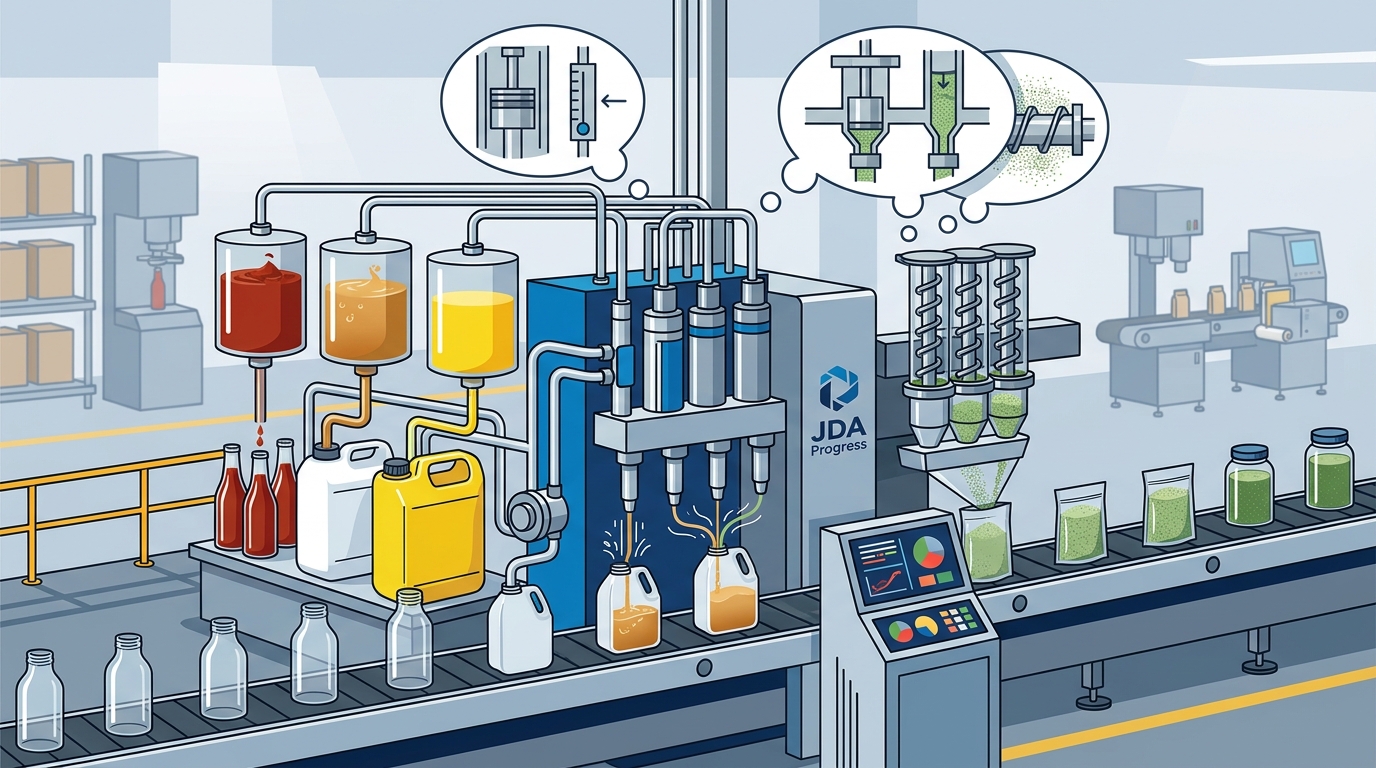
Gravity fillers use the natural force of gravity to move product from a raised tank through open nozzles and into containers below. They are best suited for free-flowing, low-viscosity liquids such as water, vinegar, and light oils. Because they have few moving parts, gravity fillers are economical to purchase and maintain, making them a popular entry-level choice.
Overflow Fillers
Overflow fillers use a dual-port nozzle: one channel delivers product, and the other allows excess liquid to flow back to the supply tank. This ensures every container is filled to the same visual level regardless of minor volume differences between bottles. They are particularly well-suited for transparent packaging where visual uniformity on the shelf is critical.
Piston Fillers
Piston fillers draw a precise volume of product into a cylinder and then push it into the container. They are highly versatile and accurate, handling everything from thin liquids to thick creams and pastes. When product viscosity exceeds roughly 1,000 cP, piston fillers are often the go-to recommendation for repeatable, accurate fills.
Pump Fillers
Pump fillers are among the most flexible filling machines available, capable of handling thin liquids, highly viscous substances, and even products with particulates. Different pump types — gear, peristaltic, lobe, and diaphragm — address specific challenges. Peristaltic pumps, for example, are excellent for corrosive or shear-sensitive liquids because the product only contacts disposable tubing.
Net Weight Fillers
Net weight fillers dispense product by weight rather than volume, using load cells or scales beneath each filling station. They are ideal for products sold by weight and for high-value products where overfill waste is costly — think specialty chemicals, pharmaceuticals, or premium food products.
Auger Fillers
Auger fillers use a rotating screw inside a funnel to meter dry powders and granules. They are well-suited to non-free-flowing powders, spices, pharmaceutical powders, and nutraceutical supplements. Fill weight is adjusted by changing the number of screw rotations per cycle.
Timed-Flow (Gravity-Pressure) Fillers
These fillers release product through a nozzle for a controlled amount of time, delivering a consistent volume each cycle. They work well for free-flowing, particulate-free liquids and can be equipped with up to twelve nozzles for moderate throughput.
Step 4 — Match Automation Level to Production Volume
Filling machines range from fully manual tabletop units to high-speed rotary systems. Choosing the right automation level is largely a function of your current and projected production volumes.
Manual & Tabletop Fillers
Best for very small batches, R&D runs, or start-ups testing a new product. Typical speeds range from 15 to 900 containers per hour depending on product and container size. Investment is low, but labour dependence is high.
Semi-Automatic Fillers
An operator positions containers and initiates the fill cycle, but dosing is automated. Semi-automatic machines are cost-effective, easy to maintain, and adapt to a wide variety of containers. They are ideal for small and medium-sized businesses or for product lines with frequent changeovers.
Fully Automatic Fillers
Containers are fed, filled, and discharged without operator intervention. Fully automatic systems integrate with conveyors, cappers, labellers, and case packers to form a complete packaging line. They are designed for continuous, high-volume production and can reach speeds of 6,000 containers per hour or more.
Rotary Fillers
For the highest throughput demands, rotary filling machines can fill containers at speeds up to 300 per minute. The number of filling nozzles (heads) can be configured to match the target speed.
Pro tip: Calculate your required bottles per hour (BPH) by dividing your target daily volume by operating hours and shifts. Then add a 15–20 % margin for changeovers, cleaning, and restarts. This simple formula tells you the minimum machine speed to specify.
Step 5 — Think Beyond the Filler: The Complete Line
A filling machine rarely operates in isolation. In most facilities, it works as part of a complete production line alongside bottle unscramblers, conveyors, cappers, labellers, coders, inspection systems, and case packers. Ensure that:
- The filler's output speed is compatible with upstream and downstream equipment.
- The control system (typically PLC-based) can communicate with the rest of the line.
- Changeover procedures are aligned — there is little point in a filler that switches formats in two minutes if your labeller takes thirty.
JDA Progress designs complete turnkey packaging lines, ensuring every component is matched for seamless integration. This holistic approach eliminates bottlenecks and maximises overall equipment effectiveness (OEE).
Step 6 — Evaluate Accuracy Requirements
Filling accuracy affects regulatory compliance, customer satisfaction, and profitability simultaneously. Underfilling can trigger compliance issues or consumer complaints. Overfilling wastes product and erodes margins over thousands of fills per day.
High-value products such as cosmetics, pharmaceuticals, specialty chemicals, and concentrated liquids typically require tighter fill tolerances. Volumetric fillers commonly achieve ±0.5 % accuracy, while premium flow-meter systems can reach ±0.2 % or better. Weigh fillers offer the highest precision for weight-critical applications.
Discuss your accuracy targets with your equipment supplier early — they affect nozzle design, sensor selection, and overall machine cost.
Step 7 — Factor in Hygiene, Cleanability, and Compliance
Industries such as food and beverage, cosmetics, and pharmaceuticals demand equipment built from sanitary-grade materials (typically 316L stainless steel) with smooth welds, minimal crevices, and tool-free disassembly for cleaning. If you fill multiple products on the same machine, consider models with integrated Clean-in-Place (CIP) systems that clean the product path without full disassembly.
Regulatory frameworks — Health Canada, FDA, USDA, GMP — may dictate specific construction materials, documentation, and validation protocols. Clarify these requirements before finalising your specification.
Step 8 — Plan for Growth and Flexibility
An ideal filling machine today may not serve your needs three years from now. Demand can grow from regional to national or even global scale, requiring significantly higher output. Choose a filling system that is scalable: look for modular nozzle configurations, servo-driven controls that can be reprogrammed for new products, and frames designed to accept additional filling heads in the future.
Step 9 — Assess Total Cost of Ownership
The purchase price of a filling machine often represents only 40–60 % of the total ownership cost. Ongoing expenses include:
- Spare parts and consumables — nozzles, seals, gaskets, tubing
- Preventive maintenance labour
- Cleaning chemicals and downtime for sanitation
- Energy consumption
- Training for new operators
- Software updates and technical support
Request a detailed total-cost-of-ownership estimate from each vendor you evaluate. A lower sticker price can easily become the more expensive option over a five-year horizon.
Step 10 — Partner with an Experienced Manufacturer
The complexity of filler selection is exactly why working with an experienced packaging equipment manufacturer matters. A knowledgeable partner will:
- Review your product samples and run bench tests or pilot fills.
- Recommend the optimal filling technology and automation level.
- Design the machine around your specific containers and line layout.
- Provide installation, commissioning, operator training, and after-sales support.
- Help you plan for future expansion.
JDA Progress has supported manufacturers across food and beverage, cosmetics, chemical, and industrial sectors for over 35 years. Our Canadian-built filling machines, cappers, and labellers are engineered for reliability, accuracy, and easy integration into new or existing packaging lines. Contact our team to discuss your filling project today.
Key Takeaways
- Always start by profiling your product — viscosity, particulates, foaming, temperature, and chemical properties dictate the right filler technology.
- Container type, size, and material are just as important as the product itself.
- There is no universal “best” filler — gravity, overflow, piston, pump, net weight, and auger machines each serve different applications.
- Match automation level to your current volume, but choose a scalable platform that can grow with you.
- Consider the entire packaging line, not just the filler in isolation.
- Filling accuracy directly impacts compliance, customer satisfaction, and profitability.
- Total cost of ownership — not purchase price alone — should drive your investment decision.
- Partner with an experienced manufacturer who can test your product and support you long term.
Frequently Asked Questions
What is the most important factor when choosing a filling machine?
Product characteristics — especially viscosity, particulate content, and foaming tendency — are the most important starting point. These physical properties determine which filling technology will deliver accurate, consistent fills without product damage or waste.
How do I know if I need a semi-automatic or fully automatic filler?
Calculate your daily production target in containers per hour. Semi-automatic machines typically suit outputs up to around 800 fills per hour and are ideal for small to medium operations. Fully automatic lines are designed for continuous production and can exceed 6,000 containers per hour.
Can one filling machine handle multiple products?
Yes, many fillers — particularly piston and pump types — can be adjusted or reprogrammed to handle different products. However, switching between products requires thorough cleaning of all wetted parts, and some product combinations (e.g., food and chemical) may require dedicated machines for regulatory reasons.
What filling machine is best for thick or viscous products?
Piston fillers and positive-displacement pump fillers (gear, lobe, or peristaltic) are the most common choices for highly viscous products such as creams, gels, pastes, and thick sauces. Piston fillers are especially effective when viscosity exceeds 1,000 centipoise.
How much does a filling machine cost?
Costs vary widely depending on technology, automation level, number of filling heads, and construction materials. Tabletop semi-automatic units may start in the low thousands, while fully automatic multi-head inline or rotary systems can range from tens of thousands to several hundred thousand dollars. Remember that the purchase price may represent only 40–60 % of total ownership costs over the life of the machine.
Does JDA Progress offer filling machines for my industry?
JDA Progress manufactures filling machines, cappers, labellers, and complete packaging lines for a broad range of industries including food and beverage, cosmetics, household chemicals, and industrial products. Contact our team to discuss your specific application and receive a tailored recommendation.