
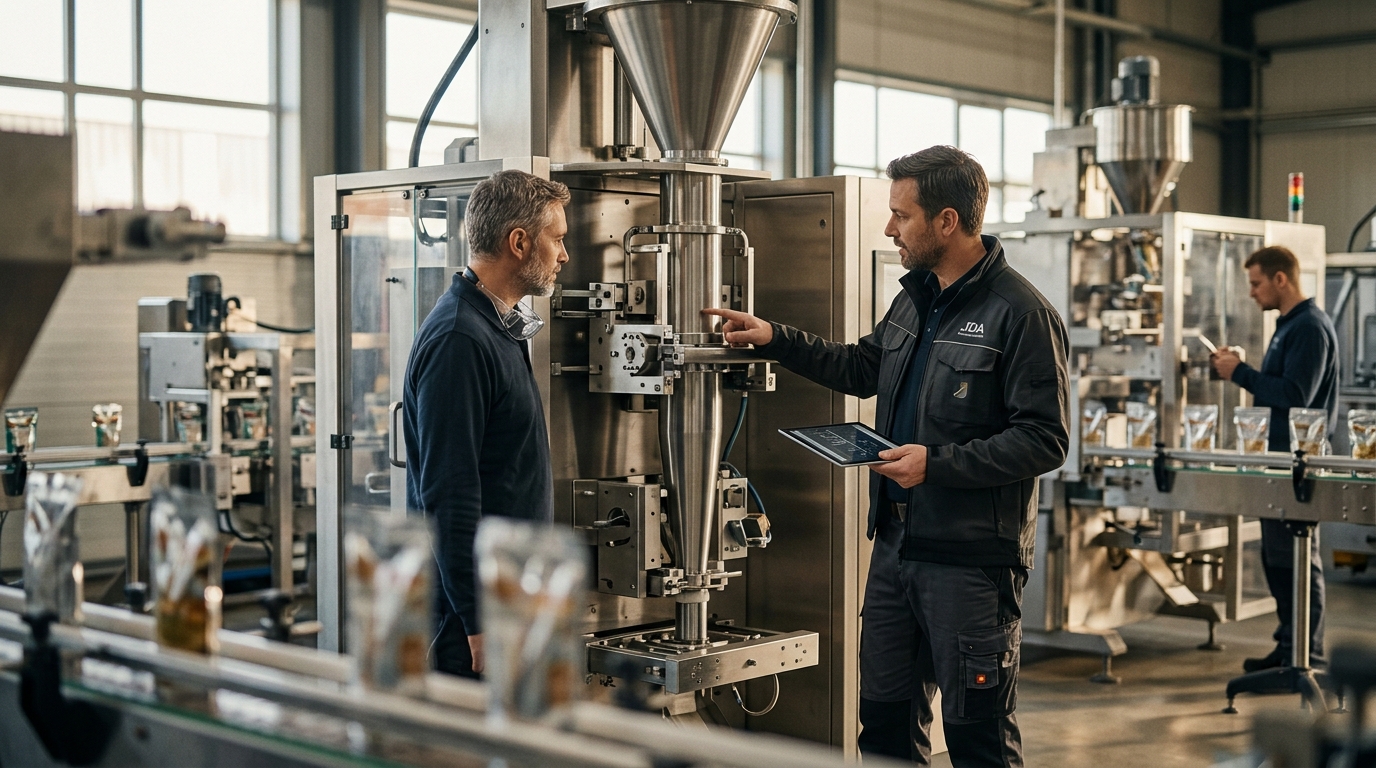
If you're packaging powders, granules, snacks, liquids, or frozen goods into flexible pouches, a Vertical Form Fill Seal (VFFS) machine is almost certainly on your shortlist. But with dozens of configurations, filler types, and speed ratings to compare, choosing the right one can feel overwhelming.
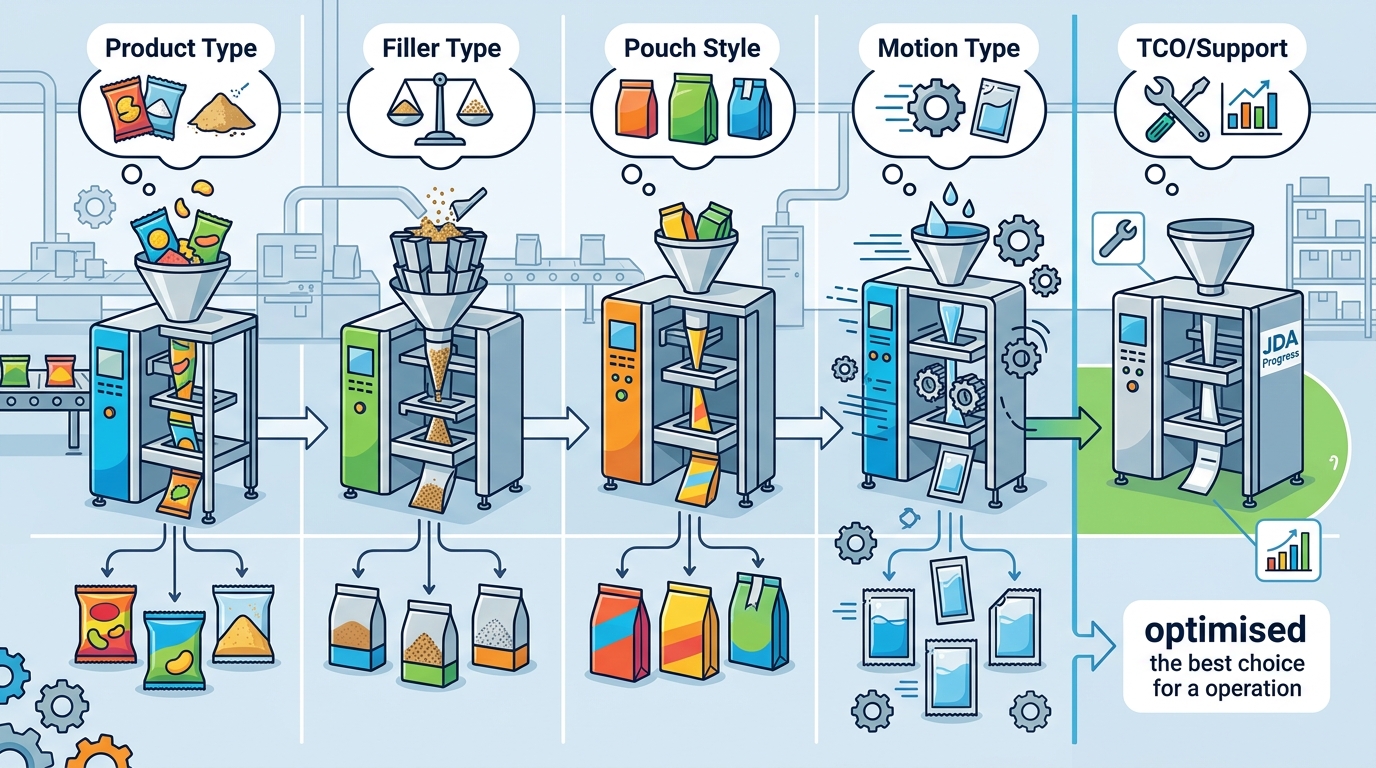
This guide walks you through every decision point—from product characteristics and pouch style to motion type and total cost of ownership—so you can invest in the VFFS machine that actually fits your operation.
What Exactly Is a VFFS Machine?
A VFFS machine is an automated packaging system that creates a bag from a flat roll of film, fills the bag with product, and seals it—all in a continuous vertical motion. The core workflow is straightforward: film unwinding → bag forming → vertical sealing → product dosing → horizontal sealing and cutting → discharge.
These machines are used across food, pharmaceutical, cosmetics, chemical, and consumer goods industries to package everything from potato chips and coffee to sauces and pet food. Their popularity comes down to three things: they form bags from rollstock rather than pre-made pouches (which cuts material costs), they automate labour-intensive bagging steps, and they produce airtight seals that protect product integrity.
Step 1: Start With Your Product
The single most important factor in choosing a VFFS machine is the product you're packing. Different products demand different dosing mechanisms, film types, and sealing parameters.
Granular Products (Snacks, Nuts, Rice, Sugar)
Free-flowing granules with uniform particle sizes in the 3–15 mm range pair well with multihead combination weighers, which can achieve ±0.5 g accuracy at speeds up to 120 bags per minute. Mixed-particle products need combination weighers with larger hoppers to prevent segregation during dosing.
Powders (Spices, Flour, Protein, Coffee)
Auger fillers are the standard for powders. They use a rotating screw to transport product from a hopper into the forming tube with precise volumetric control. Free-flowing powders with a bulk density above 0.6 g/cm³ can run at 20–60 bags per minute, while fine or cohesive powders may need anti-bridging mechanisms and dust extraction.
Liquids and Pastes (Sauces, Condiments, Dairy)
Pump-based filling systems handle viscous and semi-viscous products. Packaging speeds for liquids typically range from 20–100 bags per minute depending on viscosity, fill volume, and pouch format. Hot-fill applications (soups, sauces) and cold-fill dairy lines each require specific film and seal-bar configurations.
Fragile or Irregular Items (Chips, Cookies, Frozen Foods)
Delicate products benefit from intermittent-motion machines that pause during sealing, along with product settlers and clamps that prevent breakage as product drops through the forming tube.
Pro tip: Always conduct a 72-hour pilot test using your actual film, product, and target fill weight—not lab-grade samples. Real-world variability reveals issues no spec sheet can predict.
Step 2: Choose Your Pouch Style
VFFS machines can produce a surprisingly wide range of bag formats from a single roll of film:
- Pillow bag — The most common and economical style. Great for snacks, grains, and single-serve portions.
- Gusseted bag — Side folds add volume capacity and sometimes allow the bag to stand. Popular for coffee and pet food.
- Block-bottom (flat-bottom) bag — Provides excellent shelf stability and a premium retail appearance.
- 3- or 4-side seal pouch — A flat sachet format ideal for condiments, spice packets, and sample-size products.
- Stand-up pouch (Doypack) — A flat base lets the pouch stand upright on shelves, common in premium food and beverage packaging.
- Zipper pouch — Resealable for multi-use products like trail mix or pet treats.
- Chain bag — Multiple small pouches linked together, often used for portion-controlled items.
Your target pouch style directly affects machine configuration, forming collar design, and film compatibility. Confirm that the machine you're evaluating can produce every format you plan to run—now and in the near future.
Step 3: Intermittent Motion vs. Continuous Motion
This is a critical fork in the decision tree:
| Feature | Intermittent Motion | Continuous Motion |
|---|---|---|
| How it works | Film stops during sealing | Jaws move with the film—no stops |
| Typical speed | 40–120 bags/min | 100–300+ bags/min |
| Best for | Fragile products, longer seal dwell times, precise fills | Uniform, free-flowing products at high throughput |
| Relative cost | Lower | Higher |
Most small-to-mid-size operations start with intermittent-motion machines and upgrade to continuous motion as volume grows. If your current output is under 80 bags per minute, an intermittent system typically offers the best value.
Step 4: Pneumatic vs. Servo-Driven
VFFS machines use either compressed-air (pneumatic) or electric servo motors to drive sealing jaws, film pull, and cutting mechanisms.
- Pneumatic systems have lower upfront costs, deliver consistent pressure, and suit operations with modest speed requirements.
- Servo-driven systems offer precise digital control, faster changeovers with stored recipe settings, and significantly lower energy consumption. They typically pay back the extra investment within 2–3 years through energy savings, reduced film waste, and faster format changes.
For operations running multiple SKUs or planning to scale, servo-driven models with modular fillers offer the most flexibility for evolving production needs.
Step 5: Think Total Cost of Ownership, Not Sticker Price
The purchase price of a VFFS machine represents only about 25–35% of its five-year cost. Hidden expenses include film waste during setup (often 8–12% of first-run material), spare parts inventory, technician travel fees, and unplanned downtime.
A structured TCO calculation should account for:
- Acquisition costs: base machine, dosing system, optional modules (gas flushing, date coders, zipper applicators), shipping, customs, and installation
- Operating costs: energy consumption, compressed air usage, film material per pouch
- Maintenance costs: wear parts (sealing jaws, belts, blades), preventive maintenance labour, spare parts availability
- Downtime costs: changeover time between SKUs, mean time between failures, average repair turnaround
Machines with modular electronics and standardized pneumatic components have been shown to reduce average repair time by up to 47% compared to proprietary architectures. When evaluating quotes, always compare TCO over 60 months rather than just the invoice price.
Step 6: Don't Forget Downstream Integration
A VFFS machine rarely operates in isolation. Consider whether your system needs to connect with checkweighers, X-ray inspection, metal detectors, date coders, labellers, case packers, or cartoning machines. Planning these interfaces during the selection process prevents bottlenecks later.
Verify compatibility with your existing MES (Manufacturing Execution System) and SCADA platforms. Look for machines that support standard communication protocols like Ethernet/IP or Modbus to avoid vendor lock-in.
Step 7: Evaluate the Supplier, Not Just the Machine
The best VFFS machine is the one that still runs reliably years after installation. When evaluating suppliers, look for:
- Availability of local service technicians and spare parts
- Comprehensive training programs for your operators
- Willingness to run your product on the machine before purchase (live demonstrations)
- Clear documentation including operator manuals, maintenance guides, and wiring diagrams
- Compliance with regional safety standards (CSA, CE, UL, OSHA)
At JDA Progress, we bring over 35 years of packaging equipment manufacturing experience to every project. As a Canadian manufacturer, we work closely with customers across food and beverage, cosmetics, and chemical industries to match the right equipment configuration to real production requirements—not just specs on paper. Whether you need a standalone VFFS bagger or a fully integrated pouch packaging line with fillers, cappers, and labellers, our team provides hands-on support from equipment selection through installation and ongoing service.
Common VFFS Machine Pitfalls to Avoid
- Buying on speed alone. A machine rated at 200 bags per minute means nothing if seal quality suffers at that speed. Always test at your target run rate.
- One machine for everything. Trying to run vastly different products on a single VFFS unit leads to constant format changes and low overall efficiency.
- Ignoring film compatibility. Switching to a new film type (especially compostable or biodegradable materials) often requires adjusted sealing temperatures and slower speeds. Confirm compatibility before committing.
- Skipping the pilot test. Real-world conditions—humidity, product variability, operator skill—reveal problems that lab conditions don't.
- Overlooking after-sales support. A supplier with no local technicians or spare-parts inventory turns minor issues into multi-day shutdowns.
Quick-Reference: VFFS Machine Price Ranges
| Category | Approximate Price Range | Typical Use Case |
|---|---|---|
| Entry-level / tabletop | $8,000–$20,000 | Startups, low-volume, simple products |
| Mid-range intermittent | $20,000–$80,000 | SMEs, moderate throughput, multiple SKUs |
| High-speed / fully automated | $80,000–$150,000+ | High-volume production, continuous motion, full integration |
Key Takeaways
- Always start your VFFS selection with your product's physical properties—density, flowability, fragility, and temperature sensitivity determine the right dosing system and motion type.
- Match the pouch style to your retail and logistics requirements before narrowing machine options.
- Servo-driven, intermittent-motion VFFS machines offer the best balance of flexibility and value for most small-to-mid-size operations.
- Calculate total cost of ownership over five years, not just purchase price—hidden costs in film waste, energy, and downtime often outweigh the sticker price.
- Test with your actual product and film before signing a purchase order.
- Choose a supplier with strong local support, training, and spare-parts availability—especially important in Canada where proximity to service matters.
Frequently Asked Questions
How much does a VFFS machine cost?
Prices range from about $8,000 for basic tabletop models to over $150,000 for high-speed, fully automated systems. The final cost depends on the dosing system, speed rating, automation level, and supplier.
What pouch styles can a VFFS machine produce?
Most VFFS machines can produce pillow bags, gusseted bags, block-bottom bags, three- or four-side seal pouches, stand-up pouches, zipper pouches, and chain bags—all from a single roll of film with the appropriate forming collar.
Intermittent vs. continuous motion—which should I choose?
Intermittent-motion machines are best for fragile products and operations under 120 bags per minute. Continuous-motion machines suit high-volume lines packaging uniform, free-flowing products at 100–300+ bags per minute.
How long does a VFFS machine last?
With proper preventive maintenance, industrial VFFS machines typically last 8–12 years. Some well-maintained units continue operating beyond 15 years with periodic component upgrades.
Can I use compostable films on any VFFS machine?
Not all machines are compatible. Compostable and biodegradable films often require slower operating speeds and adjusted sealing temperatures. Always verify film compatibility with the machine manufacturer before purchasing.
What filler type do I need for my product?
Multihead weighers work best for granular products like nuts and snacks. Auger fillers are ideal for powders such as spices, flour, and coffee. Pump-based systems handle liquids and pastes. Volumetric cup fillers suit uniform granules like rice and sugar.
Ready to Find the Right VFFS Solution?
JDA Progress has been helping Canadian and international manufacturers optimize their packaging lines for over 35 years. Whether you're exploring VFFS pouch packaging for the first time or upgrading an existing line, our team can help you evaluate your product requirements, recommend the right machine configuration, and provide ongoing support after installation. Contact JDA Progress to discuss your pouch packaging project.