
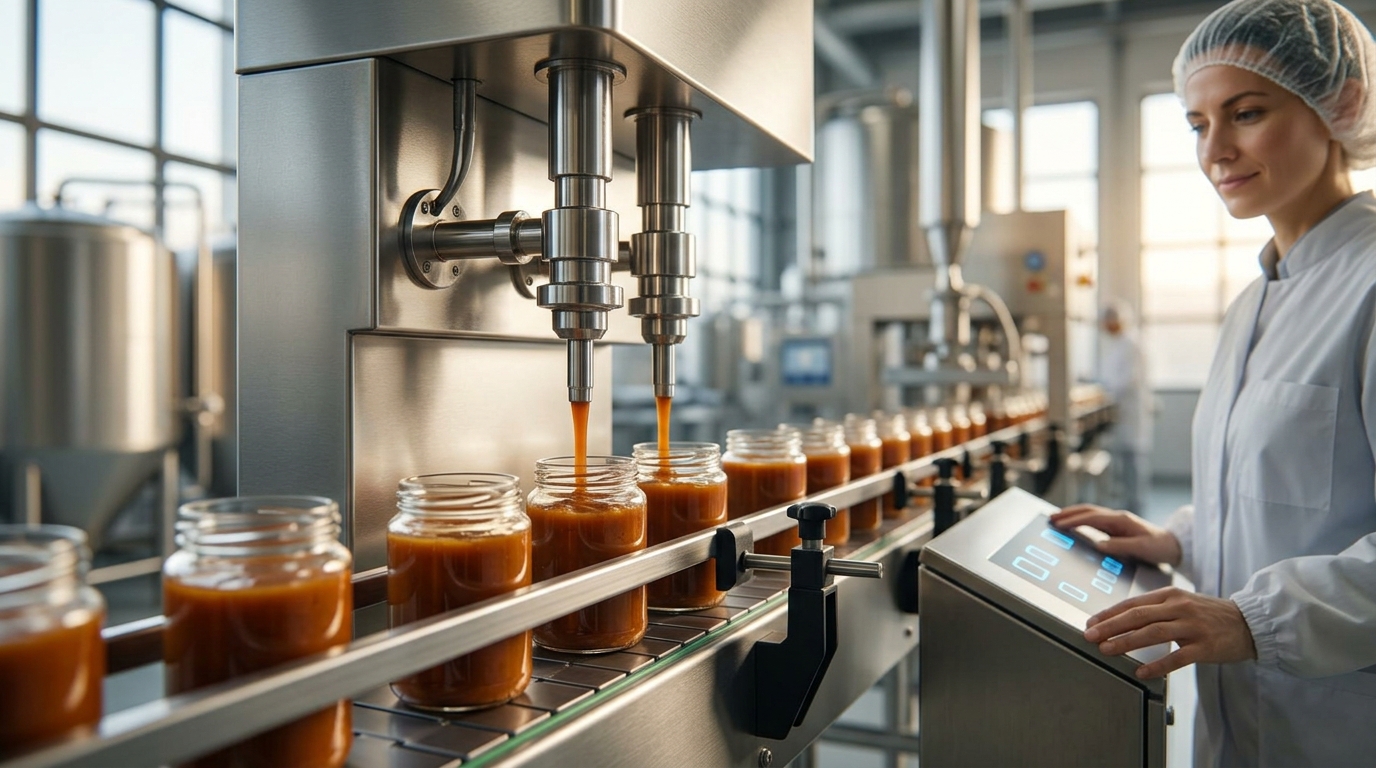
Choosing the right automatic filling machine for sauces, condiments, and liquids can make or break your production line. Whether you are packaging hot sauce, mayonnaise, salad dressing, or thin vinegar, the ideal system must handle a broad viscosity range while maintaining speed, precision, and hygiene. This guide walks you through every consideration — from filling technology types to line integration — so you can invest with confidence.
Why Fully Automatic Filling Matters for Sauce and Condiment Producers
Manual and semi-automatic filling methods introduce inconsistency, slower throughput, and higher labour costs. A fully automatic system replaces full containers with empty ones without operator intervention, keeping cycles continuous and predictable. For sauce manufacturers aiming at retail-ready consistency, automation is no longer optional — it is essential.
Modern automatic filling machines use PLC control systems with touchscreen interfaces that let operators set fill volumes, adjust speeds, and monitor operations with just a few taps. This dramatically reduces human error while boosting overall throughput and making changeovers between products faster.
Understanding Viscosity: The Starting Point for Every Decision
Sauces, condiments, and liquids vary enormously in viscosity — from water-thin soy sauce to thick peanut butter. Filling machines must handle this spectrum reliably. The product categories you should evaluate include:
- Thin liquids: Vinegar, soy sauce, cooking wines
- Medium-viscosity sauces: Ketchup, BBQ sauce, hot sauce, salad dressings
- High-viscosity pastes: Mayonnaise, tomato paste, peanut butter, tahini
- Chunky or particulate products: Salsa, chili sauce with seeds, fruit jam with pulp
The thickness and particulate content of your product directly determine which filling technology is best suited for your operation. For example, chunky sauces require filling heads engineered to pass large particulates without clogging or damaging the product texture.
Core Filling Technologies Compared
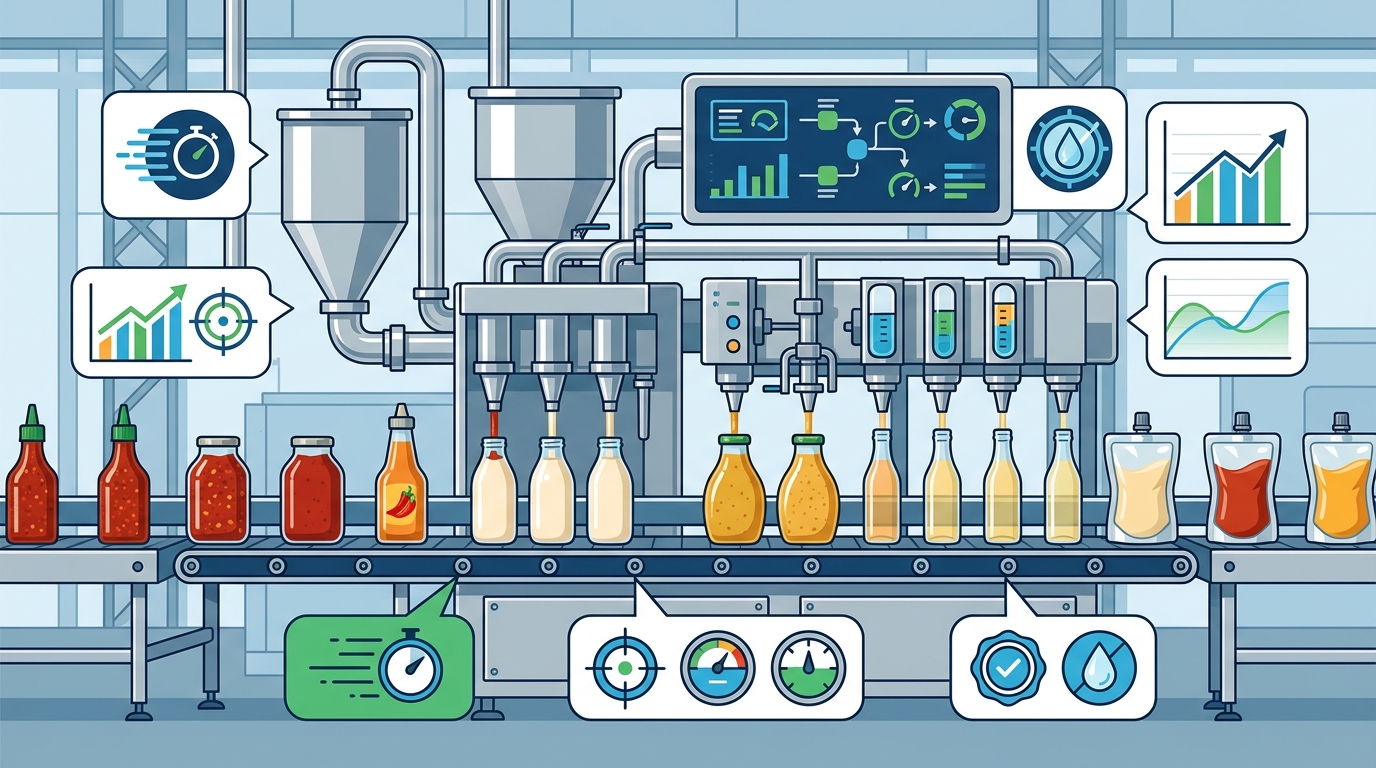
1. Servo-Driven Piston Fillers
Piston fillers are the workhorse of sauce packaging. They use a volumetric displacement method driven by a servo motor, drawing a measured volume of product into a cylinder and then dispensing it into a container. These machines are well-suited for thick, viscous, and particulate-containing products like ketchup, mayonnaise, jam, honey, and chunky salsa.
High-quality piston fillers achieve filling accuracy of ±1% or better and can operate at speeds of 15 to 100 bottles per minute depending on the number of filling heads. Many feature a three-step filling approach — slow speed at the bottom, high speed in the middle, and slow again at the neck — to prevent foaming and spilling.
2. Pump-Based Fillers (Rotary Lobe and Gear Pumps)
Pump fillers are excellent for products that are too viscous for gravity-based systems but do not require piston-style volumetric accuracy. Rotor pump systems can handle everything from pure sauces to granular variants with suspended particles. The pump action is gentler, preserving product integrity for items like fruit jams or sauces with delicate inclusions.
3. Timed-Orifice Rotary Fillers
For high-speed operations filling thin to medium-viscosity sauces and dressings, timed-orifice rotary fillers are considered an industry standard. These systems use precise flow divider manifolds to ensure equal stream division and prevent clogs. They excel at accommodating various container sizes at different speeds with minimal changeover time.
4. Net-Weight and Gravimetric Fillers
Weight-based filling is ideal when regulatory compliance or product cost makes precision paramount. Each container is filled to a target weight rather than volume, compensating for density variations in the product. This approach is common in higher-value condiments where product giveaway must be minimized.
Technology Comparison Overview
| Technology | Best For | Accuracy | Speed Range |
|---|---|---|---|
| Servo Piston | Thick, chunky, high-viscosity | ±0.5–1% | 15–100 bpm |
| Pump-Based | Medium to high viscosity, particulates | ±1–2% | 10–60 bpm |
| Timed-Orifice Rotary | Thin to medium, high-speed lines | ±0.5–1% | Up to 600+ bpm |
| Net-Weight | High-value products, regulatory compliance | ±0.1–0.5% | 10–80 bpm |
Must-Have Features in a Fully Automatic Sauce Filling Machine
Anti-Drip Nozzles
Anti-drip filling nozzles keep bottles and conveyors clean, eliminating product waste and reducing the need for manual cleaning between cycles. This feature is critical for sticky sauces like honey and BBQ sauce.
No-Bottle-No-Fill Sensors
Intelligent sensor systems automatically detect the absence of a container and halt filling, preventing product loss and mess on the line. This feature is standard on professional-grade automatic fillers.
PLC Control with Touchscreen HMI
A modern PLC control system paired with a touchscreen lets operators quickly adjust settings and monitor operations in real time. Recipe memory allows instant changeover between different products and container sizes.
Food-Grade Stainless Steel Construction
All product-contact surfaces should be made from food-grade SUS304 or SUS316L stainless steel. Quick-release structures support fast disassembly for deep cleaning between product runs, preventing cross-contamination between different sauce flavours.
Bottom-Up Fill Capability
For viscous products like mayonnaise, bottom-up filling nozzles rise as the container fills, preventing air entrapment and ensuring a smooth, bubble-free fill. This technique is especially important for transparent containers where fill quality is visible to the consumer.
Hopper with Agitation System
Products with particulates or ingredients prone to separation benefit from a hopper with a built-in stirring mechanism. The stirrer continuously mixes the product, ensuring particulates like fruit pieces, spices, or fibres stay evenly suspended for uniform consistency in every bottle.
Building a Complete Automated Bottling Line
A filling machine is just one piece of the puzzle. To achieve true end-to-end automation for sauces and condiments, you need a complete bottling line that integrates multiple stations seamlessly.
Essential Bottling Line Components
- Bottle Unscrambler or Sorting Table: Feeds empty containers onto the line in the correct orientation.
- Filling Machine: Dispenses the right amount of product into each container.
- Capping Machine: Applies and secures caps to maintain freshness and prevent leaks.
- Labeling Machine: Applies branding, product details, and regulatory information.
- Conveyors: Transport containers between stations at variable speeds for smooth production flow.
- Accumulation Table: Buffers finished products at the end of the line.
JDA Progress specializes in crafting efficient and automated bottling systems tailored to your needs. Their bottling line equipment integrates fillers, cappers, labelers, and conveyors for smoother production. Whether you are a small startup or an established business, their complete bottling solutions help transform your workspace into a high-capacity liquid packaging line.
How to Choose the Right Fully Automatic Filling Solution
Selecting the correct filling machine depends on several interrelated factors. Use this decision framework:
Step 1: Define Your Product Range
List every product you plan to fill — including viscosity, temperature requirements (hot fill versus cold fill), and particulate size. If you fill both smooth ketchup and chunky salsa on the same line, you need a machine that handles both without clogging.
Step 2: Determine Production Targets
Calculate your required bottles per minute. Entry-level automatic fillers typically start around 20–40 bottles per minute, while high-speed rotary systems can exceed several hundred. Match your equipment to your growth trajectory, not just your current demand.
Step 3: Evaluate Container Types
Glass jars, PET bottles, metal cans, and pouches each have different handling requirements. Confirm that the filler you choose is compatible with your current and anticipated container formats.
Step 4: Plan for Changeover Efficiency
If you run multiple SKUs, quick-changeover capability is non-negotiable. Look for tool-free adjustments, recipe storage in the PLC, and modular nozzle configurations that allow fast product switching without extended downtime.
Step 5: Choose a Manufacturer with Integration Expertise
A filling machine performs best when designed as part of a complete line. Work with a manufacturer that offers not just fillers but also cappers, labelers, conveyors, and integration support. JDA Progress, for example, offers a number of filling machines each built to serve a specific need — from piston fillers for sauces with particulates to pump-based systems for viscous liquids — backed by over 35 years of packaging equipment expertise in Canada.
Key Takeaways
- Match technology to viscosity: Piston fillers dominate for thick and chunky sauces; pump-based and rotary systems suit thinner liquids and high-speed lines.
- Accuracy saves money: A filling accuracy of ±0.5–1% dramatically reduces product giveaway and material costs over time.
- Hygiene is non-negotiable: Food-grade stainless steel construction, CIP compatibility, and quick-release assemblies are baseline requirements.
- Think in lines, not machines: The best results come from integrated bottling lines with filling, capping, labeling, and conveying working together.
- Plan for growth: Choose expandable systems — some fillers can be upgraded from 4 to 12+ heads as demand increases.
- Partner with experts: A manufacturer with decades of experience like JDA Progress can help you avoid costly mis-specifications.
Frequently Asked Questions
What type of filling machine is best for thick sauces like mayonnaise or peanut butter?
Servo-driven piston fillers are the best choice for high-viscosity products. They use volumetric displacement to push thick product through wide-bore nozzles, achieving ±1% accuracy or better. For extremely thick pastes, bottom-up filling nozzles prevent air pockets and ensure a smooth fill.
Can one automatic filling machine handle both thin liquids and thick sauces?
Some machines are designed for versatility across viscosity ranges. Pump-based fillers with adjustable speed controls and interchangeable nozzles can handle everything from water-thin liquids to semi-viscous sauces. However, for the best performance on very thick pastes AND very thin liquids, separate optimized machines often yield better results.
What filling accuracy should I expect from a modern automatic sauce filler?
Professional-grade automatic fillers typically achieve ±0.5% to ±1% accuracy. This level of precision reduces product giveaway and ensures consistent fill levels that meet regulatory and quality standards.
How fast can an automatic sauce filling machine operate?
Speed depends on technology and configuration. Inline piston fillers typically range from 15 to 100 bottles per minute depending on the number of heads. High-speed rotary systems used in large-scale condiment production can exceed several hundred containers per minute.
What materials should a food-grade filling machine be made from?
All product-contact parts should be made from SUS304 or SUS316L stainless steel. Gaskets and seals are typically food-grade silicone, Teflon, or Viton. The entire machine should meet FDA, USDA, or equivalent food safety standards for your market.
Does JDA Progress offer fully automatic filling solutions for sauces?
Yes. JDA Progress manufactures a range of filling machines including piston fillers for sauces with particulates and pump-based viscous product fillers. They also provide complete bottling line solutions integrating filling, capping, labeling, and conveyors, all backed by a 1-year warranty and in-stock parts for fast delivery.