
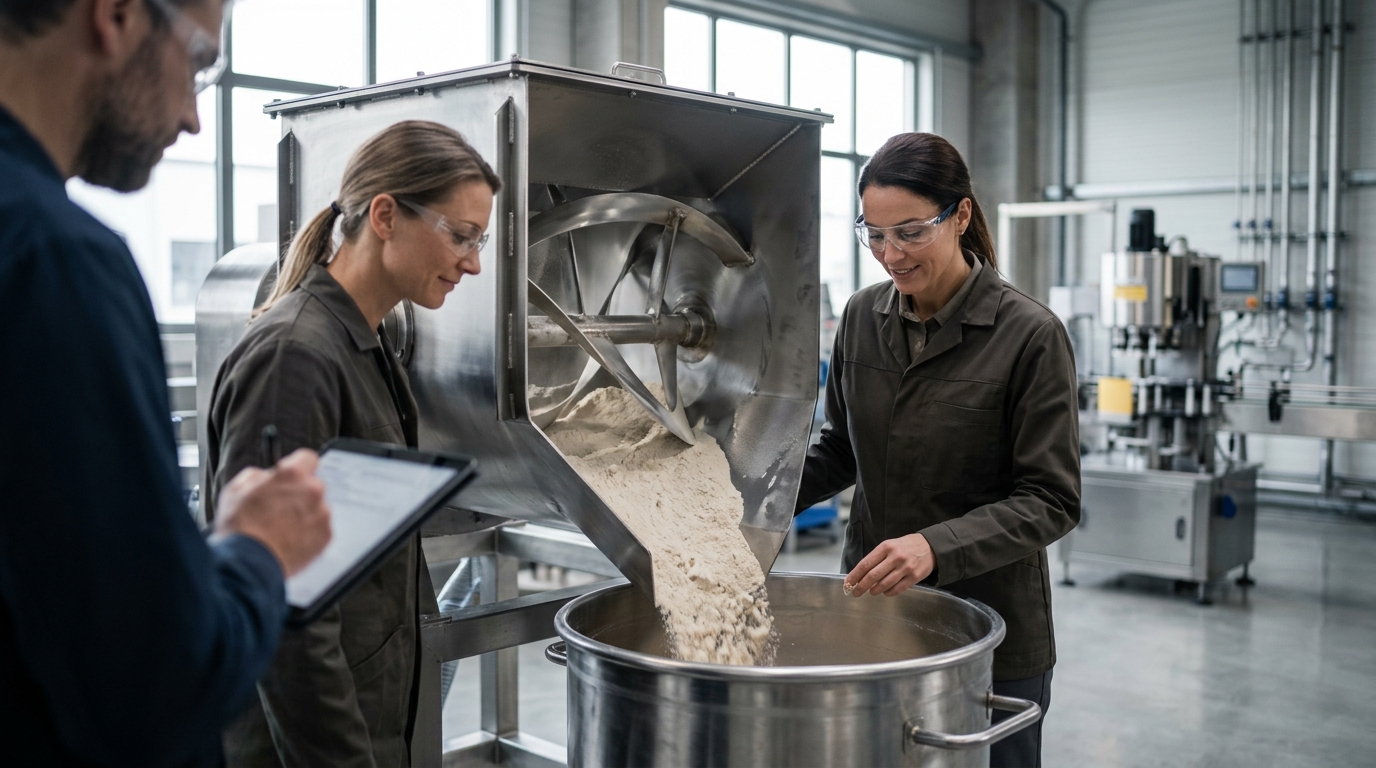
Whether you're blending spice formulations, pharmaceutical excipients, cosmetic powders, or chemical additives, the ribbon blender is the most widely deployed piece of dry mixing equipment in modern manufacturing. But not every ribbon blender is created equal. Choosing the wrong capacity, drive type, or agitator configuration can lead to inconsistent batches, wasted product, and costly downtime.
In this guide, we break down exactly how ribbon blenders work, the different types available, the critical specifications you need to evaluate, and practical tips for matching the right machine to your powder mixing operation. If your packaging line depends on precise, homogeneous blends — read on.
How a Ribbon Blender Works
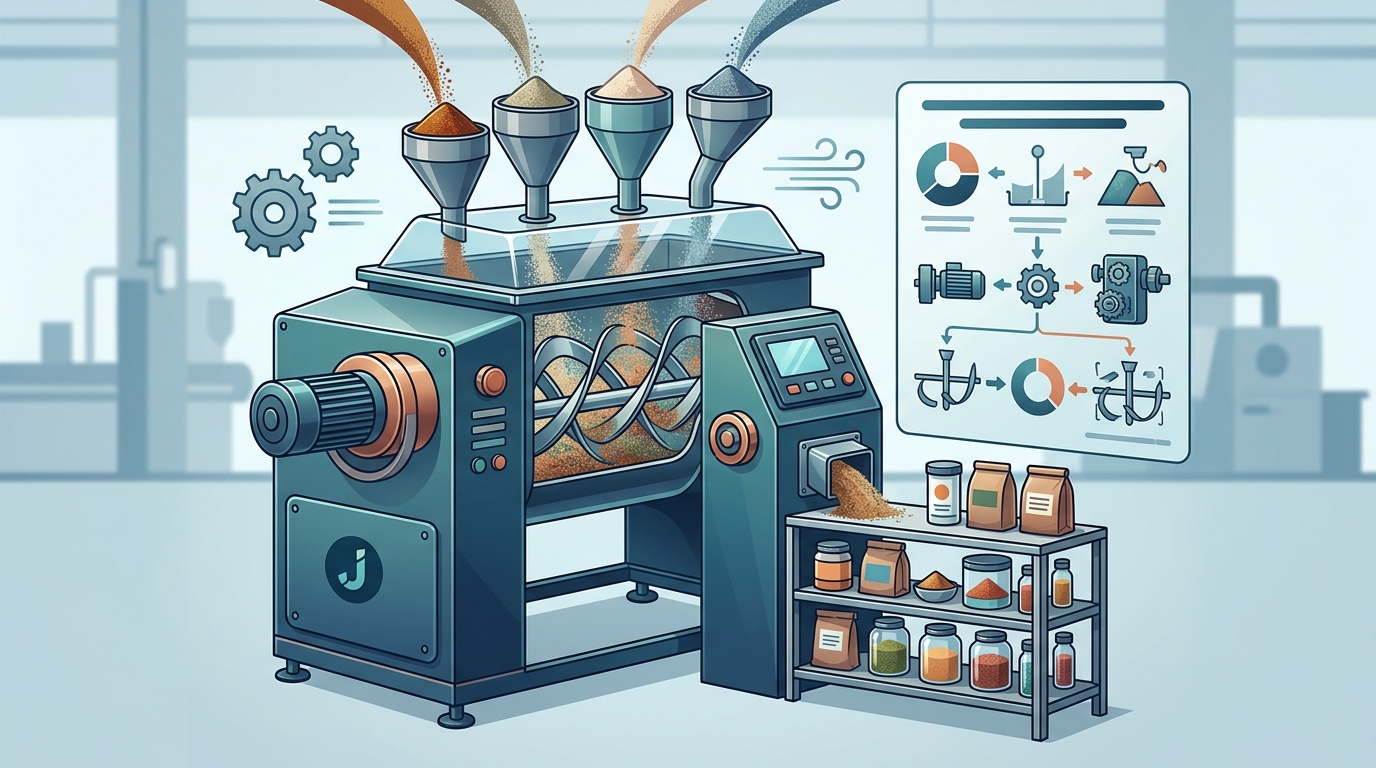
A ribbon blender consists of a U-shaped horizontal trough and an agitator shaft fitted with inner and outer helical blades — called ribbons. Powered by a gearmotor, the agitator rotates and produces a peripheral tip speed of up to approximately 300 feet per minute. The outer ribbon pushes material toward the centre of the trough while the inner ribbon moves it outward, creating a highly effective counter-current flow.
This dual-action produces three types of material movement simultaneously: radial flow (toward and away from the walls), two-way axial flow (along the length of the trough), and localised shear from particle-to-ribbon and particle-to-wall collisions. The result is fast, thorough blending — often within 3 to 15 minutes depending on batch size and formula complexity.
Types of Ribbon Blenders for Powder Mixing
Not all ribbon blenders share the same internal design. Understanding the different agitator types helps you choose the right one for your product characteristics.
1. Double Ribbon Blender
The most common configuration features two offset helical ribbons — a larger outer ribbon and a smaller inner ribbon — mounted on the same shaft. This design creates vigorous counter-current mixing and is ideal for free-flowing powders of similar particle size and density. Double ribbon blenders are widely used in food, chemical, and pharmaceutical operations where batch consistency is essential.
2. Hybrid Ribbon-Paddle Blender
Hybrid models combine the scrubbing action of a ribbon agitator with the figure-eight movement pattern of paddles. This design is best for products with high texture or bulk, such as cappuccino mixes and sugar-based spice blends, where extra energy transfer into the ingredients is needed.
3. Vertical Ribbon Blender
In a vertical ribbon blender, the helical screw rotates inside a conical vessel. This style requires less floor space and is suited to smaller batches or applications where complete discharge is critical, though it is less common for high-throughput powder mixing.
4. Triple Ribbon Blender
Some manufacturers offer a three-ribbon configuration for even faster homogeneity in complex formulations involving micro-ingredients or trace additives.
Seven Critical Factors for Selecting the Best Ribbon Blender
Selecting the right ribbon blender requires more than simply matching a volume number. Here are the factors experienced process engineers evaluate.
Factor 1: Batch Volume and Fill Level
The desired batch volume — not mass — determines the size of the blender. Optimal mixing requires the batch material to fill between 40 and 80 percent of the blender's rated volumetric capacity. Filling below 30 percent can leave the ribbons without sufficient material contact, while overfilling restricts the counter-current flow that creates homogeneity.
If you process 500 litres per batch, for example, you should select a ribbon blender with a total capacity between 700 and 1,000 litres to stay within the ideal fill range.
Factor 2: Product Bulk Density
Bulk density is the deciding variable for motor horsepower and structural duty rating. Most standard-duty ribbon blenders are rated for materials with bulk densities up to about 35 lb/cu ft (0.56 kg/L). Denser products — such as mineral powders, certain chemical compounds, or heavy granules — demand heavy-duty shafts, spokes, and motors. Running an overweight batch on a light-duty machine can overload the motor or cause mechanical failure.
Factor 3: Drive Mechanism
Modern ribbon blenders driven by a one-piece gearmotor (direct drive) are generally recommended over belt- or chain-driven designs. Direct drive is more compact, quieter, lower-maintenance, and pairs efficiently with electronic variable frequency drives (VFDs) for precise speed control, soft-start capability, and overload protection.
Factor 4: Material of Construction
For food, pharmaceutical, and cosmetic applications, 304 or 316L stainless steel wetted surfaces are the industry standard. Interior surfaces should be polished to at least 150 grit to prevent powder buildup. Every weld should be radiused, ground smooth, and pit-free to eliminate dead zones where material can accumulate and cause contamination.
Factor 5: Ribbon-to-Trough Clearance
High-quality ribbon blenders maintain tightly controlled clearances — typically 3 to 5 mm (approximately 1/8 to 3/16 inch) — between the outer ribbon tips and the trough wall. Tight clearances eliminate dead zones, but the gap must remain large enough to avoid metal-to-metal contact, which is a critical safety consideration when mixing combustible powders to prevent ignition from friction or sparks.
Factor 6: Discharge Valve Type
Ribbon blenders are available with centre-bottom or end-discharge configurations. Flush-mounted slide gate or plug valves are common; plug valves sit flush with the interior surface when closed, preventing material buildup during the mixing cycle. For applications requiring liquid-tight sealing, ball valves are the better choice.
Factor 7: Optional Accessories
Depending on your application, you may need one or more of the following add-ons:
- High-speed choppers: Break apart agglomerates and improve dispersion of minor ingredients.
- Liquid spray bars: Coat dry particles with flavouring oils, binders, or other liquids.
- Heating/cooling jackets: Maintain temperature-sensitive blends within spec.
- Vacuum capability: Remove volatiles or moisture at low temperatures.
- CIP (Clean-in-Place) systems: Reduce changeover time between batches from over an hour to as little as 15–30 minutes.
Ribbon Blender vs. Other Powder Mixers: When Is a Ribbon Blender the Right Choice?
| Mixer Type | Best For | Typical Mix Time | Shear Level |
|---|---|---|---|
| Ribbon Blender | Free-flowing powders, granules, bulk solids | 3–15 min | Low to moderate |
| Paddle Mixer | Fragile or shear-sensitive materials | 5–20 min | Very low |
| V-Blender / Tumble Blender | Small batches, friable products | 10–30 min | Minimal |
| Fluidising Mixer | Ultra-fast homogeneity requirements | 7–20 sec | High |
| High-Shear Mixer | Wet granulation, emulsions | 2–10 min | Very high |
Ribbon blenders occupy a versatile middle ground: gentle enough for most dry powders yet capable of handling minor liquid additions, heating, cooling, and even vacuum drying when properly configured.
Industry-Specific Considerations
Food and Beverage
Sanitary design is non-negotiable. Look for fully welded ribbons (no bolted joints), 316L stainless steel contact parts, and safety interlocks on every access door. CIP capability dramatically reduces changeover time — a critical advantage for operations running multiple recipes per shift.
Cosmetics and Personal Care
Cosmetic powders often contain pigments and micro-ingredients at very low inclusion rates. Tight ribbon-to-trough clearances and spray nozzle systems for liquid additions are essential for achieving uniform colour distribution and consistent product quality.
Chemicals and Industrial Products
When handling abrasive or corrosive powders, consider specialty alloys (such as Hastelloy C-276) or hard-faced ribbon surfaces. Dust-tight construction and explosion-proof electrical components are mandatory for combustible dust environments.
Integrating a Ribbon Blender Into Your Packaging Line
A ribbon blender is only as productive as the line it feeds. For maximum throughput, the blending step should be the bottleneck of the process — meaning upstream feeding and downstream packaging equipment should keep pace with your batch cycle time. Here is how to think about integration:
- Upstream: Bulk bag unloaders, screw feeders, or vibrating feeders deliver raw materials directly into the blender, reducing manual handling.
- Downstream: Pneumatic conveying or gravity discharge connects the blender to your filling equipment — whether auger fillers, volumetric fillers, or net-weigh systems.
- Controls: PLC-driven touchscreen panels coordinate batch timing, discharge sequencing, and data logging for traceability.
At JDA Progress, we design packaging lines that account for every step from blending through filling, capping, and labelling. With over 35 years of experience supplying industrial packaging equipment across Canada and beyond, our team can help you specify the right upstream mixing solution to pair with your filling and packaging systems.
Key Takeaways
- The double ribbon blender is the most versatile and widely used configuration for mixing dry powders in food, cosmetic, pharmaceutical, and chemical applications.
- Size your blender by batch volume, not mass — and plan to fill the trough to 40–80% of rated capacity for optimal homogeneity.
- Bulk density determines whether you need a standard-duty or heavy-duty model (the threshold is roughly 35 lb/cu ft).
- Direct-drive gearmotors are superior to belt or chain drives for reliability, noise, and maintenance.
- Ribbon-to-trough clearance of 3–5 mm eliminates dead zones while preventing metal contact.
- Always request a mixing trial with your actual product before committing to a purchase.
- Plan your blender as part of a complete packaging line — not in isolation.
Frequently Asked Questions
How long does a ribbon blender take to mix powders?
Most dry powder blends reach acceptable homogeneity in 3 to 15 minutes. If mixing consistently takes longer than 15 minutes for a straightforward dry blend, the batch size, fill level, or ribbon speed may need adjustment.
What is the ideal fill level for a ribbon blender?
The optimal working capacity is 40–80% of the blender's total rated volume. Filling below 30% can result in poor ribbon-to-material contact, while overfilling restricts the counter-current flow pattern the ribbons depend on.
Can a ribbon blender handle liquids as well as powders?
Yes. Ribbon blenders are routinely used to coat dry particles with small amounts of liquid — flavouring oils, binders, colourants — using integrated spray nozzles. Some models handle wet applications like slurries and batters, though these require careful specification.
What maintenance does a ribbon blender require?
Key maintenance tasks include monitoring ribbon-to-trough clearance, inspecting ribbons for wear (repair when thickness loss exceeds 10%), lubricating bearings on a regular schedule, and checking gear reducer oil. Direct-drive models require significantly less maintenance than belt-driven designs.
How do I choose between a ribbon blender and a paddle mixer?
Paddle mixers generate less shear and are better for fragile or shear-sensitive materials. Ribbon blenders offer faster mixing times and greater versatility for the majority of free-flowing dry powder applications. A mixing trial with your actual product is the best way to confirm the right choice.
What capacity range do ribbon blenders come in?
Industrial ribbon blenders are available from as small as half a cubic foot (laboratory scale) up to over 1,000 cubic feet for large-scale production operations.