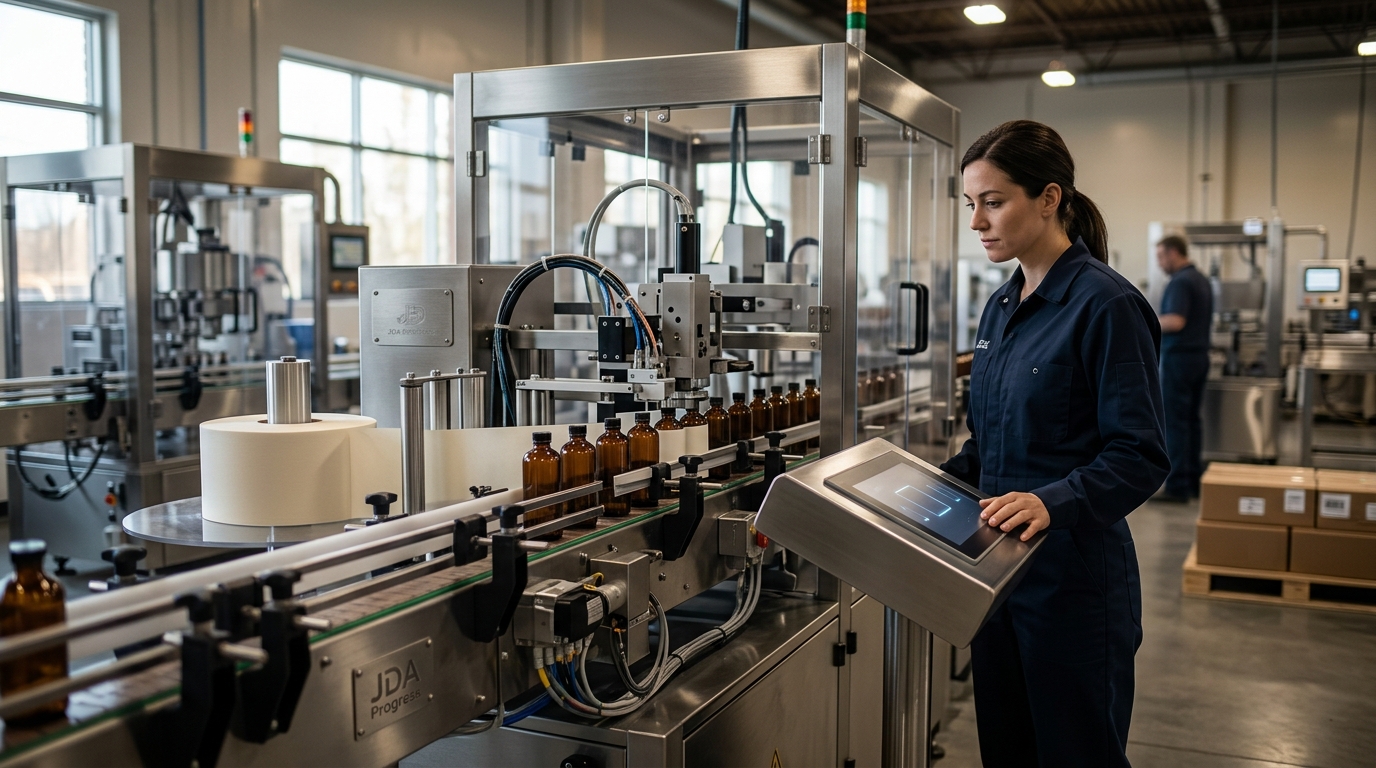
If you're searching for an automatic round bottle labeling machine, you're likely dealing with the pain of slow, inconsistent hand-applied labels or you've outgrown a semi-automatic setup. Either way, the right labeling machine can transform your throughput, brand presentation, and bottom line. This guide walks you through everything you need to know—from how these machines work and the features that matter most, to real specifications and tips for matching a labeler to your specific production needs.
What Is an Automatic Round Bottle Labeling Machine?
An automatic round bottle labeling machine is a piece of packaging equipment engineered to apply pressure-sensitive (self-adhesive) labels to cylindrical or round containers—bottles, jars, cans, and tubes—without manual intervention. The machine typically uses a conveyor system, optical sensors, and a servo or stepper motor-driven dispensing head to detect each container and apply the label with precision.
These labelers handle several label application styles including full wrap-around labels, half-wrap (partial) labels, and orientation-specific placements. They are used extensively across food and beverage, cosmetics, pharmaceuticals, chemicals, and household product industries.
Why Switch from Manual or Semi-Automatic Labeling?
Manual labeling is slow, inconsistent, and error-prone. Even semi-automatic labelers, while an improvement, still require an operator to hand-feed each container. An automatic round bottle labeler eliminates these bottlenecks and delivers measurable advantages:
- Speed: Automatic systems typically label between 20 and 300 products per minute depending on the model, compared to a handful per minute by hand.
- Accuracy: High-end servo-driven labelers achieve placement accuracy of ±0.5 mm or better, ensuring every label looks professional.
- Labour savings: One operator can oversee the entire labeling process, freeing staff for other tasks.
- Consistency: Every bottle gets the same label position—no wrinkles, bubbles, or skewed placement.
- Reduced waste: Precise dispensing minimises label waste and product rework.
Key Features to Look for in a Round Bottle Labeler
Not all labeling machines are created equal. Here are the features and specifications that separate a reliable investment from an expensive headache.
1. Label Application Head & Drive System
The heart of any labeler is its dispensing mechanism. Look for a servo motor or precision stepper motor drive. Servo-driven heads offer the highest accuracy. For example, some industrial-grade machines achieve labeling accuracy of less than ±0.5 mm using high-performance servo motor systems. A stepper motor is a more affordable option that still delivers precise label dispensing through step-counted delivery.
2. Conveyor and Container Handling
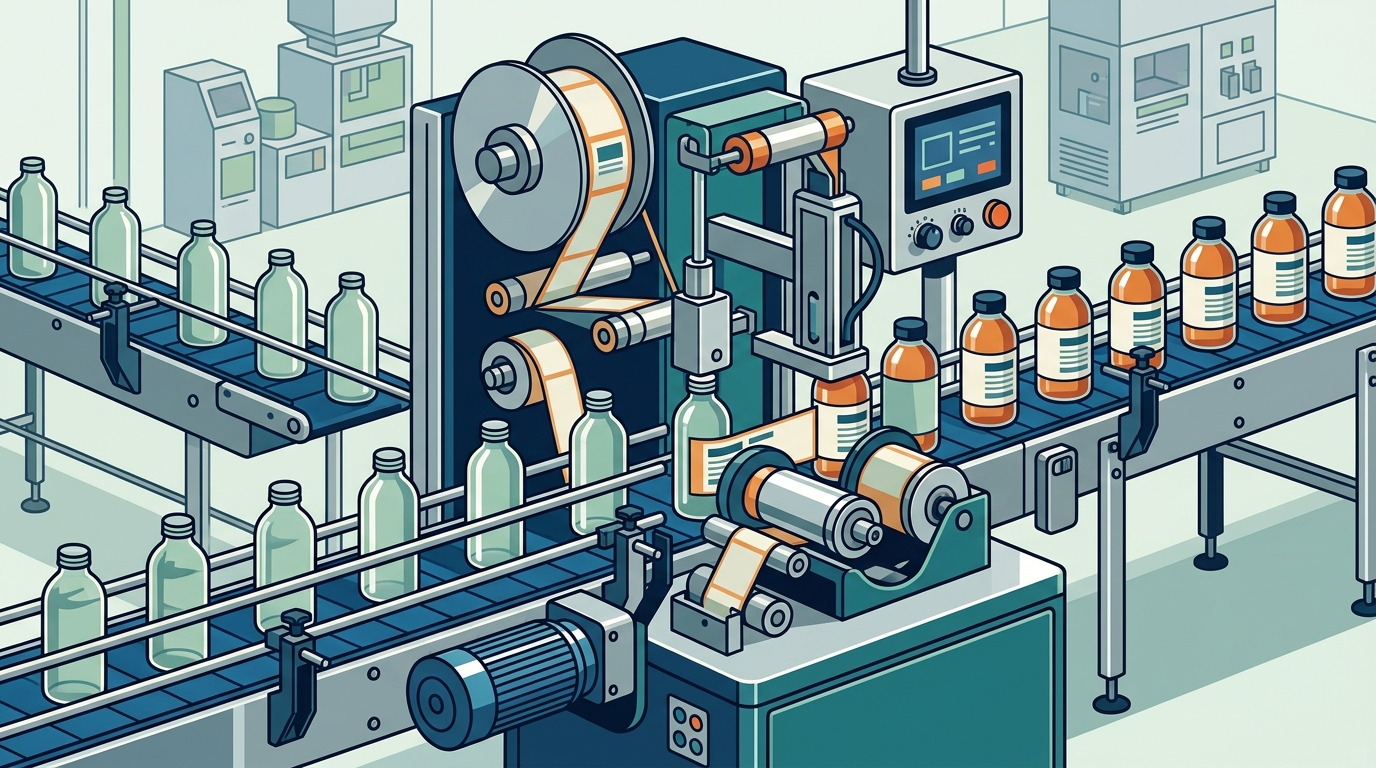
A quality machine includes an integrated conveyor with adjustable guide rails and a speed-adjustable separation module. The separation component ensures correct bottle timing and spacing, which is critical for consistent label placement at higher speeds. Check whether the conveyor speed automatically synchronises with the label dispense speed—this prevents misalignment as throughput increases.
3. Control System and Interface
Modern labelers use PLC-based control systems with touchscreen HMI panels. The interface should allow you to adjust product spacing, conveyor speed, label positioning, and sensor sensitivity without tools. One-button sensor teach functions simplify setup—you press a button and the sensor calibrates itself to your label and product, reducing changeover time dramatically.
4. Container Size Range
Verify the machine's minimum and maximum container diameter, height, and the label dimensions it supports. Many automatic round bottle labelers accommodate diameters from 20 mm up to 150 mm or more, and label lengths from 20 mm to 450 mm. If you run multiple bottle sizes, prioritise machines with tool-free adjustment—hand cranks or twist mechanisms that let you switch sizes in minutes rather than hours.
5. Construction Materials
For food, cosmetic, or pharmaceutical applications, look for 304 stainless steel frames and anodized aluminum components. These materials resist corrosion, meet GMP hygiene standards, and hold up in washdown environments. Avoid painted mild steel—it rusts quickly in production settings.
6. Integration Options
Consider whether you need add-ons such as hot-foil date coders, inkjet printers for batch numbers or expiry dates, inspection cameras, or rejection units. A good manufacturer will offer these as modular upgrades so you can expand capabilities without replacing the entire machine.
Types of Automatic Round Bottle Labelers
Understanding the different configurations helps you match a machine to your workflow.
Vertical Wrap-Around Labeler
This is the most common type for round bottles. The container sits upright on a conveyor, and the label wraps around its circumference as it passes through the application station. JDA Progress offers the JDA-1 vertical wrap-around labeling machine, which is a compact, portable unit designed for bottles, jars, cans, and cylindrical containers. It can label up to 40 pieces per minute and supports label heights up to 7.5 inches and product widths up to 6 inches. Its 304 stainless steel and anodized aluminum construction meets GMP standards, and its tabletop design makes it ideal for businesses transitioning from semi-automatic to automatic labeling.
Inline Wrap-Around Labeler
For higher-volume production, an inline wrap-around labeler integrates directly into your packaging line. JDA Progress's WLA-2 inline wrap-around labeler is a fully automatic unit suitable for food and beverages, pharmaceuticals, cosmetics, and household products. It handles a wide range of container sizes and label lengths with adjustable settings and a user-friendly interface. Demonstrations have shown it labeling 341 ml beer bottles at 40–50 bottles per minute.
Front and Back Bottle Labeler
If your round bottles need labels on two sides—such as a brand label on the front and ingredient details on the back—a dual-head labeler handles both simultaneously. JDA Progress's front and back bottle labeler is a fully automatic inline system ideal for sauces, spirits, cosmetics, and chemicals.
Tabletop / Entry-Level Labeler
Compact machines designed for startups or small-batch producers. They sit on a table or bench and offer the precision of automatic labeling at a lower price point. The JDA-1 fills this role perfectly—it bridges the gap between desktop semi-automatic labelers and full inline systems.
How an Automatic Round Bottle Labeler Works: Step by Step
- Bottle infeed: Containers enter the conveyor belt and are separated at a consistent interval by a timing mechanism or star wheel.
- Detection: A photoelectric sensor detects each bottle as it reaches the labeling station and triggers the label dispense cycle.
- Label dispense: The drive motor pulls the label strip, peeling the label off the backing paper at the dispensing edge.
- Application: The label contacts the bottle surface and a wrap station (rollers or brushes) presses it firmly around the container to eliminate bubbles and wrinkles.
- Outfeed: The labelled bottle continues down the conveyor to the next station—whether that's capping, coding, cartoning, or case packing.
Matching the Right Machine to Your Industry
Food & Beverage
Strict hygiene standards demand stainless steel construction. Labels must adhere firmly through refrigeration, moisture, and handling. Look for machines rated for washdown environments. Inline wrap-around labelers excel in bottling lines running sauces, oils, juices, beer, and spirits.
Cosmetics & Personal Care
Brand appearance is paramount. Precision label placement avoids the wrinkles and bubbles that cheapen a premium product. Soft tube labelers are required for squeezable tubes, while wrap-around labelers handle jars and bottles. JDA Progress offers a dedicated soft cosmetic tube labeler for this exact application.
Chemicals & Industrial
Chemical labels must resist solvents, abrasion, and extreme temperatures. The labeling machine needs to handle thicker label stocks and larger containers. Ensure the machine's diameter range covers your biggest containers and that the materials are chemical-resistant.
Pharmaceuticals
Regulatory compliance requires accurate, traceable labeling. Integration with date coders and serialisation printers is essential. Choose a labeler with a PLC control system that can log batch data and interface with line management software.
What to Expect: Realistic Specifications
Here is a general performance range for automatic round bottle labeling machines across the market:
| Specification | Typical Range |
|---|---|
| Labeling speed | 20–300 products/minute |
| Label accuracy | ±0.5 mm to ±1.0 mm |
| Container diameter | 20 mm–350 mm |
| Label length | 20 mm–450 mm |
| Label width | 10 mm–200 mm |
| Control system | PLC with touchscreen HMI |
| Construction | 304 stainless steel / anodized aluminum |
| Power | 110V/220V, 50/60 Hz |
Buyer's Checklist: 8 Questions to Ask Before You Purchase
- What is the full diameter and height range? Make sure it covers your smallest and largest containers.
- What's the realistic throughput? Ask for speeds at your specific bottle/label combination, not just the maximum rating.
- How long does a changeover take? If you run multiple SKUs, changeover time directly impacts uptime.
- Is the machine standalone or inline? A standalone unit is more flexible; inline integrates into your existing conveyor.
- What coding or printing add-ons are available? Hot-foil printers, inkjet coders, and print-and-apply systems add traceability.
- What warranty and after-sales support is included? JDA Progress, for example, includes a 1-year warranty on all machines and parts along with installation training and ongoing support.
- Can I see a demonstration? Reputable manufacturers offer free demos so you can validate performance with your actual product.
- What's the construction material? Insist on 304 stainless steel and anodized aluminum for food-grade or GMP environments.
Why Canadian Manufacturers Choose JDA Progress for Round Bottle Labeling
JDA Progress Industries has over 35 years of experience designing and manufacturing packaging equipment in Canada. Their labeling machine lineup covers every common round-bottle scenario—from the entry-level JDA-1 vertical wrap-around labeler to fully automatic inline systems like the WLA-2. Here's what differentiates them:
- In-stock equipment: JDA Progress keeps machines and parts in stock for fast delivery, minimising the wait time that plagues import-dependent competitors.
- 1-year warranty: Every machine and replacement part comes with a full year of coverage.
- Free product demonstrations: You can see the machine run your actual product before committing.
- Competitive, transparent pricing: No hidden costs or surprise line items.
- Tailored solutions: JDA Progress collaborates with customers to configure machines with print-and-apply systems, inspection cameras, and rejection units based on specific requirements.
- GMP-grade construction: All JDA labelers are built from 304 stainless steel and anodized aluminum, ensuring durability and compliance in regulated environments.
Key Takeaways
- An automatic round bottle labeling machine eliminates the inconsistency, slowness, and labour cost of manual or semi-automatic labeling.
- Core features to prioritise include servo or stepper motor drives, PLC touchscreen controls, stainless steel construction, and tool-free changeover.
- Match the machine type to your workflow: tabletop wrap-around for smaller runs, inline wrap-around for high-volume lines, and front-and-back labelers for dual-label applications.
- Always request a live demonstration with your actual bottles and labels before purchasing.
- JDA Progress Industries offers a complete range of labelers backed by 35+ years of Canadian manufacturing experience, in-stock availability, and a 1-year warranty.
Frequently Asked Questions
What types of bottles can an automatic round bottle labeling machine handle?
Automatic round bottle labelers work with virtually any cylindrical container including PET plastic bottles, glass bottles, metal cans, jars, and even slightly tapered containers. Diameter ranges typically span from 20 mm to 350 mm depending on the machine model.
How fast can an automatic round bottle labeler apply labels?
Speeds vary by machine class. Entry-level tabletop models like the JDA-1 can label up to 40 pieces per minute, while high-speed inline systems can reach 300 products per minute. The actual speed depends on your container size, label dimensions, and required accuracy.
What is the label placement accuracy of these machines?
Industrial-grade automatic labelers with servo motor drives typically achieve ±0.5 mm accuracy. Stepper motor models are slightly less precise but still deliver consistent, professional-quality placement that far exceeds manual application.
Can a round bottle labeler apply wrap-around and partial labels?
Yes. Most automatic round bottle labelers support both full wrap-around labels and half-wrap (partial) labels. Some models can also apply front-and-back labels simultaneously using dual application heads.
What maintenance does an automatic labeling machine require?
Routine maintenance is minimal—primarily cleaning the sensors, checking the label path for adhesive buildup, and inspecting wear parts like dispensing edges and rollers. Machines built from stainless steel and anodized aluminum are particularly low-maintenance and resist corrosion in production environments.
Does JDA Progress offer labeling machines for round bottles?
Yes. JDA Progress Industries manufactures several labeling machines suited for round bottles, including the JDA-1 vertical wrap-around labeler for small-to-mid production, the WLA-2 inline wrap-around labeler for high-volume lines, and a front-and-back bottle labeler for dual-label applications. All are built in Canada with 304 stainless steel construction and come with a 1-year warranty.
How do I choose between a tabletop and inline labeling machine?
If you run fewer than 40 bottles per minute and need flexibility to move the machine between workstations, a tabletop model like the JDA-1 is ideal. If your production line runs continuously at higher speeds and the labeler needs to integrate with upstream and downstream equipment, choose an inline system like the WLA-2.