
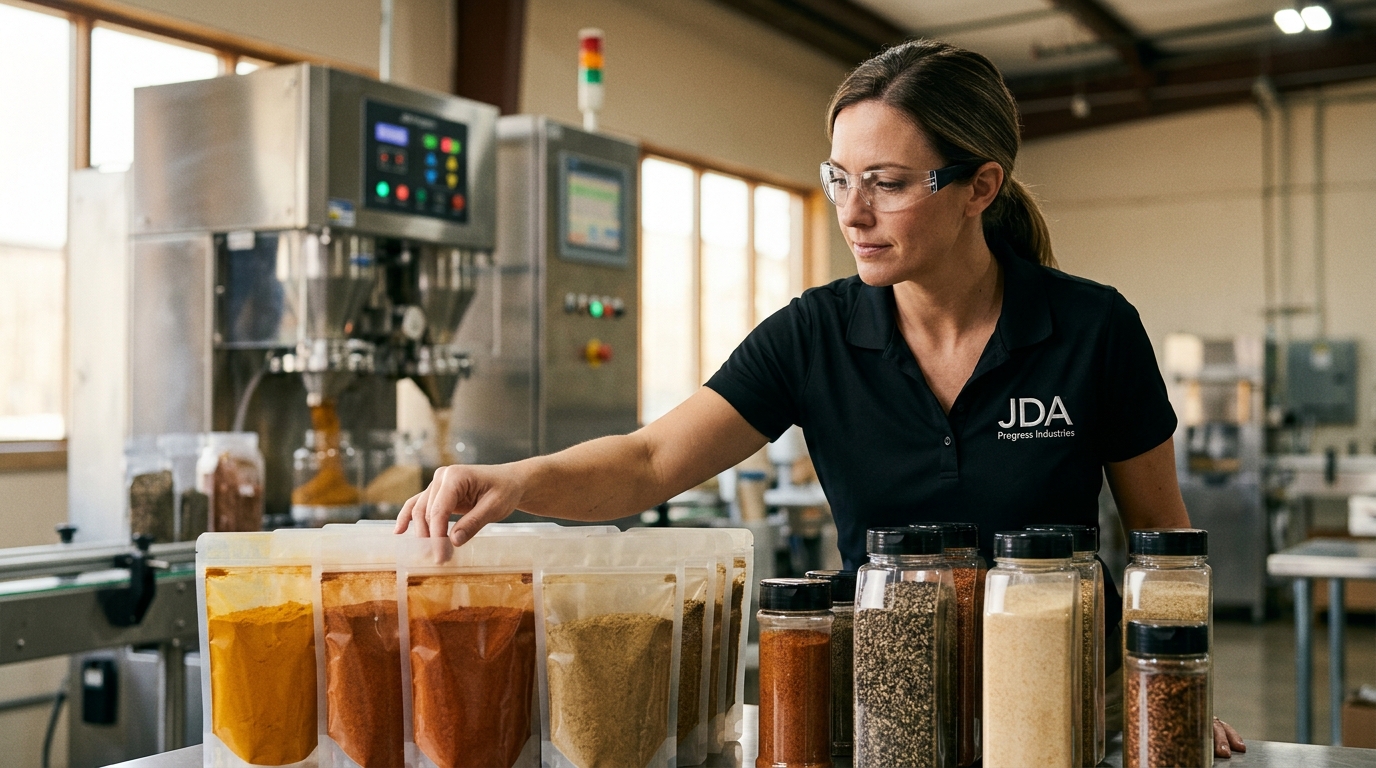
Spice Filling Machines for Pouches and Bottles: A Complete Buyer’s Guide
If you fill spices into pouches and bottles, choosing the right filling machine is one of the most impactful decisions you will make. Spice products—ground turmeric, chili powder, cumin, black pepper, garlic powder, seasoning blends—each behave differently in a filling system. Container format matters too: a stand-up pouch demands a different workflow than a rigid PET bottle or glass jar. This guide walks you through every variable so you can invest confidently.
Why Spices Are Challenging to Package
Spices are not a single product category—they range from ultra-fine powders like garlic and onion powder to coarse granules like cracked pepper and whole cumin seeds. Each form creates specific handling issues.
Moisture and Clumping
Many ground spices are hygroscopic. Garlic powder, ginger powder, and onion powder readily absorb ambient moisture, causing clumps that interrupt flow into the filling head. Modern auger fillers address this with agitator paddles and conditioning hoppers that keep powder moving consistently.
Dust Control
Ultra-fine spice powders generate airborne dust that contaminates sealing surfaces, reduces fill accuracy, and creates housekeeping hazards. Quality machines feature dust-tight filling heads, vacuum suction ports, and enclosed filling chambers to minimise powder dispersion during filling cycles.
Aroma and Freshness
Spices degrade quickly when exposed to light, moisture, and oxygen. The packaging process itself should minimise exposure time. Many spice packaging lines integrate nitrogen flushing or vacuum sealing to extend shelf life and preserve colour, aroma, and potency.
Three Core Filling Technologies for Spices
Not every filler handles every spice format well. Understanding the three dominant technologies will narrow your search immediately.
1. Auger Fillers
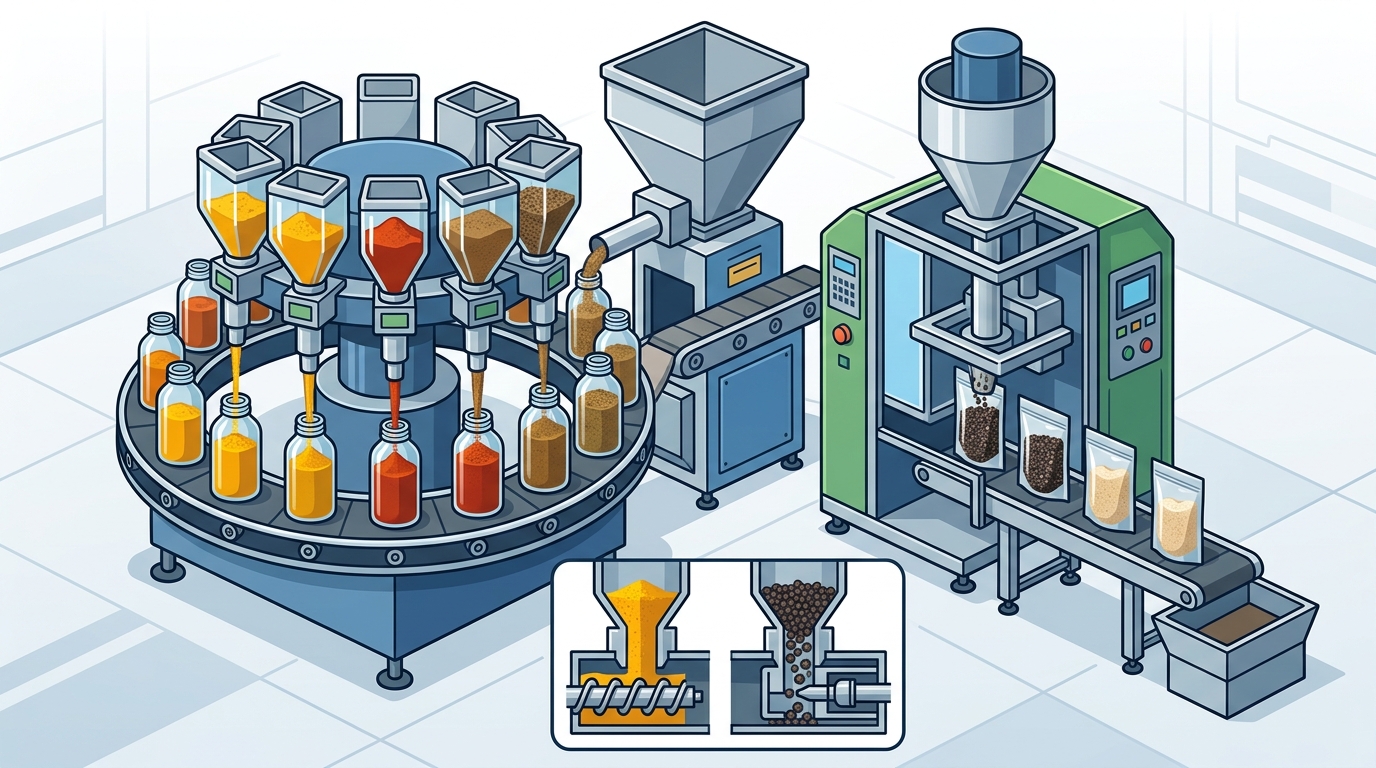
Auger fillers are the industry standard for ground and powdered spices. A rotating screw (the auger) inside a tube dispenses a precise volume of powder per revolution. The number of revolutions determines fill weight. Servo-driven auger motors paired with PLC controls deliver repeatable accuracy, typically within ±1% or better.
Auger fillers work well for turmeric, chili powder, paprika, cinnamon, garlic powder, cocoa, and similar products. They can fill into bottles, jars, pouches, and sachets. The enclosed design inherently controls dust—a major advantage for fine spice powders.
2. Volumetric Cup Fillers
Cup fillers use interchangeable measuring cups to scoop a set volume of product. They excel with free-flowing granules—whole seeds, coarse salt, cracked pepper, dried herb flakes. Changeovers between cup sizes are fast, making them practical for producers running multiple SKUs.
3. Weigh-Metric (Net Weight) Fillers
Net weight fillers dispense product onto a load cell and stop when the target weight is reached. This method provides the highest accuracy—critical for premium or regulated spice products. Weigh-metric systems are often paired with auger or vibratory feeders for initial bulk dosing and final dribble adjustment.
| Technology | Best For | Typical Accuracy | Speed Range |
|---|---|---|---|
| Auger filler | Fine powders, ground spices | ±0.5%–1.0% | 10–120 fills/min |
| Volumetric cup | Free-flowing granules, seeds | ±1.0%–2.0% | 15–80 fills/min |
| Net weight | Premium blends, regulated fills | ±0.25%–0.5% | 8–60 fills/min |
Pouch Filling vs. Bottle Filling: Key Differences
Your container format affects every machine downstream of the filler—and sometimes the filler itself.
Filling Spices into Pouches
Pouches are the fastest-growing format in retail spice packaging. Stand-up pouches (doy packs), pillow bags, sachets, and three-side-seal bags are all common. There are two main machine architectures for pouch filling:
- Vertical Form Fill Seal (VFFS): The machine forms a pouch from a flat roll of film, fills it via an integrated auger or cup filler, and seals it—all in one motion. VFFS systems are the workhorse for high-volume sachet and pillow-bag spice lines, achieving speeds up to 150 bags per minute on continuous-motion models.
- Pre-made Pouch Machines: These accept pre-formed pouches (stand-up, zippered, spout pouches), open them, fill them, and seal them. Speeds typically reach 40–60 pouches per minute. Pre-made pouch machines are ideal when brand presentation demands a premium bag style that VFFS cannot easily produce.
Filling Spices into Bottles and Jars
Rigid containers—glass jars, PET bottles, HDPE bottles—require a different line layout. Bottles are typically fed by an unscrambler or orientor, conveyed under the filler head, filled, then moved to a capper and labeler. The filler itself can be an auger, cup, or net-weight unit mounted above an inline or rotary conveyor. Changeover between bottle sizes involves swapping guide rails and sometimes the auger tooling.
Running Both Formats on One Line
Many spice producers need to fill both pouches and bottles. The most flexible approach is to invest in a standalone filler (auger or net-weight head) that can be integrated with either a VFFS bagger or a bottle conveyor system. Modular equipment from a manufacturer like JDA Progress allows you to pair a single filling head with interchangeable downstream modules, protecting your investment as your product line grows.
Automation Levels and Approximate Investment
Matching automation to your current throughput—and your growth plan—prevents overspending today or outgrowing your line within a year.
Manual and Tabletop Fillers
Operator-initiated per-cycle filling via foot pedal. Suitable for startups, test batches, and farmers’ market brands. Typical investment: $500–$2,000 USD.
Semi-Automatic Fillers
The operator places containers; the machine doses automatically. PLC-controlled with touchscreen parameter adjustment. Ideal for mid-scale production. Typical investment: $2,000–$10,000 USD.
Fully Automatic Lines
From container feeding through filling, capping or sealing, labelling, and checkweighing—minimal operator involvement. PLC and servo-driven, with recipe storage for fast changeovers. Typical investment: $15,000–$60,000+ USD depending on speed, heads, and integration scope.
Ancillary Equipment You Will Likely Need
A filling machine rarely operates in isolation. A complete spice packaging line typically includes:
- Feeding system: Screw conveyor or vibratory elevator to transfer spice from bulk storage into the filler hopper.
- Checkweigher: Verifies every fill meets target weight. Rejects under- and over-weight units automatically.
- Capping machine: For bottles and jars—screw caps, flip-tops, shaker fitments, or induction seals.
- Sealing system: Heat sealing or ultrasonic sealing for pouches and sachets.
- Labelling machine: Applies wrap-around, front-and-back, or top labels to bottles; or prints date codes on pouches.
- Metal detector / X-ray: Food safety compliance for retail and food-service channels.
- Bottle unscrambler: Automatically orients and feeds bottles onto the conveyor.
JDA Progress manufactures fillers, cappers, labelers, and conveyors under one roof—simplifying integration, spare parts sourcing, and service across your entire line.
Choosing the Right Container for Your Spices
Your container choice directly affects which filler configuration you need. Here is a practical breakdown:
- Glass jars: Premium appearance, non-reactive, excellent shelf appeal. Heavier shipping weight. Best for retail gourmet lines.
- PET or HDPE bottles: Lightweight, shatterproof, cost-effective. Widely used for mid-range retail spice brands.
- Stand-up pouches (doy packs): Strong shelf presence, re-sealable with zippers, lower material cost than rigid containers, compact for shipping.
- Sachets and pillow bags: Lowest per-unit cost, ideal for food-service portions, sample packs, and high-volume retail multipacks.
- Laminated pouches: Barrier films (PET/AL/PE or PET/PE) protect spice freshness from moisture, oxygen, and UV light.
How to Evaluate a Spice Filling Machine Manufacturer
Not all equipment suppliers are equal. Use this checklist when shortlisting vendors:
- Product testing: Can the manufacturer run your actual spice products on their machines before you buy? This is the single best predictor of real-world performance.
- Material construction: All product-contact surfaces should be SS304 or SS316 stainless steel, meeting food-grade and GMP standards.
- Changeover speed: If you run multiple SKUs, tool-less changeover mechanisms and stored recipes save significant production time.
- Integration capability: A manufacturer who builds fillers, cappers, and labelers (like JDA Progress) can deliver a turnkey line where every component communicates smoothly.
- Local support: Proximity matters. A Canadian manufacturer like JDA Progress offers faster service response, easier access to spare parts, and no cross-border complications for Canadian producers.
- Scalability: Choose modular equipment that can grow from semi-automatic to fully automatic without replacing the core filling head.
Key Takeaways
- Auger fillers are the default choice for ground spice powders; volumetric cups suit granular spices; net-weight systems offer the highest accuracy.
- VFFS machines handle high-speed pouch production, while pre-made pouch machines suit premium bag formats.
- Bottle lines need unscramblers, cappers, and labelers alongside the filler.
- Modular, standalone filling heads give you flexibility to serve both pouch and bottle formats.
- Total line cost ranges from under $2,000 for manual setups to $60,000+ for fully automatic integrated lines.
- A single-source manufacturer like JDA Progress simplifies integration, service, and long-term support.
Frequently Asked Questions
What type of filling machine is best for ground spices?
An auger filler is the most common and effective choice for ground spice powders. The enclosed screw mechanism controls dust, delivers consistent dose accuracy (typically ±1% or better), and handles both free-flowing and non-free-flowing powders. For mixed herb-and-powder blends, a volumetric cup or electronic scale filler may be more appropriate.
Can one machine fill both pouches and bottles?
A standalone auger filling head can be integrated with either a VFFS bagger for pouches or a bottle conveyor for rigid containers. This modular approach lets you serve both formats without purchasing two completely separate filling systems. JDA Progress engineers packaging lines with this kind of flexibility built in.
How fast can a spice filling machine run?
Speed depends on the container, fill size, and automation level. Semi-automatic auger fillers typically achieve 10–25 fills per minute. Fully automatic rotary auger systems can exceed 100 fills per minute. VFFS pouch machines with auger dosing can reach up to 150 bags per minute on continuous-motion models.
What materials should the machine be made from?
All product-contact parts should be food-grade stainless steel—SS304 at minimum, SS316 for acidic or corrosive spice oils. Look for machines that meet GMP and CE standards and feature tool-free disassembly for easy cleaning between product changeovers.
How much does a spice filling machine cost?
Manual tabletop fillers start around $500–$2,000 USD. Semi-automatic systems range from $2,000–$10,000 USD. Fully automatic integrated lines typically cost $15,000–$60,000+ USD, depending on speed, number of filling heads, and downstream equipment included.
Do I need a checkweigher?
Yes, for any commercial spice operation. A checkweigher after the filler verifies that every container meets your declared net weight. This protects you from costly product giveaway on overfills and regulatory penalties on underfills. Inline checkweighers integrate directly with your filling line for real-time feedback.
Why choose a Canadian packaging equipment manufacturer?
For Canadian spice producers, sourcing equipment domestically from a manufacturer like JDA Progress means faster lead times, easier access to service technicians and spare parts, no cross-border tariffs or import delays, and a team that understands Canadian food-safety regulations.
Ready to Find the Right Spice Filling Machine?
JDA Progress has over 35 years of experience designing and manufacturing packaging equipment—including fillers, cappers, labelers, and complete line solutions—for food, beverage, cosmetic, and chemical producers across Canada and beyond. Whether you are filling chili powder into sachets or gourmet seasoning blends into glass jars, our team can spec, build, and support the right solution for your operation.
Contact JDA Progress to discuss your spice filling requirements and request a product trial on our equipment.