Industrial powder blending requires precision that manual methods simply cannot provide. According to recent industry benchmarks, automated mixing systems reduce batch-to-batch variance by over 40 percent compared to traditional manual techniques. This statistic highlights why manufacturers in the food, chemical, and nutraceutical sectors are aggressively upgrading their infrastructure. JDA Progress has spent over 35 years perfecting the machinery that drives these efficiencies. We understand that selecting the right equipment is not just about volume; it is about achieving homogeneity without degrading sensitive ingredients. (Trusted Packaging Equipment Manufacturer)
What Is a Ribbon Blender?
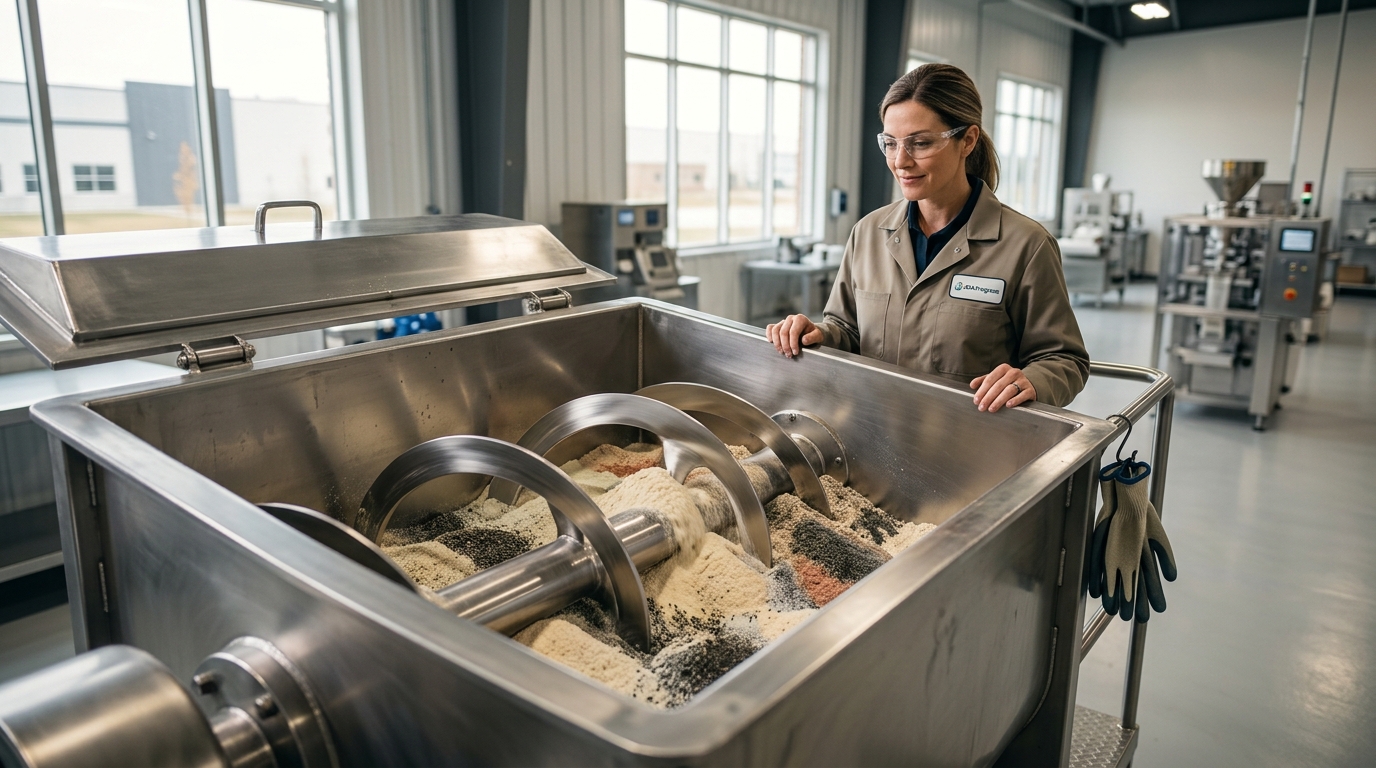
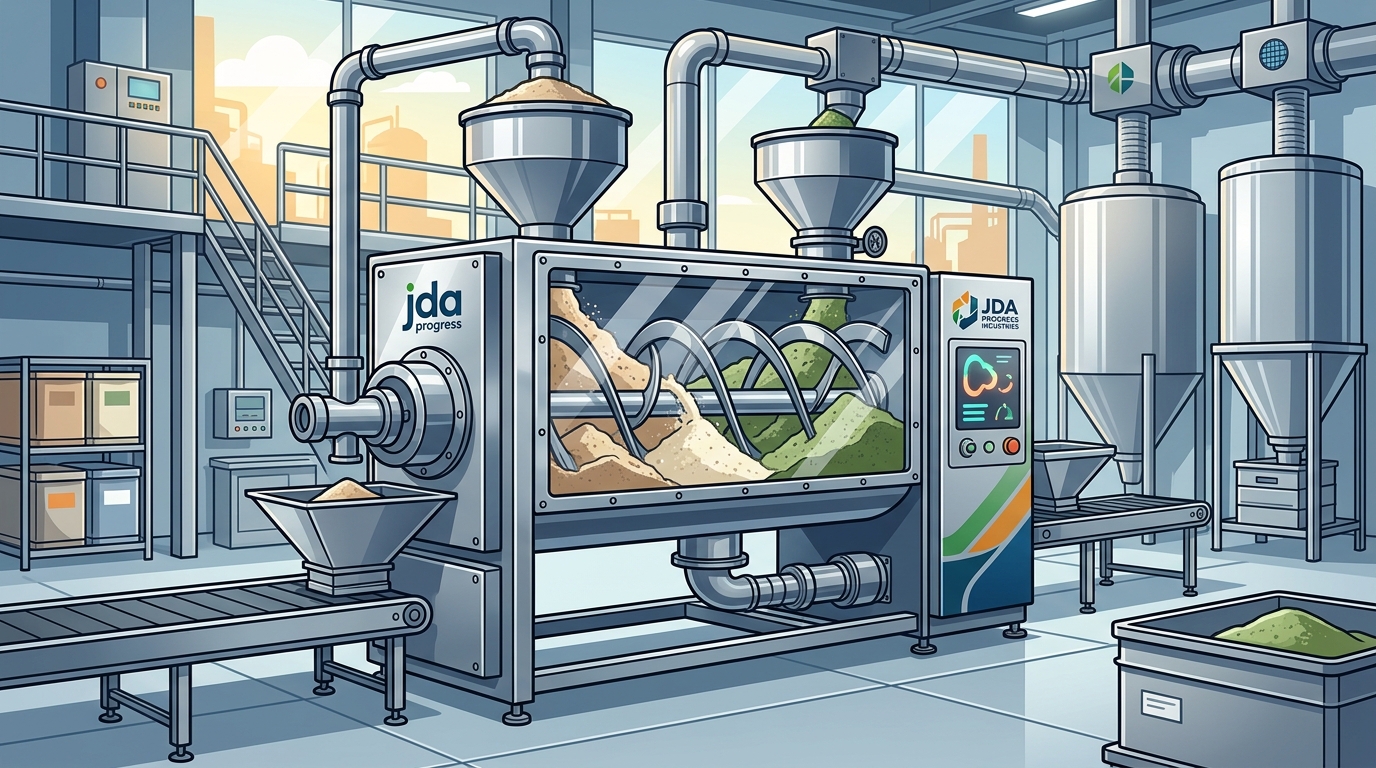
A ribbon blender is a type of industrial mixer that uses a helical ribbon agitator to blend dry powders and granules. The design features a U-shaped trough and a central shaft with two ribbons. One ribbon moves material toward the center, while the other moves it outward. This counter-current flow ensures rapid and uniform mixing. The term ribbon blender is defined as a high-efficiency dry powder mixing device that utilizes opposing helical flights to create a convective mixing pattern.
These machines are staples in facilities that handle ingredients like flour, spices, pharmaceutical compounds, and chemical additives. The simplicity of the design contributes to its longevity and ease of maintenance. Unlike complex pneumatic systems, ribbon blenders rely on mechanical force to move material. This makes them reliable for high-volume production lines. Many manufacturers prefer this technology because it handles a wide range of bulk densities effectively.
When evaluating your options, consider the specific gravity of your powders. Ribbon blenders excel when mixing materials with similar densities. If your process involves significant density differences, you may need to adjust the mixing time or select a different agitation method. Understanding these nuances is critical for optimizing your production workflow.
How Ribbon Blenders Work
The mechanics of a ribbon blender are straightforward yet powerful. As the central shaft rotates, the inner ribbon pushes material toward the center of the trough. Simultaneously, the outer ribbon pushes material toward the ends. This creates a continuous circulation pattern. The result is a homogeneous mixture in a fraction of the time required by manual labor.
According to engineering data, optimal mixing times for ribbon blenders typically range from 3 to 10 minutes depending on the batch size and ingredient complexity. Over-mixing can sometimes lead to segregation, especially with fine powders. Therefore, precise control over the motor speed and discharge mechanism is essential. JDA Progress engineers design our systems to minimize dead zones where material might get trapped.
The discharge valve is another critical component. Most ribbon blenders use a butterfly valve or a slide gate at the bottom of the U-trough. This allows for quick and complete emptying of the batch. Some applications require a vacuum discharge system to prevent dust generation. This is particularly important in the pharmaceutical and nutraceutical industries where cleanliness and safety are paramount.
Key Selection Factors for Powder Mixing
Selecting the best ribbon blender for your needs involves several technical considerations. First, evaluate the capacity requirements. JDA Progress offers equipment ranging from small laboratory units to large industrial scales. Your production volume will dictate the trough diameter and length. A longer trough generally provides better mixing for large batches, while a wider trough handles higher volumes.
Second, consider the material properties. Are your powders free-flowing or cohesive? Free-flowing powders mix easily, but cohesive powders may require additional agitation or a different blade design. JDA Progress provides custom solutions for difficult materials. We also offer various liner materials, including stainless steel, to prevent corrosion and contamination.
Third, look at the drive system. Direct drive motors are common for their simplicity and low maintenance. However, some applications benefit from variable frequency drives (VFDs) to control the mixing speed precisely. This flexibility allows you to optimize the process for different products. Visit our Blenders & Feeders page to explore our specific models.
Finally, consider the after-sales support. The best equipment is only as good as the service behind it. JDA Progress stands behind our machinery with comprehensive warranty and parts support. Our team is available to assist with installation, training, and ongoing maintenance. This commitment ensures that your production line remains operational and efficient.
Equipment Comparison Matrix
Understanding the differences between various mixing technologies helps you make an informed decision. The table below compares ribbon blenders with other common industrial mixers.
| Equipment Type | Best For | Mixing Action | Typical Application |
|---|---|---|---|
| Ribbon Blender | Dry powders and granules | Convective and diffusive | Food, chemical, nutraceutical |
| Paddle Mixer | Heavy or sticky materials | Shear and convective | Soil, fertilizer, waste |
| V-Blender | Free-flowing powders | Diffusive | Pharmaceuticals, spices |
| Bin Mixer | Large batch volumes | Convective | Plastics, aggregates |
As shown, ribbon blenders offer a versatile solution for a wide range of dry mixing applications. Their ability to handle both free-flowing and cohesive materials makes them a popular choice for multi-product facilities.
JDA Progress Solutions
At JDA Progress, we do not believe in one-size-fits-all solutions. Our team of experts works closely with you to design a mixing system that meets your specific requirements. We offer a range of blenders and feeders tailored to different industries.
Our equipment is built in our Vaughan, Ontario facility. We use high-quality materials and rigorous manufacturing processes to ensure durability. Each machine undergoes thorough testing before it leaves our showroom. This commitment to quality is reflected in the long-term performance of our equipment in customer plants.
We also provide extensive training and support. Our technicians can help you optimize your mixing parameters to achieve the best results. Whether you need a single unit or a complete production line, JDA Progress is your trusted partner. Learn more about our company history and values.
Key Takeaways
- Ribbon blenders use opposing helical ribbons to create a convective mixing pattern for dry powders.
- Optimal mixing times typically range from 3 to 10 minutes, depending on batch size and material properties.
- JDA Progress has been manufacturing packaging and mixing equipment since 1988, serving clients globally.
- Key selection factors include capacity, material density, drive system type, and after-sales support.
- Ribbon blenders are versatile and suitable for food, chemical, and nutraceutical industries.
- JDA Progress offers in-stock equipment and parts for fast delivery and minimal downtime.
- Our 15,000 square foot showroom in Vaughan allows for hands-on machine demonstrations.
Frequently Asked Questions
What is the difference between a ribbon blender and a paddle mixer?
A ribbon blender uses a helical ribbon agitator for gentle, uniform mixing of dry powders. A paddle mixer uses flat paddles to handle heavier, stickier, or more abrasive materials that require shear force.
How long does it take to mix powders in a ribbon blender?
Mixing time varies based on the batch size and ingredient complexity. Generally, most dry powder blends achieve homogeneity in 3 to 10 minutes. Over-mixing should be avoided to prevent segregation.
Can JDA Progress handle custom mixing requirements?
Yes, JDA Progress designs custom solutions for specific industrial needs. We can modify trough sizes, agitator designs, and discharge mechanisms to suit your process.
What industries use ribbon blenders?
Ribbon blenders are widely used in the food, chemical, pharmaceutical, and nutraceutical industries. They are ideal for mixing spices, flour, supplements, and other dry ingredients.
Does JDA Progress offer warranty on their equipment?
Yes, JDA Progress provides a 1-year warranty on all machines and parts. We also offer comprehensive service and support to ensure long-term performance.
Where is JDA Progress located?
JDA Progress is headquartered in Vaughan, Ontario, Canada. Our facility includes a showroom and demo center open to the public for machine evaluations.
How do I request a quote for a ribbon blender?
You can request a quote by contacting our sales team directly through our website or by calling our office. We will guide you through the selection process based on your specific needs.
Contact Us
Ready to optimize your powder mixing process? Contact JDA Progress today to discuss your requirements. Our team of experts is ready to help you find the perfect solution for your business. Visit our Contact Us page to get started. You can also visit our demo center to see our equipment in action.