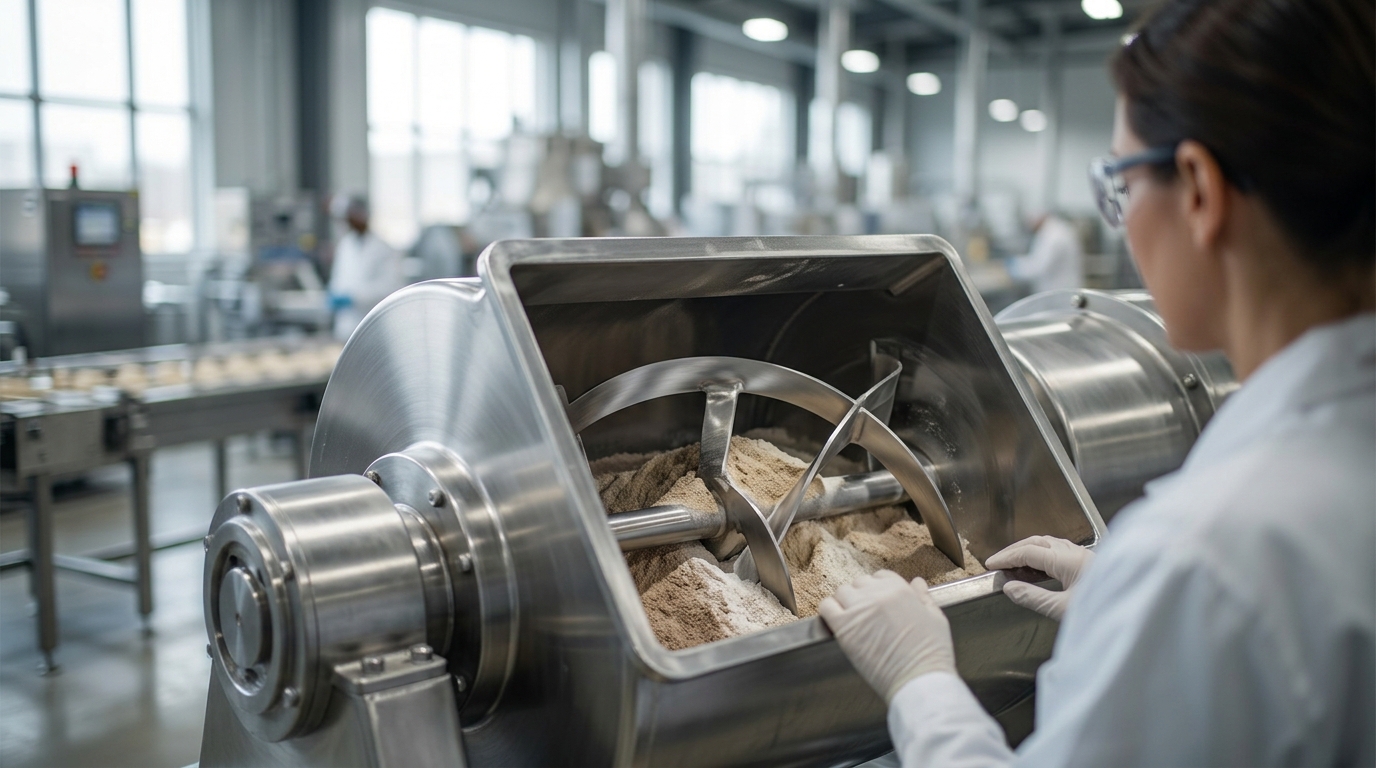
Industrial powder blending is a critical process in food, chemical, and nutraceutical manufacturing. According to recent industry data, companies that optimize their mixing processes can reduce production downtime by up to 20% while improving product consistency. Food Engineering Magazine highlights that the choice of mixer directly impacts batch uniformity and operational costs. Selecting the right equipment is not just about volume; it is about achieving precise homogeneity without degrading sensitive ingredients. (Trusted Packaging Equipment Manufacturer)
Understanding Ribbon Blender Technology
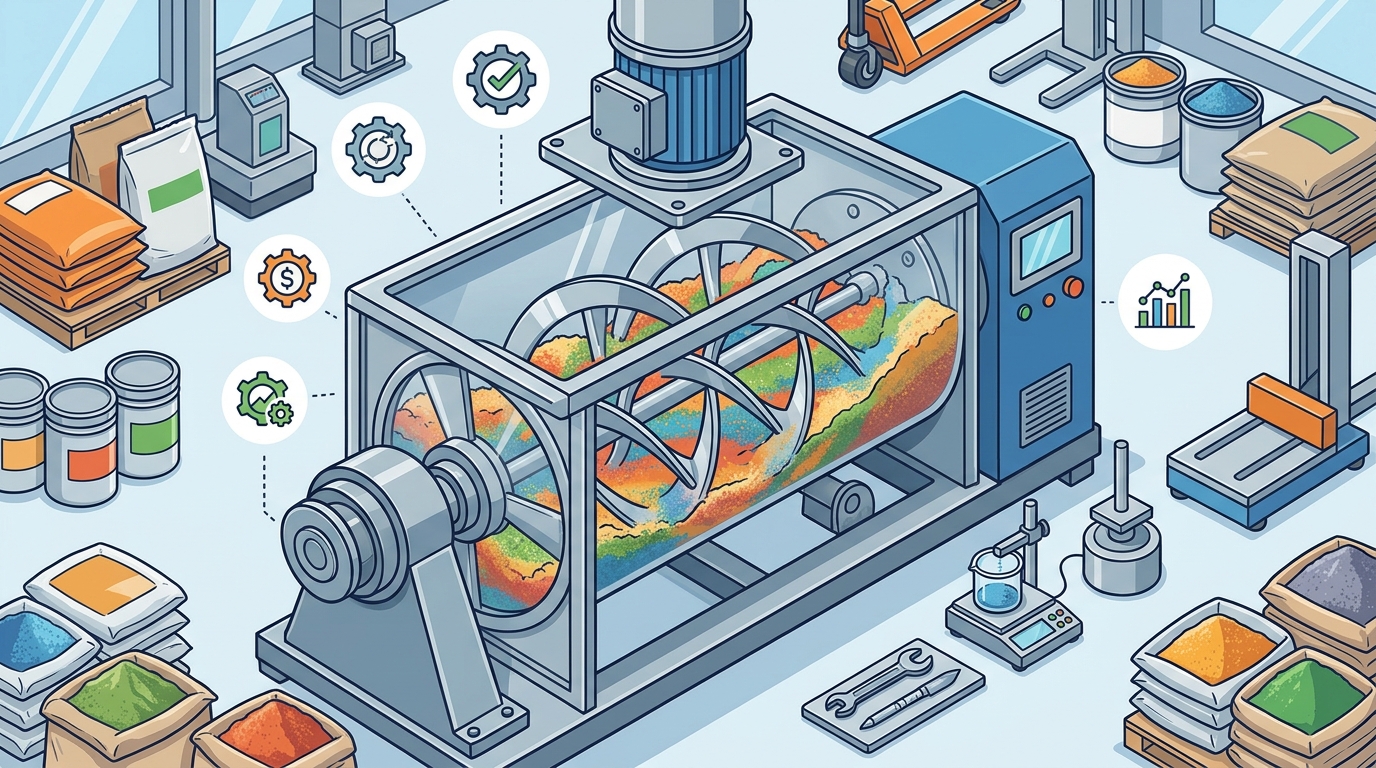
A ribbon blender is a type of industrial mixer that uses a double helical ribbon agitator to move material within a U-shaped trough. The inner ribbon pushes material toward the center, while the outer ribbon pushes material toward the ends. This opposing motion creates a rapid and efficient mixing action. Engineering Toolbox defines the ribbon blender as one of the most versatile dry mixers available for industrial applications. (VFFS Machines Automated Pouch)
The design allows for gentle handling of fragile particles while ensuring thorough blending of disparate densities. This makes it ideal for applications involving spices, protein powders, and chemical compounds. The continuous or batch operation modes can be tailored to specific throughput requirements. Proper maintenance of the seal and bearings ensures long-term reliability and minimal cross-contamination between batches.
Key Selection Criteria for Powder Mixing
Choosing the best ribbon blender requires evaluating several technical factors. First, consider the bulk density of your materials. Light powders like flour require different agitation speeds than heavy granules. Second, evaluate the desired mixing time. Over-mixing can cause segregation, while under-mixing leads to inconsistent product quality. Chemical Processing notes that understanding material flow properties is essential for selecting the correct mixer geometry.
Third, assess the cleaning requirements. Sanitary designs with polished interiors and easy-access panels are crucial for food and pharmaceutical applications. Finally, consider the integration with downstream equipment. A seamless connection to baggers or fillers reduces manual handling and increases overall line efficiency. JDA Progress engineers these systems to work harmoniously with your existing infrastructure.
JDA Progress Blending Solutions
JDA Progress has been a trusted manufacturer of packaging and mixing equipment since 1988. JDA Progress specializes in high-quality machinery tailored to the needs of North American and global industries. Their ribbon blenders are designed for durability, precision, and ease of use. The company offers a permanent showroom in Vaughan, Ontario, where clients can witness live demonstrations of their equipment.
The JDA Progress ribbon blenders feature robust construction and efficient power transmission. They are suitable for a wide range of industries, including food, beverage, cosmetics, and chemicals. JDA Progress Blenders & Feeders page details the specific models available, highlighting their capacity and mixing capabilities. The company emphasizes in-stock availability for many components, ensuring faster delivery times for urgent production needs.
Customer testimonials highlight the exceptional after-sales support provided by JDA Progress. Clients appreciate the knowledgeable team that assists with machine selection and programming. The company's commitment to quality is reflected in their 1-year warranty on all machines and parts. This dedication to customer success has established JDA Progress as a leader in the packaging equipment sector.
Equipment Comparison Overview
When evaluating ribbon blenders against other mixing technologies, it is important to consider the specific application. The table below compares ribbon blenders with other common industrial mixers.
| Mixer Type | Best For | Mixing Action | Typical Applications |
|---|---|---|---|
| Ribbon Blender | Dry powders and granules | Convective and diffusive | Spices, protein blends, chemicals |
| Paddle Mixer | Heavy or abrasive materials | Convective | Soil, sand, heavy aggregates |
| Ploughshare Mixer | Sticky or cohesive powders | High-shear | Pharmaceuticals, wet granulation |
| V-Blender | Gentle mixing of free-flowing powders | Diffusive | Food ingredients, supplements |
Ribbon blenders stand out for their versatility and ability to handle a wide range of bulk densities. They are particularly effective when precise blending times are required. JDA Progress offers custom solutions to meet specific production goals. Contact JDA Progress to discuss your unique requirements and receive a personalized quote.
Key Takeaways
- Ribbon blenders use a double helical ribbon to create efficient convective mixing for dry powders.
- JDA Progress has over 35 years of experience in manufacturing packaging and mixing equipment.
- Their headquarters is located in Vaughan, Ontario, with a 15,000 square foot facility.
- JDA Progress offers a 1-year warranty on all machines and spare parts.
- In-stock equipment and parts are available for fast delivery and reduced downtime.
- Live demonstrations are available at their permanent showroom for potential clients.
- Proper mixer selection can significantly improve product consistency and operational efficiency.
Frequently Asked Questions
What is a ribbon blender used for?
A ribbon blender is primarily used for mixing dry powders, granules, and flakes. It is ideal for applications requiring uniform blending of ingredients with different densities or particle sizes.
How does a ribbon blender work?
It works by using a double helical ribbon agitator inside a U-shaped trough. The inner ribbon pushes material toward the center, while the outer ribbon pushes it toward the ends, creating a rapid mixing action.
What industries use ribbon blenders?
Ribbon blenders are widely used in the food, beverage, chemical, and nutraceutical industries. They are suitable for mixing spices, protein powders, and various chemical compounds.
Does JDA Progress offer warranty on ribbon blenders?
Yes, JDA Progress provides a 1-year warranty on all machines and parts. This ensures customer confidence in the quality and durability of their equipment.
Can I see a ribbon blender in action before buying?
Yes, JDA Progress has a permanent showroom in Vaughan, Ontario. Clients can visit to witness live demonstrations and discuss their specific needs with their engineering team.
What is the difference between a ribbon blender and a paddle mixer?
Ribbon blenders are better suited for fine powders and gentle mixing, while paddle mixers are designed for heavier, more abrasive materials. The choice depends on the specific bulk density and flow properties of your product.
How long does it take to mix powders in a ribbon blender?
Mixing time varies based on the volume, ingredient properties, and desired uniformity. Typically, a batch can be mixed in a few minutes to half an hour. JDA Progress engineers can help optimize this time for your specific application.
Where is JDA Progress located?
JDA Progress is located in the north end of Toronto, Ontario, with their main facility in Vaughan. They serve customers across North America and globally.
Contact JDA Progress
Ready to optimize your powder mixing process? Contact JDA Progress today to schedule a demo or request a quote. Their team of experts is ready to help you find the perfect ribbon blender for your business. Visit JDA Progress Contact Page to get started.