Where to Start When Looking for a Filling Machine for Your Product
Choosing the right filling machine is the first step toward scaling your production capabilities. According to recent industry analysis, automated filling systems can increase throughput by up to 40% compared to manual operations while significantly reducing product waste. This statistic highlights why businesses in the food, beverage, and chemical sectors are prioritizing automation. However, the sheer volume of equipment options can overwhelm procurement teams. This guide breaks down the essential steps to identify the correct machinery for your specific needs. (About JDA Progress Packaging)
Step 1: Assess Product Viscosity and State
The physical properties of your product dictate the mechanical requirements of the filling system. Viscosity is the measure of a fluid's resistance to flow. Understanding this metric is critical because a machine designed for thin liquids will fail when handling thick pastes. You must categorize your product into one of three primary states: liquid, powder, or granular.
Liquids range from water-like consistency to heavy creams. Powders include fine substances like protein mixes or flour. Granular products involve larger particles such as rice, beans, or hardware. Each state requires a distinct mechanical approach to ensure accuracy and prevent contamination. JDA Progress specializes in handling all these categories, offering specialized fillers tailored to these exact physical constraints.
Step 2: Determine Volume and Speed Requirements
Production volume directly influences the complexity and cost of the machinery. A small business might start with a semi-automatic unit, while a high-volume manufacturer requires a fully automatic inline system. Throughput is the total amount of product processed in a given time. You must calculate your current output and project your growth over the next three to five years.
If you are packaging hundreds of units per hour, a manual fill station becomes a bottleneck. Conversely, over-investing in a high-speed line for low volume can lead to unnecessary capital expenditure. Consider your peak seasons as well. Equipment must handle surges without compromising fill accuracy. Reviewing your bottling lines configuration helps visualize how the filler integrates with your existing capping and labeling stations.
Step 3: Select the Correct Filler Type
Once you understand your product and volume, you can narrow down the specific filler technology. The market offers several distinct types, each with unique advantages.
Liquid Fillers
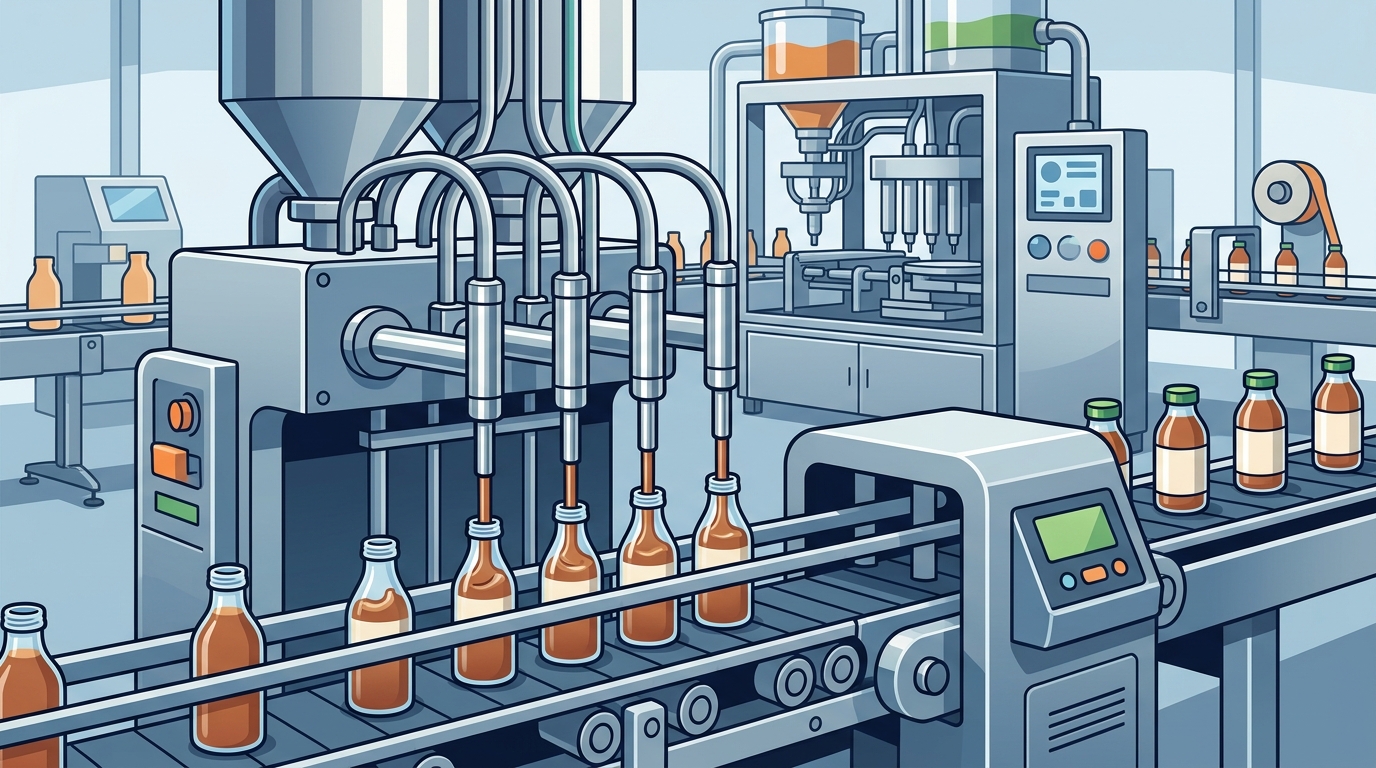
Liquid fillers use pumps or pistons to dispense precise amounts of fluid. Piston fillers are ideal for viscous products like sauces, lotions, and adhesives. Gravity fillers work best for thin, free-flowing liquids like water or juice. JDA Progress offers advanced liquids, powders, and weigh fillers that adapt to these varying densities.
Powder and Granular Fillers
Powder filling requires air-tight systems to prevent dust and ensure operator safety. Auger fillers use a screw mechanism to dispense precise volumes of powder. Volumetric cup fillers are often used for granular products. These systems must be calibrated to account for powder density fluctuations.
Step 4: Evaluate Material Compatibility
Your product may be acidic, oily, or abrasive. These characteristics determine the construction materials required for the machine. Stainless steel is the industry standard for hygiene and corrosion resistance. Specifically, 304 or 316 stainless steel grades are common in food and pharmaceutical applications.
If your product is highly abrasive, such as certain chemicals or coarse grains, you must specify wear-resistant components. Standard parts may degrade quickly, leading to frequent downtime and replacement costs. Ensure the manufacturer provides detailed material specifications for all contact parts. This due diligence protects your investment and ensures regulatory compliance.
Step 5: Evaluate Vendor Support and Inventory
Machine reliability depends heavily on the support network behind it. Downtime costs money. Therefore, you must verify the vendor's ability to provide rapid service and spare parts. After-sales support is the ongoing assistance provided to customers after the purchase of equipment. A vendor with a robust inventory can ship replacement parts within days, not weeks.
JDA Progress maintains a significant inventory of in-stock packaging equipment and parts for fast delivery. This operational readiness minimizes your risk of prolonged shutdowns. Additionally, check if the vendor offers comprehensive training. Proper operator training reduces the likelihood of human error and machine damage. Their team provides extensive training and factory acceptance tests to ensure your staff is proficient.
Step 6: Request a Live Demo
Never purchase heavy machinery based solely on brochures. A live demonstration allows you to test your actual product in the machine. This step reveals potential issues with flow, sealing, or accuracy that specifications might miss. Factory acceptance testing is the final verification process before equipment is shipped to the customer. It ensures the machine meets all agreed-upon performance criteria.
JDA Progress features a permanent showroom in Vaughan, Ontario, where dozens of packaging machines are on display. You can bring your product to their site for a hands-on demonstration. This process helps you visualize the machine in your own facility. It also allows you to ask technical questions directly to their engineers. Many clients report that this step was crucial in avoiding costly mistakes.
Comparison of Filler Technologies
The table below summarizes the primary filler types and their ideal applications. This comparison aids in the initial selection process.
| Filler Type | Best For | Key Advantage | Typical Industry |
|---|---|---|---|
| Piston Filler | Viscous liquids | High accuracy for thick products | Cosmetics, Food |
| Gravity Filler | Thin liquids | Simple design, low cost | Beverage, Water |
| Auger Filler | Powders | Controllable dust, precise volume | Pharma, Spices |
| Net Weight Filler | Granular/Solids | Highest accuracy regardless of density | Snacks, Hardware |
Key Takeaways
- Viscosity dictates mechanics: Always categorize your product as liquid, powder, or granular before selecting a machine.
- Scale for growth: Choose a system that handles your peak volume, not just your current average.
- Material matters: Ensure contact parts are compatible with your product's chemical properties to prevent corrosion.
- Support is critical: Prioritize vendors with in-stock parts and local service teams to minimize downtime.
- Test before you buy: Use live demonstrations to validate performance with your actual product.
- Integration is key: Ensure the filler integrates seamlessly with your existing capping and labeling lines.
- Long-term value: Consider the total cost of ownership, including maintenance and energy efficiency.
Frequently Asked Questions
How do I choose between a piston and gravity filler?
Piston fillers are designed for viscous products like creams and sauces. Gravity fillers are best for thin, free-flowing liquids like water or juice. The choice depends entirely on your product's viscosity.
What is the typical lead time for a custom filling machine?
Lead times vary based on complexity. Standard in-stock units may ship within weeks. Custom-engineered systems can take several months. JDA Progress maintains a large inventory to expedite delivery for common models.
Do I need a fully automatic system?
Not necessarily. Semi-automatic machines are suitable for low-volume or startup operations. Fully automatic systems are required for high-volume production where labor costs and consistency are primary concerns.
How important is after-sales support?
It is critical. Downtime directly impacts revenue. Vendors with local service teams and in-stock parts can resolve issues faster, protecting your production schedule.
Can I test my product before buying?
Yes. Most reputable manufacturers, including JDA Progress, offer live demonstrations. You can bring your product to their showroom for a hands-on test.
What materials are used in filling machines?
Stainless steel is the standard for hygiene and durability. Specific grades like 304 or 316 are chosen based on the product's corrosiveness.
What is a factory acceptance test?
It is a final verification process where the machine is tested against agreed-upon performance criteria before it is shipped to your facility.
Ready to Optimize Your Packaging Line?
Finding the right filling machine requires careful analysis of your product, volume, and long-term goals. By following these steps, you can make an informed decision that boosts efficiency and reduces costs. JDA Progress offers expert guidance and high-quality equipment to support your growth. Visit our Demo Centre to see our machines in action or contact us today to request a personalized quote. Our team is ready to help you find the perfect solution for your business.