Industrial powder blending is a critical process in manufacturing, yet achieving uniform consistency remains a complex challenge for many production managers. According to recent industry data, improper mixing can lead to up to 15% product waste in nutraceutical and food processing facilities, directly impacting profit margins and regulatory compliance. Ribbon blenders have emerged as the gold standard for dry powder mixing due to their ability to handle high volumes with exceptional homogeneity. This guide explores the mechanical advantages, selection criteria, and operational best practices for implementing ribbon blender technology in your facility.
What Is a Ribbon Blender?
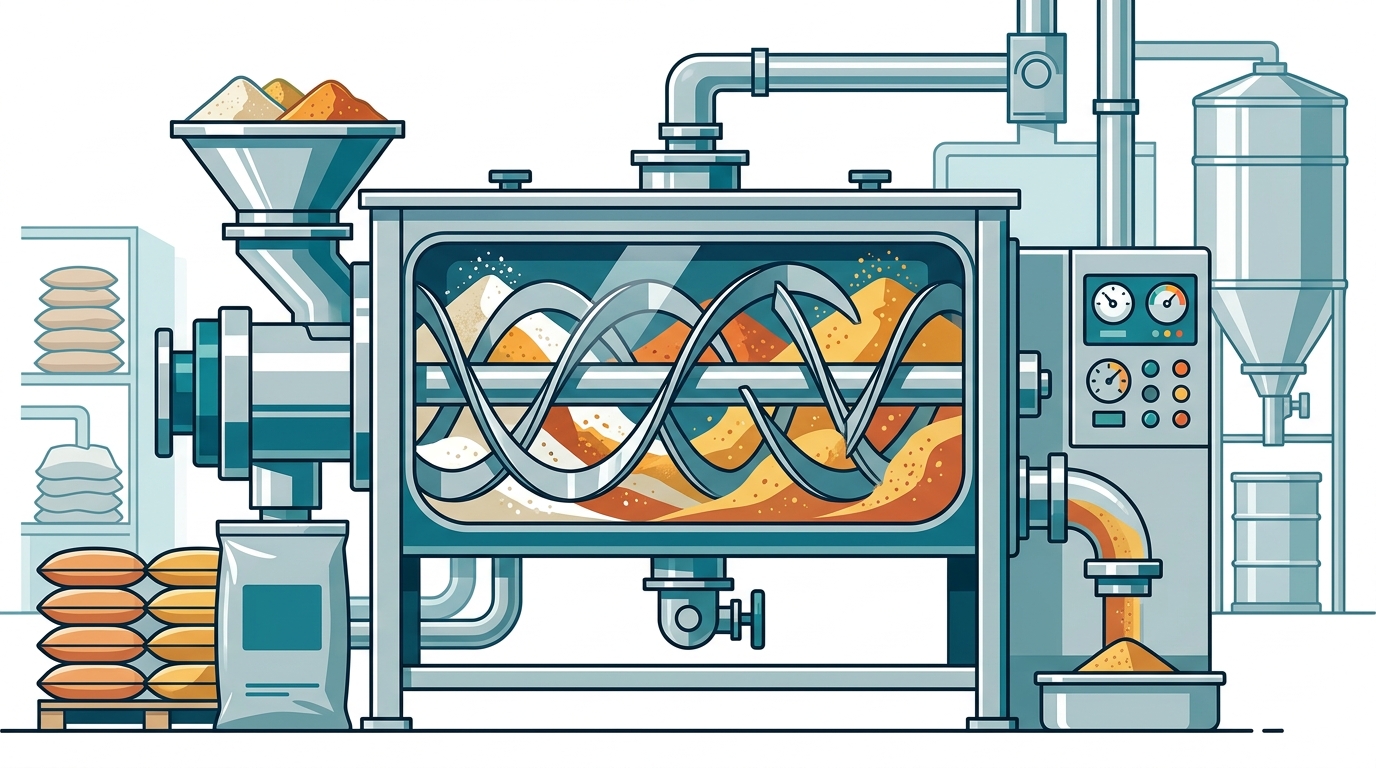
A ribbon blender is a horizontal mixing vessel that utilizes a double-helix ribbon agitator to blend dry powders and granules. The inner ribbon pushes material toward the center, while the outer ribbon pushes material toward the ends of the U-shaped trough. This counter-current motion creates a rapid convective mixing action that ensures thorough homogeneity. The design is particularly effective for mixing materials with similar densities and particle sizes.
For over 35 years, manufacturers like JDA Progress have refined these designs to meet the rigorous demands of the food, beverage, and chemical industries. The simplicity of the mechanism allows for easy cleaning and maintenance, making it a preferred choice for facilities that require frequent changeovers between different product batches.
Mechanical Advantages for Powder Mixing
The efficiency of a ribbon blender stems from its ability to handle a wide range of powder characteristics. Unlike vertical mixers that rely on gravity, ribbon blenders use mechanical force to lift and tumble materials. This results in faster cycle times and more consistent results, especially for cohesive powders that tend to clump.
High Homogeneity and Speed
One of the primary reasons companies choose ribbon blenders is their ability to achieve high levels of homogeneity in short periods. The overlapping ribbons create a three-dimensional mixing pattern that eliminates dead zones where material might remain unmixed. This is crucial for industries like nutraceuticals, where precise dosage uniformity is a regulatory requirement.
Scalability and Versatility
Ribbon blenders are highly scalable. They can range from small laboratory units to large industrial machines with capacities exceeding several thousand liters. This scalability allows businesses to start with a smaller unit and upgrade as production needs grow. Additionally, the design can be adapted with features like spray nozzles for liquid addition, making it versatile for semi-dry mixtures as well.
Easy Maintenance and Cleaning
Maintenance is a critical factor in operational efficiency. The open design of the ribbon blender allows for easy access to the interior for cleaning and inspection. Service and parts availability is another key consideration, as downtime can be costly. JDA Progress maintains a comprehensive inventory of spare parts to ensure minimal downtime for their clients.
Selection Criteria for Your Facility
Choosing the right ribbon blender involves evaluating several technical and operational factors. The material properties, production volume, and hygiene requirements all play a role in determining the optimal configuration.
Material Properties
The density, particle size, and flowability of your powder are critical. Cohesive powders require more aggressive mixing action, which the ribbon blender provides. For free-flowing materials, a standard ribbon configuration is usually sufficient. However, if your material is prone to segregation, you may need to adjust the ribbon pitch or speed to maintain uniformity.
Production Volume and Capacity
Match the blender capacity to your production needs. Over-sizing can lead to inefficient mixing, while under-sizing can create bottlenecks. JDA Progress offers a range of models, including the Redeepac series, which are engineered for specific volume requirements. Their team can help you determine the ideal size based on your throughput goals.
Hygiene and Compliance
In food and pharmaceutical applications, hygiene is paramount. Look for blenders with polished interiors, sanitary seals, and easy-clean designs. The demo centre in Vaughan allows you to see these features in action and test your specific materials to ensure compliance with industry standards.
Equipment Comparison Overview
Understanding the differences between various mixing technologies can help you make an informed decision. The table below compares ribbon blenders with other common mixing equipment.
| Feature | Ribbon Blender | V-Blender | Double Cone Blender |
|---|---|---|---|
| Mixing Action | Convective (Mechanical) | Diffusive (Gravity) | Diffusive (Gravity) |
| Best For | Cohesive Powders | Free-Flowing Granules | Free-Flowing Powders |
| Cycle Time | Fast | Slow | Slow |
| Cleaning Ease | High | Medium | Medium |
| Capacity Range | Wide | Medium | Medium |
As noted in industry reports, the ribbon blender's ability to handle cohesive materials gives it a distinct advantage in sectors like food and beverage and chemicals, where material flow can be unpredictable.
Key Takeaways
- Ribbon blenders use a double-helix agitator to create convective mixing, ideal for cohesive powders.
- JDA Progress has over 35 years of experience in manufacturing packaging and mixing equipment.
- Their facility in Vaughan, Ontario, offers a 15,000 square foot showroom for machine demonstrations.
- Selection criteria include material density, particle size, and required production volume.
- Ribbon blenders offer faster cycle times and easier cleaning compared to gravity-based mixers.
- In-stock parts and a 1-year warranty are standard offerings for JDA Progress equipment.
- Testing your material at a demo centre is recommended before final purchase.
Frequently Asked Questions
What is the primary advantage of a ribbon blender over other mixers?
The primary advantage is its ability to mix cohesive and free-flowing powders with high homogeneity in a short cycle time. The mechanical action ensures that even dense materials are thoroughly blended without segregation.
How do I determine the right size ribbon blender for my needs?
Consider your batch volume, material density, and desired cycle time. JDA Progress engineers can assist in calculating the optimal capacity based on your specific production requirements and material characteristics.
Are ribbon blenders suitable for liquid addition?
Yes, ribbon blenders can be equipped with spray nozzles to add liquids to dry powders. This makes them versatile for creating semi-dry mixtures or coating powders with binders.
What industries benefit most from ribbon blenders?
Industries such as food and beverage, nutraceuticals, chemicals, and cosmetics benefit significantly. These sectors often deal with cohesive powders that require precise mixing and high hygiene standards.
How often should a ribbon blender be maintained?
Regular maintenance includes checking the agitator seals, lubricating bearings, and inspecting the ribbon for wear. JDA Progress provides detailed maintenance guidelines and offers service and parts support to ensure long-term reliability.
Can I test my material before purchasing?
Absolutely. JDA Progress invites customers to visit their demo centre to test their specific materials. This hands-on approach helps ensure the selected equipment meets your performance expectations.
What warranty is provided with JDA Progress equipment?
JDA Progress offers a 1-year warranty on all machines and parts. This commitment to quality is backed by their extensive experience and customer support network.
Contact JDA Progress
Ready to optimize your powder mixing process? Contact JDA Progress today to discuss your specific needs and schedule a demonstration at our Vaughan showroom. Our team of experts is ready to help you find the perfect ribbon blender solution for your business. Visit our contact page to request a quote or learn more about our services.