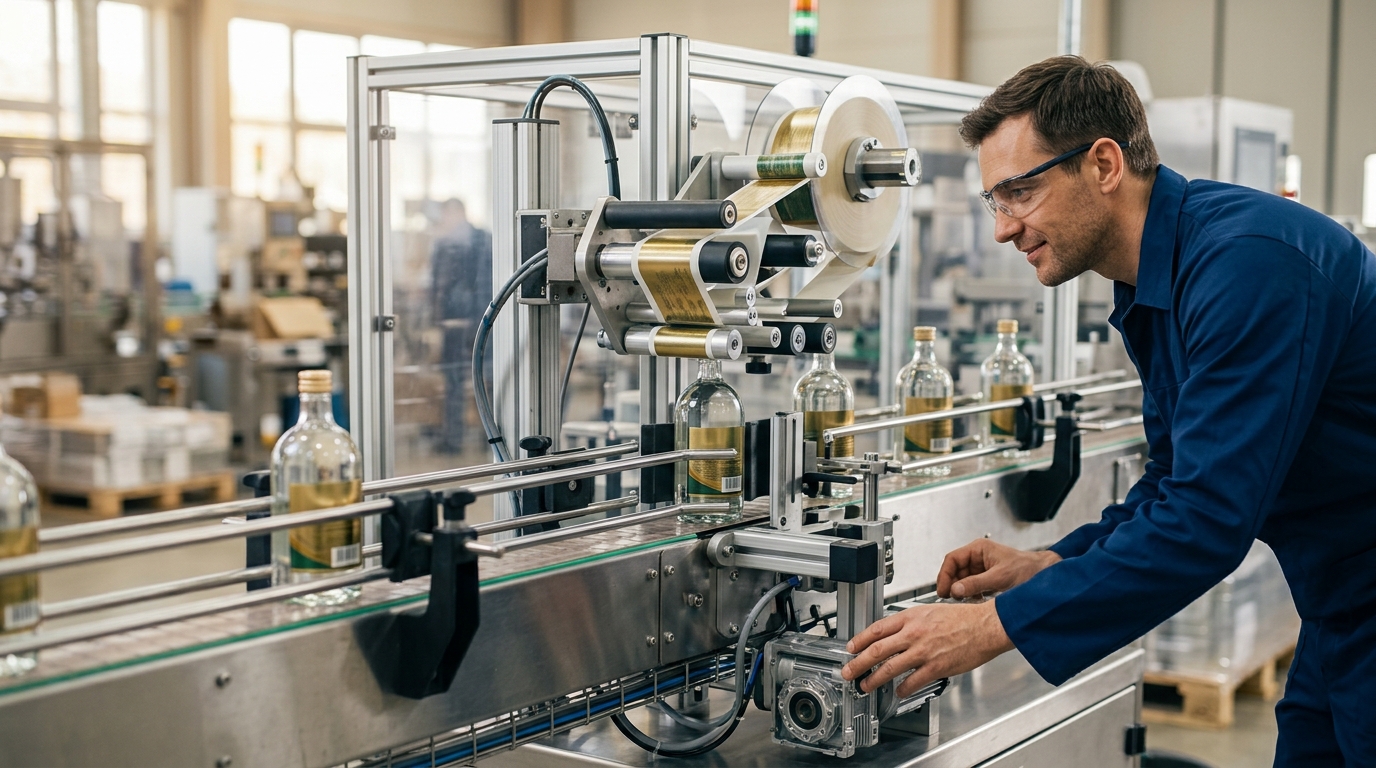
Choosing the right automatic round bottle labeling machine requires matching your container geometry, production speed, and label type to a specific machine architecture. JDA Progress provides specialized labeling equipment designed for cylindrical containers, ensuring precision and efficiency. This guide covers wrap-around mechanics, speed capabilities, diameter compatibility, label options, and conveyor integration.
Wrap Around Labeling
Wrap around labeling is a process where a label is applied to the entire circumference of a cylindrical container. This method ensures complete coverage and a professional appearance, which is critical for brand identity. For round bottles, this technique is the industry standard for primary labeling.
Inline vs. Vertical Orientation
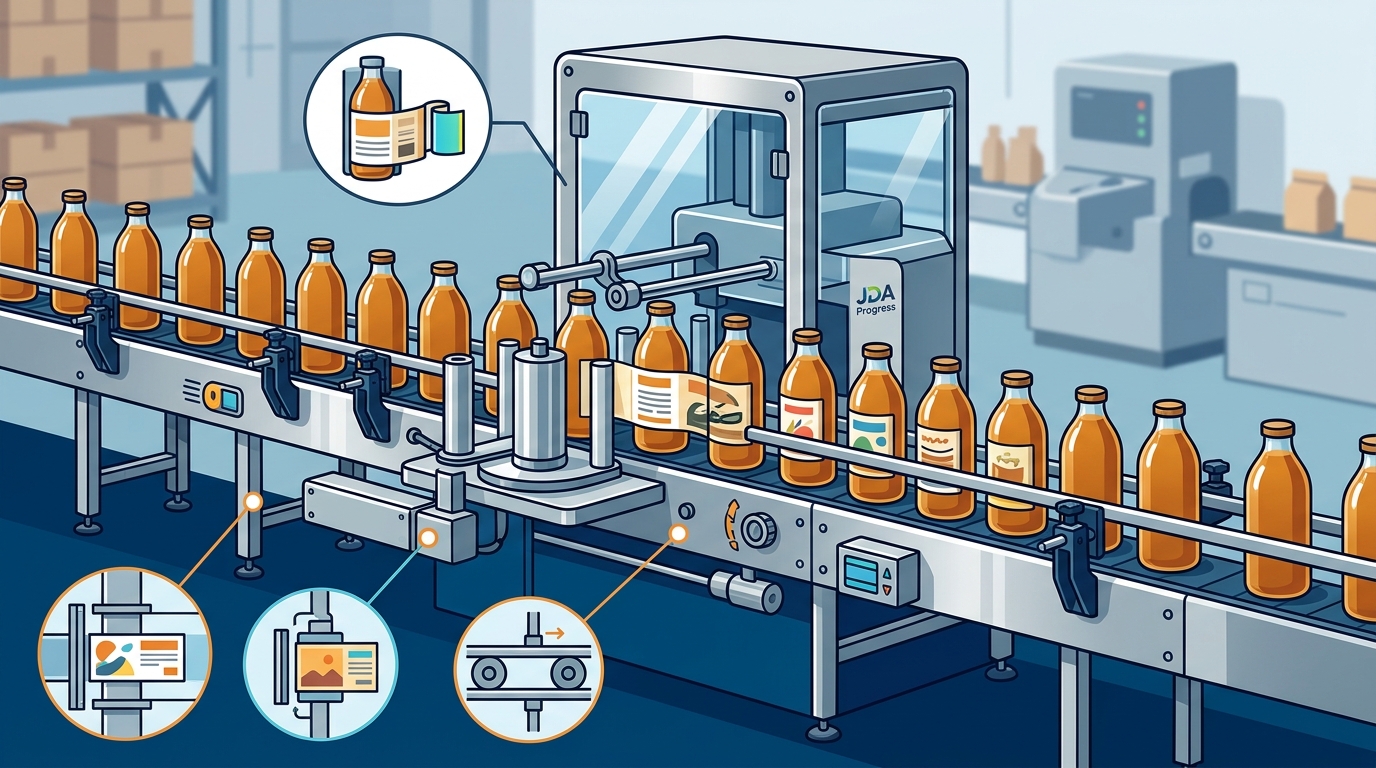
There are two primary orientations for wrap-around labelers: inline and vertical. Inline labelers apply labels as bottles move horizontally along a conveyor. Vertical labelers apply labels to bottles standing upright on a rotating turntable. The choice depends on your production line layout and bottle stability requirements.
JDA Progress offers both configurations to suit different operational needs. The Inline Wrap Around Labeler is ideal for high-speed, continuous production lines. It applies labels seamlessly as products pass through the station. This design minimizes floor space and integrates easily with existing bottling lines.
Alternatively, the Vertical Wrap Around Labeler is a compact, entry-level solution. It is suitable for smaller batches or lines where space is limited. This machine is portable and can be placed on a bench or tabletop. It provides a reliable upgrade from manual labeling without the complexity of a full inline system.
Label Application Precision
Precision is the defining feature of automatic wrap-around labeling. Sensors detect the bottle and trigger the label application at the exact moment. This ensures consistent placement, preventing misaligned labels that can damage brand perception. The machine adjusts to different bottle sizes with minimal downtime.
Production Speed
Production speed is measured in bottles per minute (bpm) and determines the throughput of your labeling station. Selecting a machine with the correct speed rating is essential to avoid bottlenecks in your packaging line. If the labeler is slower than the filler or capper, it will slow down the entire process.
Speed Ranges by Machine Type
Different labeling machines operate at different speed ranges. Entry-level vertical labelers typically run at lower speeds, suitable for small to medium production volumes. High-speed inline labelers can handle significantly higher volumes, making them ideal for large-scale operations.
| Machine Model | Type | Labeling Speed | Best For |
|---|---|---|---|
| JDA-1 | Vertical Wrap Around | 40 bpm | Small batches, entry-level automation |
| WLA-2 | Inline Wrap Around | Up to 60 bpm | Medium to high volume production |
| FBLA-2 | Front and Back | 60 bpm | Two-sided labeling on round bottles |
The Inline Wrap Around Labeler (Model WLA-2) is capable of labeling up to 60 pieces per minute. This speed is suitable for most food and beverage applications. It ensures that your labeling station keeps pace with modern filling and capping equipment.
For businesses transitioning from semi-automatic to fully automatic systems, the speed increase is significant. Manual labeling is often limited to 10-20 bpm. Automatic machines can triple or quadruple this rate, reducing labor costs and increasing output. The consistent speed also improves product quality by reducing human error.
Bottle Diameter Compatibility
Bottle diameter compatibility refers to the range of container sizes a labeling machine can handle. Round bottles vary widely in diameter, from small cosmetic vials to large beverage containers. A flexible labeling machine must accommodate this range without requiring major hardware changes.
Adjustable Labeling Heads
Modern labeling machines feature adjustable labeling heads that adapt to different bottle diameters. These adjustments are typically made via hand cranks or digital controls. The goal is to minimize changeover time when switching between product sizes. Quick changeovers are critical for multi-product facilities.
The Inline Wrap Around Labeler handles product widths from 10 mm to 150 mm. This wide range covers most standard round bottle sizes. The machine uses adjustable settings to accommodate different container shapes and sizes. This flexibility allows you to label multiple SKUs on the same line.
The Vertical Wrap Around Labeler also offers a broad compatibility range. It handles product widths from 10 mm to 150 mm. The compact design makes it easy to adjust for smaller bottles. This machine is a great choice for companies that need to label various container types without investing in multiple machines.
Container Shape Considerations
While this guide focuses on round bottles, it is important to consider container shape. Some round bottles have unique features, such as shoulders or tapered necks. The labeling machine must be able to navigate these features without damaging the label or the bottle. JDA Progress machines are designed to handle a variety of container shapes, including F-Style bottles, oval, and rectangular containers.
Label Type Options
Label type options determine the material and adhesive used for your labels. The most common type for automatic labeling is the pressure-sensitive adhesive label. These labels are easy to apply and provide a strong bond to the container surface. They are available in various materials, including paper, plastic, and foil.
Pressure-Sensitive Adhesive Labels
Pressure-sensitive adhesive labels are the standard for automatic labeling machines. They require no heat or solvent to adhere to the container. The machine applies the label with a specific amount of pressure, ensuring a secure bond. This method is fast, clean, and reliable. It is suitable for a wide range of products, including those that are refrigerated or frozen.
The Inline Wrap Around Labeler is designed for pressure-sensitive labels. It ensures high-quality label adherence with every application. The machine uses a precision labeling head that applies the label smoothly and evenly. This results in a professional finish that enhances brand value.
Label Size and Reel Specifications
Label size and reel specifications are critical for machine compatibility. Most automatic labelers use roll-fed labels. The reel inner diameter is typically 75 mm, and the outer diameter is up to 300 mm. The label length can vary from 10 mm to 425 mm, depending on the machine model. Ensuring your label supplier provides labels that match these specifications is essential for smooth operation.
The Inline Wrap Around Labeler supports label lengths from 10 mm to 425 mm. This wide range allows you to use different label designs for different products. The machine is compatible with standard reel sizes, making it easy to source labels from most suppliers. This flexibility reduces the risk of supply chain disruptions.
Conveyor Systems
Conveyor systems are the backbone of any automatic labeling line. They transport bottles from the filler to the labeler and then to the capper. A well-designed conveyor system ensures a steady flow of products, preventing jams and misalignments. The type of conveyor used depends on the bottle size and production speed.
Inline Conveyor Integration
Inline labelers require a conveyor system to feed bottles into the labeling station. The conveyor must be synchronized with the labeling head to ensure accurate label placement. JDA Progress offers a range of bottle conveyors that are designed to integrate seamlessly with their labeling machines. These conveyors are crafted to meet stringent quality standards, ensuring outstanding productivity while requiring minimal maintenance.
The conveyor system can be tailored to meet specific requirements. For example, flighted inclined conveyors are often used to move bottles between different stations. These conveyors are frequently paired with vertical form-fill-seal machines and premade pouch baggers. They provide a seamless and integrated solution for complex packaging lines.
Conveyor Material and Design
The material and design of the conveyor are important for hygiene and durability. Food-grade conveyors are made from stainless steel and other sanitary materials. They are easy to clean and resistant to corrosion. This is essential for maintaining food safety standards. JDA Progress conveyors are meticulously crafted to ensure outstanding productivity while requiring minimal maintenance.
For businesses that need to transport bottles to automatic filling machines, capping machines, and labeling machines, a reliable conveyor system is essential. The conveyor systems offered by JDA Progress are designed to handle a variety of bottle sizes and shapes. They ensure a smooth flow of production, minimizing bottlenecks and maximizing efficiency.
Key Takeaways
- Wrap around labeling is the standard for round bottles, ensuring complete coverage and a professional appearance.
- Inline labelers are best for high-speed production, while vertical labelers are suitable for smaller batches.
- Production speed should match your filler and capper to avoid bottlenecks in the packaging line.
- Bottle diameter compatibility is critical; look for machines with adjustable labeling heads.
- Pressure-sensitive adhesive labels are the most common and versatile option for automatic labeling.
- Conveyor systems must be synchronized with the labeler to ensure accurate label placement.
- JDA Progress offers a range of labeling machines and conveyors designed for seamless integration.
- Choosing the right machine depends on your production volume, bottle size, and label type.
Frequently Asked Questions
What is the difference between an inline and a vertical labeler?
An inline labeler applies labels as bottles move horizontally along a conveyor. A vertical labeler applies labels to bottles standing upright on a rotating turntable. Inline labelers are typically faster and better suited for high-volume production. Vertical labelers are more compact and suitable for smaller batches.
What is the maximum speed of an automatic round bottle labeling machine?
The maximum speed depends on the machine model. The JDA Progress Inline Wrap Around Labeler (WLA-2) can label up to 60 pieces per minute. The Vertical Wrap Around Labeler (JDA-1) labels at 40 pieces per minute. Higher-speed machines are available for large-scale operations.
Can a labeling machine handle different bottle sizes?
Yes, most automatic labeling machines have adjustable labeling heads that can accommodate different bottle sizes. The JDA Progress machines handle product widths from 10 mm to 150 mm. Changeovers are typically quick and easy, allowing you to label multiple SKUs on the same line.
What type of labels are used in automatic labeling machines?
Pressure-sensitive adhesive labels are the most common type used in automatic labeling machines. They are easy to apply and provide a strong bond to the container surface. They are available in various materials, including paper, plastic, and foil.
Do I need a conveyor system for my labeling machine?
Yes, a conveyor system is essential for automatic labeling. It transports bottles from the filler to the labeler and then to the capper. The conveyor must be synchronized with the labeling head to ensure accurate label placement. JDA Progress offers a range of conveyors that integrate seamlessly with their labeling machines.
How do I choose the right labeling machine for my business?
Consider your production volume, bottle size, and label type. If you have high production volumes, an inline labeler is a good choice. If you have smaller batches, a vertical labeler may be more suitable. JDA Progress can help you choose the right machine for your specific needs.
Conclusion
Selecting the right automatic round bottle labeling machine is a critical decision for your packaging line. By understanding the differences between inline and vertical labelers, production speeds, bottle compatibility, label types, and conveyor systems, you can make an informed choice. JDA Progress provides a range of high-quality labeling machines designed to meet the needs of various industries. Whether you are a small startup or an established business, JDA Progress can help you find the perfect packaging solution. to discuss your requirements and discover the ideal labeling machine for your operation.