
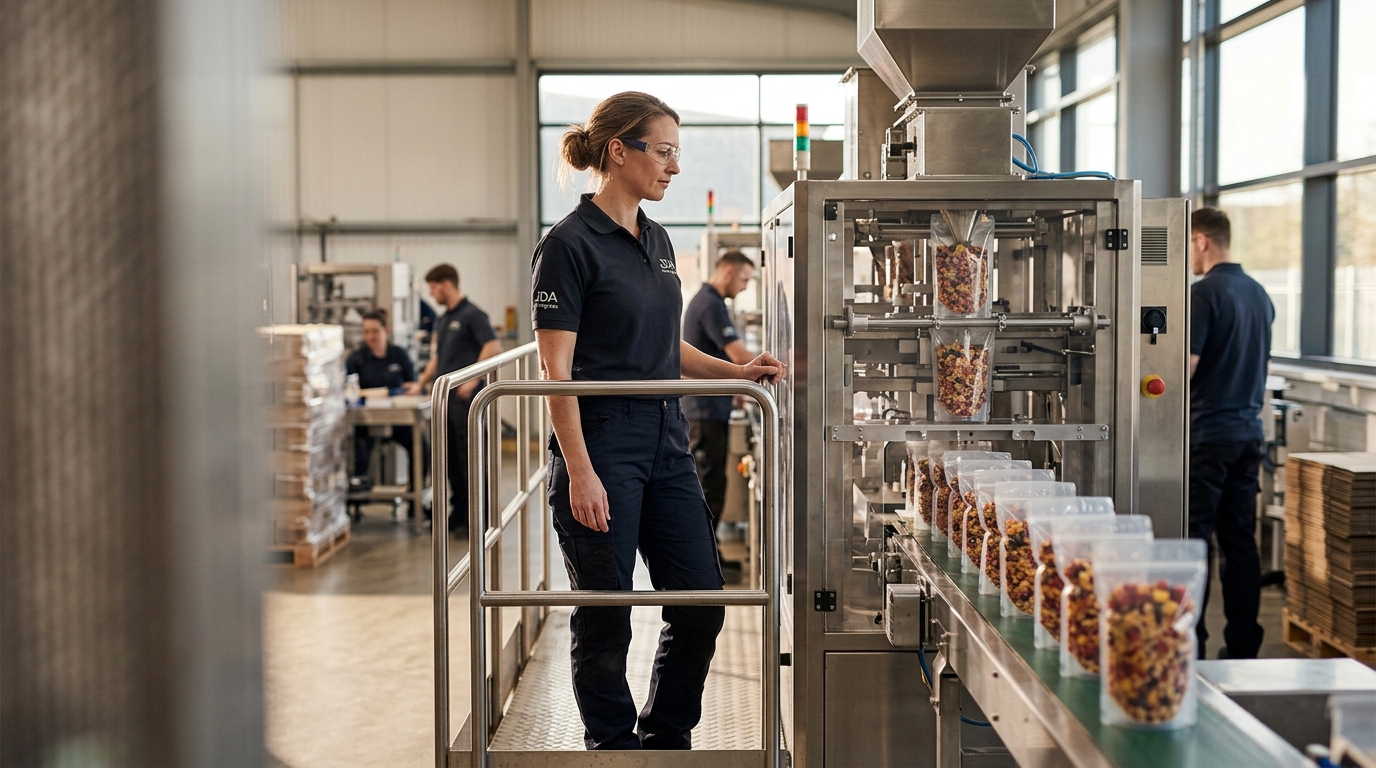
Most manufacturers overestimate the speed required for standup pouch filling. You only need enough throughput to meet your peak demand, not your theoretical maximum. JDA Progress helps operators calculate realistic production targets based on actual order volumes and shift schedules. This prevents unnecessary capital expenditure on high-speed machinery that sits idle most of the time.
Calculating Realistic Throughput Requirements
Production speed is a calculated metric, not a guess. It is derived from your total annual volume divided by available operating hours. For example, if you ship 100,000 units per year and operate two shifts per day for 250 days, you need a machine that handles roughly 200 units per hour. This baseline ensures you cover demand without overpaying for speed you do not use.
Many buyers look at the maximum speed listed in a brochure. This is a mistake. The maximum speed assumes perfect conditions with zero downtime. Real-world lines experience changeovers, cleaning, and minor mechanical adjustments. You should target a machine that runs at 70 to 80 percent of its maximum capacity during peak hours. This buffer absorbs variability without requiring a larger, more expensive unit.
JDA Progress engineers often find that mid-range speeds are sufficient for most small to mid-sized brands. If your peak order is 5,000 units in a single shift, a machine rated for 100 units per minute is more than enough. Buying a 200 units per minute machine for this volume adds cost without adding value. Focus on reliability and accuracy first, then consider speed only if your data supports it.
The Impact of Product Viscosity on Speed
Product viscosity is a critical factor that directly limits filling speed. Thick liquids, such as sauces or creams, require slower nozzle cycles to ensure accurate volume delivery. Thin liquids, like water or alcohol, can be filled much faster because they flow easily through the system. Ignoring this variable leads to inaccurate fills and wasted product.
For standup pouches, the filling mechanism must account for the pouch's flexibility. Unlike rigid bottles, pouches can deform under pressure. This deformation can affect the fill level if the machine runs too fast. A slower, controlled fill ensures the pouch settles properly before the seal is applied. This stability is more important than raw speed for maintaining product quality.
Consider the specific product you are packaging. If you are filling a high-viscosity cosmetic cream, a piston filler running at 30 units per minute may be optimal. If you are filling a thin beverage, a pressure filler might handle 100 units per minute. JDA Progress offers various filler types, including piston and pressure fillers, to match your specific product characteristics. Choosing the right mechanism ensures you achieve the best possible speed for your material.
Changeover Time vs. Continuous Run Speed
Continuous run speed is only one part of the equation. Changeover time is the duration required to switch from one product or size to another. If you run multiple SKUs, frequent changeovers can significantly reduce your effective output. A machine that runs fast but takes 45 minutes to change over may produce less than a slower machine that changes over in 10 minutes.
Modern packaging lines prioritize quick changeover capabilities. This includes tool-less adjustments and digital presets that store settings for different pouch sizes. When evaluating a machine, ask about the average changeover time for your specific product mix. If you run five different pouch sizes, a 15-minute changeover adds 75 minutes of downtime per shift. This downtime must be factored into your speed calculations.
At JDA Progress, we design systems with operator efficiency in mind. Our machines feature intuitive controls that minimize the learning curve for changeovers. This reduces the time operators spend adjusting settings and verifying accuracy. By minimizing changeover time, you can maintain a higher average speed across the entire shift, even when running multiple products.
Scalability and Future Growth Considerations
Buying a machine for your current needs is a common strategy. However, you must also consider future growth. If you expect your sales to double in the next two years, a machine that barely meets your current needs will become a bottleneck. This forces you to buy a new machine sooner, resulting in higher total costs.
Scalability is the ability of a machine to handle increased volume without major modifications. Look for machines that offer modular upgrades or higher capacity options. For instance, a machine that can be upgraded from 50 to 100 units per minute is more flexible than one fixed at 50 units per minute. This flexibility allows you to start with a lower initial investment and expand as your business grows.
JDA Progress provides solutions that can scale with your operation. We offer a range of bagging and filling machines that can be configured for different throughput levels. By planning for future growth, you avoid the disruption and expense of replacing your entire line. A slightly faster machine now can save you significant capital expenditure in the future.
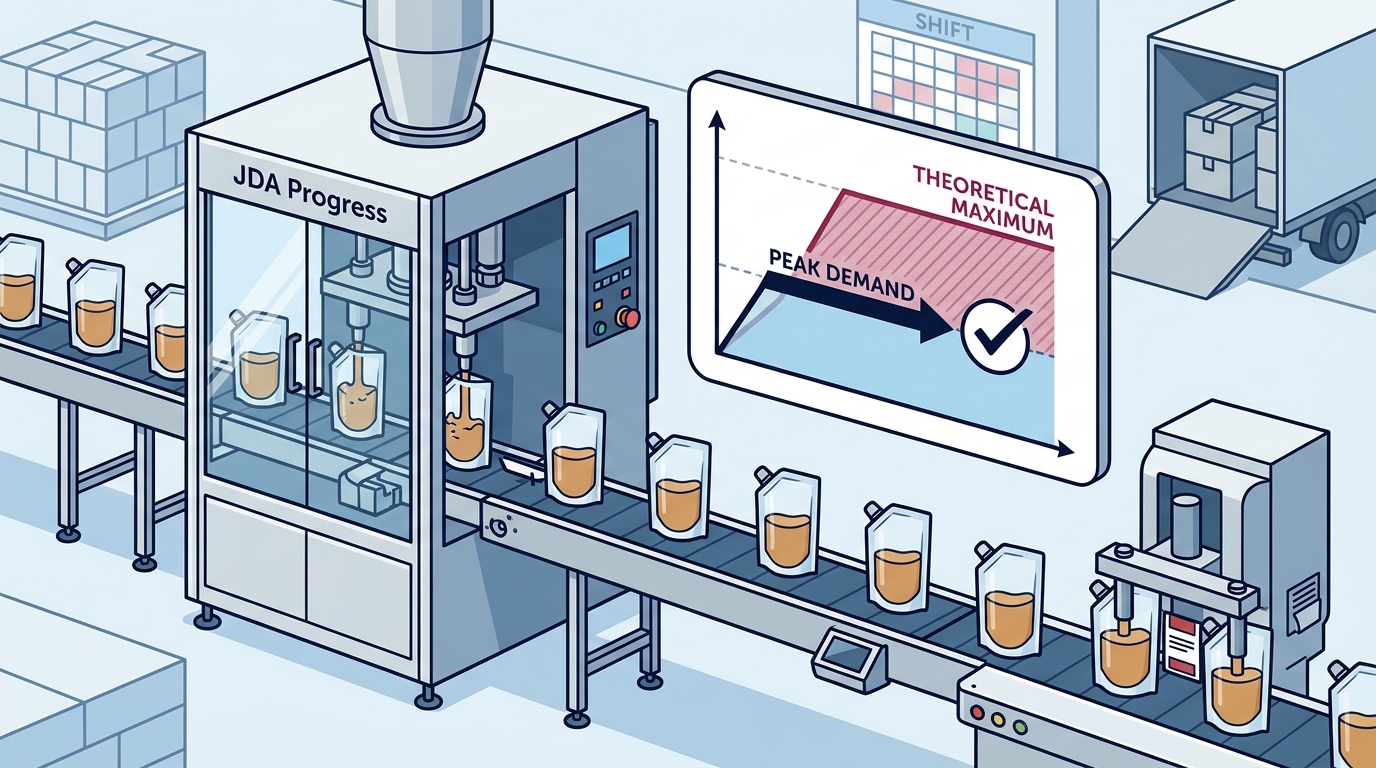
Key Takeaways
- Calculate speed based on peak demand, not theoretical maximums.
- Target 70 to 80 percent of maximum capacity to allow for downtime.
- Product viscosity directly impacts the achievable filling speed.
- Changeover time is as important as continuous run speed.
- Consider scalability to avoid bottlenecks as your business grows.
- Reliability and accuracy are more critical than raw speed for most brands.
Frequently Asked Questions
What is the average speed for a standup pouch filler?
The average speed varies by product and machine type. Most standard fillers run between 30 and 100 units per minute. High-speed lines can exceed 200 units per minute, but these are typically for large-scale operations.
How does pouch size affect filling speed?
Larger pouches generally take longer to fill and seal. The filling time increases with volume, and the sealing process requires more time for larger surface areas. This reduces the overall cycle time compared to smaller pouches.
Can I upgrade my filler to run faster later?
What is the difference between piston and pressure fillers?
Piston fillers use a mechanical piston to dispense product, making them ideal for viscous liquids. Pressure fillers use gravity or pressure to fill, which is better for thin liquids. The choice depends on your product's viscosity.
How much downtime should I expect in a day?
Expect 10 to 20 percent downtime for cleaning, changeovers, and maintenance. This varies by operation, but it is a standard factor in production planning. Always build this buffer into your speed calculations.
Conclusion
Determining the right speed for your standup pouch filler requires a data-driven approach. Focus on your actual production needs, product characteristics, and future growth plans. JDA Progress provides the expertise and equipment to help you find the perfect balance between speed and efficiency. to discuss your specific requirements and find the right solution for your line.