
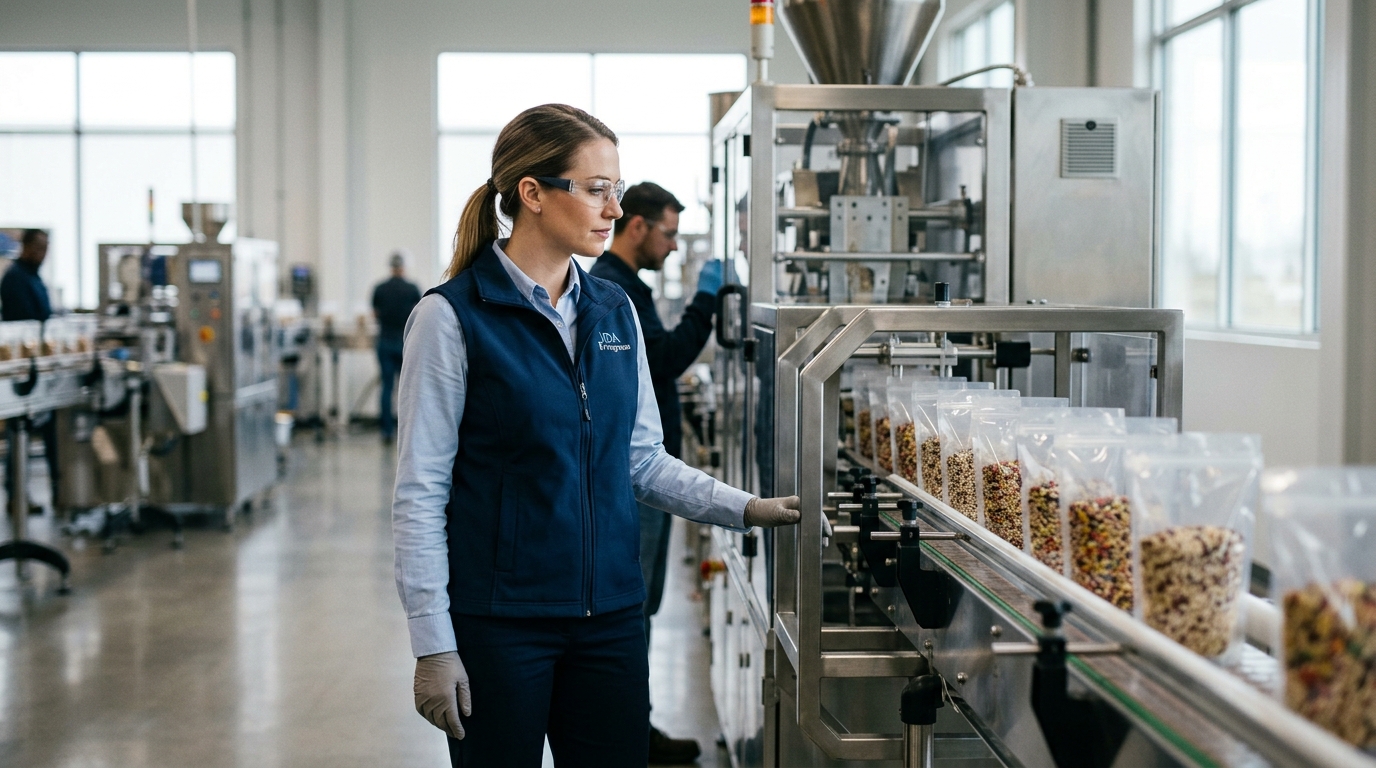
Throughput speed is the number of pouches a machine can fill and seal per minute. It directly impacts your production capacity and labor costs. JDA Progress helps manufacturers match their specific output needs to the right equipment.
1. Semi-Automatic Benchtop Fillers
Best for: 10 to 30 pouches per minute.
Semi-automatic systems are ideal for small batches or startups. The operator places the pouch, triggers the fill, and removes it. This method offers high flexibility for changing products but requires manual labor for every unit.
2. Single-Head Volumetric Fillers
Best for: 30 to 60 pouches per minute.
These machines use a single pump or auger to dose product. They are a step up from benchtop units because the machine handles the filling action automatically. Operators still need to load and unload pouches, but the process is faster and more consistent.
3. Multi-Head Volumetric Fillers
Best for: 60 to 120 pouches per minute.
Multi-head systems use two or more fill heads working in parallel. This setup doubles or triples the output of a single-head machine. It is a popular choice for mid-sized operations that need to scale without a full conveyor line.
4. Inline Premade Pouch Baggers
Best for: 120 to 200 pouches per minute.
Inline baggers integrate filling and sealing into a continuous flow. Pouches move along a conveyor, are filled, and are sealed in one pass. This automation significantly reduces manual handling and increases overall line efficiency.
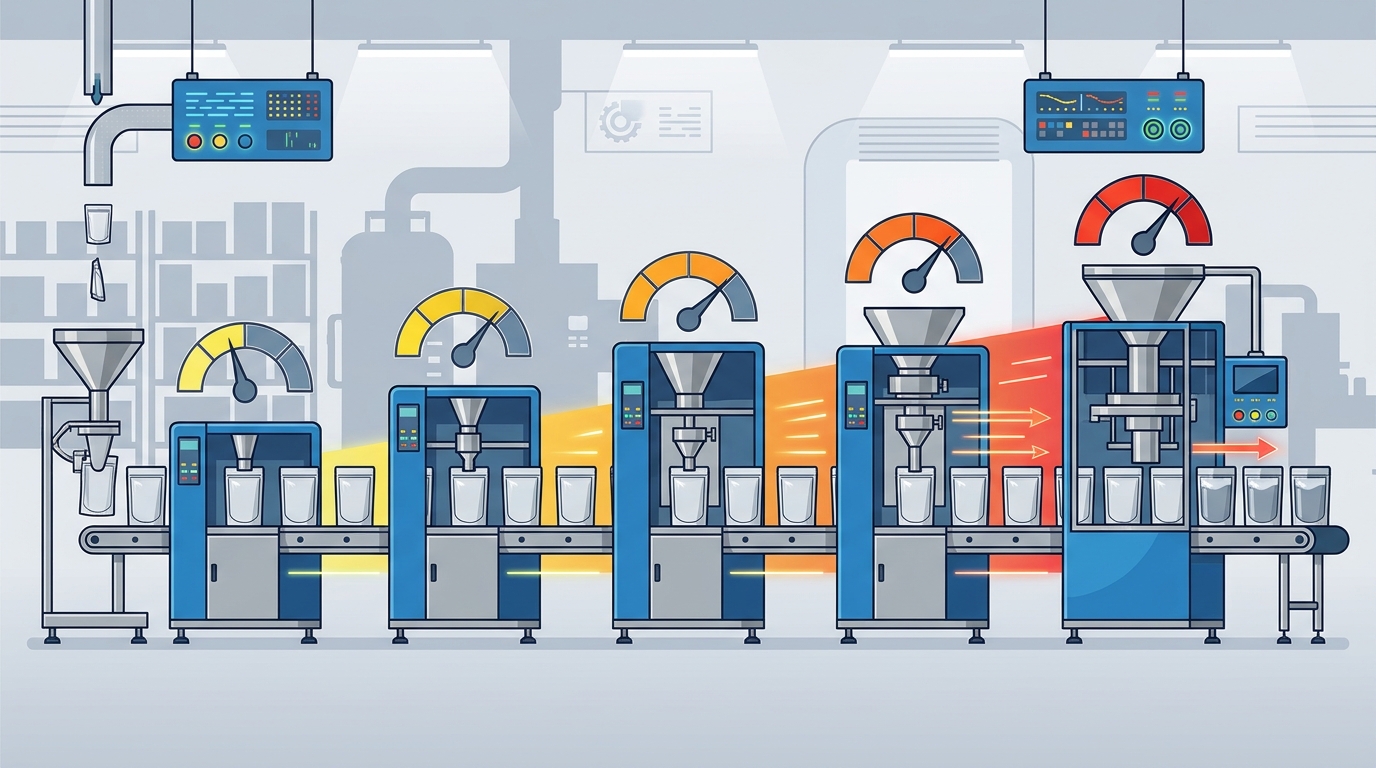
5. High-Speed Inline Baggers
Best for: 200 to 300 pouches per minute.
These systems are designed for high-volume production environments. They feature advanced synchronization between the filling, sealing, and conveying mechanisms. This speed is suitable for established brands with large distribution networks.
6. Vertical Form Fill Seal (VFFS) Systems
Best for: 300 to 500 pouches per minute.
VFFS machines form the pouch from a roll of film, fill it, and seal it. This eliminates the need for pre-made pouches, reducing material costs. It is the fastest option for flexible packaging and is ideal for very high throughput.
7. Multi-Lane VFFS Configurations
Best for: 500+ pouches per minute.
Multi-lane systems run multiple VFFS heads side-by-side. This configuration allows for massive output while maintaining product integrity. It is the peak of flexible packaging automation for large-scale manufacturers.
Choosing the Right Speed for Your Line
Select a machine that matches your current volume with room for growth. If you are unsure, start with a semi-automatic or single-head system. You can upgrade to inline or VFFS systems as your demand increases. JDA Progress offers a range of options to fit your specific production goals.
Frequently Asked Questions
What is the average speed of a premade pouch filler?
The average speed depends on the machine type. Semi-automatic fillers run at 10 to 30 pouches per minute, while inline baggers can reach 200 to 300 pouches per minute.
Can I change products on a high-speed filler?
Yes, but changeover time varies. High-speed machines often require more time to adjust settings and clean the system. Semi-automatic machines are faster to change over but have lower throughput.
What is the difference between a bagger and a filler?
A filler doses product into a container. A bagger typically includes filling and sealing functions. A VFFS machine forms the bag, fills it, and seals it in one process.
How does pouch size affect throughput speed?
Larger pouches generally take longer to fill and seal. This can reduce the maximum speed of the machine. Smaller pouches allow for faster cycle times and higher output.
Do I need a conveyor for a premade pouch filler?
Inline baggers require a conveyor to move pouches through the filling and sealing stations. Semi-automatic and single-head fillers do not require a conveyor, as the operator handles the pouches manually.
Where can I see these machines in action?
You can visit the JDA Progress Test and Demo Centre to see various packaging machines operating with your own products.