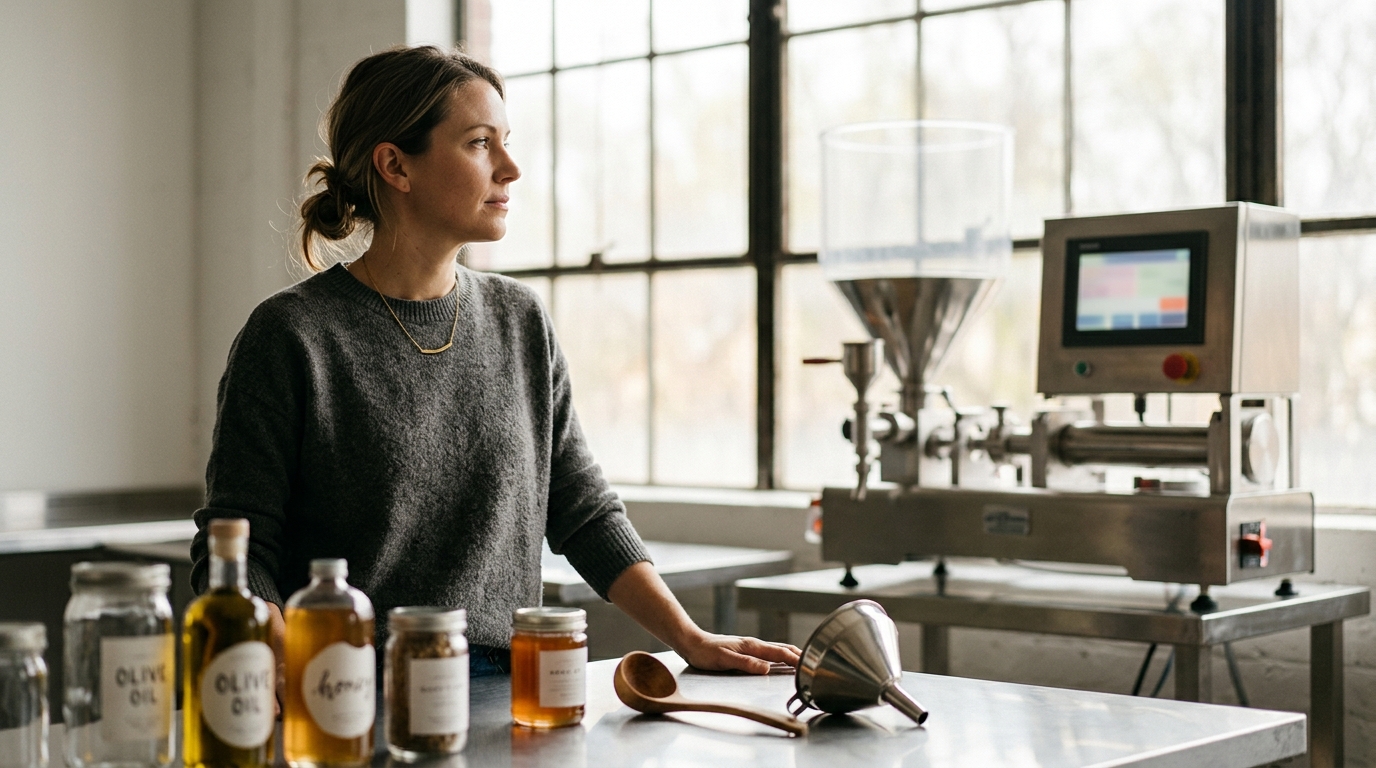
You have a product that needs to go into bottles, jars, pouches, or tubs — and you know hand-filling is no longer sustainable. The next logical step is a filling machine, but the sheer number of options can feel overwhelming. This guide walks you through a proven, step-by-step process so you can confidently narrow down the right filling machine for your exact product, container, and production goals.
Step 1: Profile Your Product First
Before you look at a single machine spec sheet, you need to understand what you are filling. The characteristics of your product are the single biggest factor in determining the correct filling technology.
Viscosity Is the Starting Point
Viscosity — how thick or thin your product flows — is the most important variable. A water-like juice behaves completely differently from a heavy cream or peanut butter.
- Low viscosity (water-thin): water, vinegar, rubbing alcohol, light oils
- Medium viscosity: syrups, shampoos, liquid soaps, light sauces
- High viscosity: pastes, creams, honey, tomato sauce, peanut butter
As a rule, thin free-flowing products may need nothing more than gravity to achieve a consistent fill, while thicker products usually require mechanical assistance from a piston or pump mechanism.
Particulates and Special Properties
Does your product contain chunks, seeds, beads, or suspended solids? Some free-flowing dressings or sauces include grains, spices, or vegetable pieces that can block nozzles on gravity or overflow machines. In those cases, a piston filler may be needed to move both the liquid and the particulates reliably.
Also consider whether your product is foamy, shear-sensitive, corrosive, or requires a sterile environment. Each of these properties influences which filling principle — and which materials of construction — are appropriate.
Step 2: Define Your Container
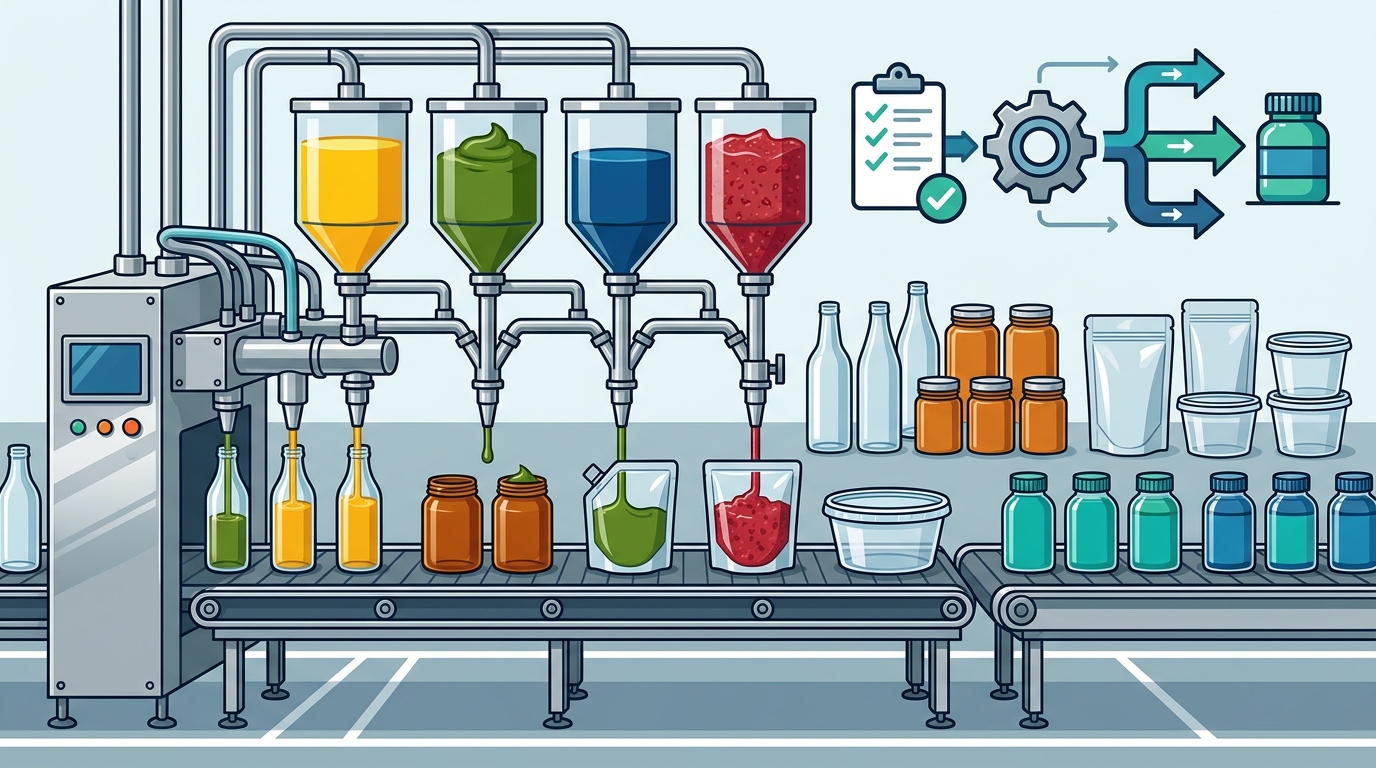
The container you are filling is the second major decision driver. Bottles, jars, pouches, cans, tubes, drums, and vials all have different filling requirements.
Key Container Variables
- Shape and opening: Narrow-neck bottles require precision nozzles (lance or funnel types). Wide-mouth jars accommodate overflow, gravity, or piston nozzles easily.
- Material: Glass demands gentle handling to avoid breakage; flexible pouches require specialised filling heads; PET bottles may deform under certain pressures.
- Size range: Know your minimum and maximum container volumes. Machines with quick-change tooling can switch between sizes with minimal downtime.
If your container is transparent, visual fill-level consistency matters to consumers. Overflow fillers are specifically designed to ensure every container is filled to the same visual level, making them ideal for clear bottles where appearance is critical.
Step 3: Match the Filling Technology to Your Product
With your product profile and container information in hand, you can now narrow down the filling method. Here are the four most common types of filling machines used across food, beverage, cosmetic, pharmaceutical, and chemical industries.
Gravity Fillers
Gravity fillers use a raised tank and timed valve openings to let product flow into containers by its own weight. They are simple, cost-effective, and well-suited for free-flowing, low-viscosity liquids such as water, juice, and cooking oils. They are often recommended as an entry-level solution for cost-conscious manufacturers.
Overflow Fillers
Overflow fillers use a two-part nozzle system: product is pumped in until it reaches a target level, and any excess flows back to the supply tank. This guarantees every bottle is filled to the same height — perfect for transparent packaging. They handle thin to moderately viscous liquids but are not ideal for very thick products or extremely large containers.
Piston Fillers
Piston fillers use a piston-cylinder mechanism to draw product in and dispense it with high accuracy. They are the go-to choice for thick, viscous products such as sauces, pastes, creams, and condiments. They can also handle thinner liquids, making them one of the most versatile filling technologies available.
Pump Fillers
Pump fillers use gear, peristaltic, or diaphragm pumps to move product into containers. They are extremely flexible and well-suited for liquids with varying viscosities and particulates. Industries from chemicals and personal care to food and beverage use pump fillers for products like detergents, chunky soups, and syrups.
| Product Type | Example Products | Best-Fit Filler |
|---|---|---|
| Thin, free-flowing liquid | Water, juice, vinegar | Gravity or Overflow |
| Medium-viscosity liquid | Shampoo, syrup, light sauce | Overflow or Pump |
| Thick paste or cream | Peanut butter, tomato paste, lotion | Piston or Pump |
| Liquid with particulates | Salsa, chunky soup, scrub with beads | Piston or Pump |
| Dry powder or granule | Spices, protein powder, flour | Auger or Weigh Filler |
Step 4: Choose Your Automation Level
Filling machines come in three tiers of automation, and the right level depends on your current throughput, budget, and growth plans.
Manual Machines
Operated by hand with foot pedals or simple controls. Suitable for very small batches and start-up operations with low initial investment.
Semi-Automatic Machines
An operator places containers and initiates the fill cycle, but dosing is automated. These offer a practical balance between flexibility and output — ideal for small-to-medium businesses that need consistency without a massive capital outlay.
Fully Automatic Machines
Containers are fed, filled, and discharged with no manual intervention. Fully automatic systems provide high speed, consistent performance, and reduced labour for large-scale production. They can fill 100 or more containers per minute, but they come with a higher upfront cost and require more floor space.
Pro tip: Many growing manufacturers start with semi-automatic equipment and upgrade to fully automatic lines as volume increases. Look for modular machine designs that allow for easy upgrades so your investment stays future-proof.
Step 5: Think About Accuracy — Volume vs. Weight
How your machine measures each dose matters for both regulatory compliance and cost control.
- Volumetric (volume-based) filling: Faster and widely used for most liquid products. The machine dispenses a set volume per cycle.
- Gravimetric (weight-based) filling: Offers higher precision and is preferred for high-value or regulated products where exact net weight is critical.
Choosing the right accuracy method helps reduce overfilling, minimise waste, and improve overall efficiency across every production run.
Step 6: Consider Hygiene, Compliance, and Cleaning
For food, pharmaceutical, or cosmetic products, hygiene standards are non-negotiable. Your filling machine should be constructed with food-grade or pharmaceutical-grade stainless steel and meet relevant safety standards for your market.
CIP and SIP Systems
Clean-in-Place (CIP) and Sterilise-in-Place (SIP) systems allow you to flush and sanitise internal product pathways without disassembling the machine. This saves significant time if you run multiple products on the same line.
If you frequently switch between different formulations, also evaluate how easily the machine's contact parts can be removed, cleaned, and reassembled. Peristaltic pump fillers, for example, allow quick tubing swaps between batches, while piston fillers may need more thorough disassembly.
Step 7: Plan for Line Integration and Floor Space
A filling machine rarely operates in isolation. It needs to work smoothly with conveyors, cappers, labelers, sealers, and other downstream equipment.
- Check compatibility with your existing (or planned) capping and labeling systems.
- Consider whether you need a standalone machine or a fully integrated turnkey bottling line.
- Measure your available floor space — filling machines and their surrounding conveyors can be bulky.
JDA Progress, for example, manufactures not just fillers but also cappers, labelers, conveyors, sealers, and complete bottling lines — making it straightforward to build a cohesive packaging line from a single source.
Step 8: Evaluate Total Cost of Ownership
The purchase price is only one part of the equation. A smart decision considers total cost of ownership (TCO) over the machine's projected lifespan — typically seven to ten years.
TCO Factors to Calculate
- Purchase price and financing
- Installation, commissioning, and operator training
- Ongoing maintenance and spare parts
- Energy consumption
- Labour costs per unit produced
- Downtime costs from breakdowns or slow changeovers
A slightly higher-priced machine with reliable components, superior engineering, and built-in support can save thousands in maintenance, downtime, and inefficiency over its lifetime.
Step 9: Request Demos and Run Pilot Tests
Never commit to a filling machine without seeing it run your actual product. Before a final purchase, arrange to test your product and containers on the shortlisted machine at the vendor's facility. Observe fill accuracy, speed, changeover ease, and cleaning procedures first-hand.
JDA Progress operates a dedicated test and demo centre in Vaughan, Ontario, where dozens of packaging machines are on display. Their engineering team can run your product samples through different filler configurations so you see real-world performance before you invest.
Common Mistakes to Avoid
- Buying on price alone. A lower price often means compromises in build quality, performance, or durability that cost more long-term.
- Ignoring product characteristics. Not accounting for viscosity, particulates, or foaming leads to poor fill accuracy and operational headaches.
- Overlooking future scalability. Selecting a machine that only meets today's volume can force a costly replacement when demand grows.
- Skipping pilot testing. Failing to test with your real product increases the risk of buying the wrong machine entirely.
- Forgetting about after-sales support. Spare parts availability, technical service, and training are critical to keeping your line running.
Key Takeaways
- Always start with your product's viscosity, particulate content, and special properties — these determine the filling method.
- Container shape, material, and opening size are the second filter for machine selection.
- Match filling technology (gravity, overflow, piston, pump, auger) to your specific product-container combination.
- Choose an automation level that fits your current volume but allows room for growth.
- Factor in total cost of ownership, not just the sticker price.
- Always pilot-test with your real product before purchasing.
- Work with a manufacturer who offers demos, integration support, and after-sales service.
Frequently Asked Questions
What is the most important factor when choosing a filling machine?
Product viscosity is the single most important characteristic. Thin, free-flowing liquids work well with gravity or overflow fillers, while thick pastes and creams require piston or pump fillers for accurate dispensing.
Can one filling machine handle multiple products?
Many modern filling machines are designed with quick-change tooling and adjustable settings to handle a range of products and container sizes. However, switching between very different viscosities (e.g., water and peanut butter) may still require different filler types.
Should I start with a semi-automatic or fully automatic machine?
For small-to-medium production volumes, a semi-automatic machine offers a good balance of precision and affordability. Many manufacturers start semi-automatic and upgrade to fully automatic systems as production demand grows.
How do I know if a machine will work with my product?
Request a pilot test. Reputable equipment suppliers will let you run your actual product and containers on the machine at their facility before you commit to a purchase.
What is total cost of ownership and why does it matter?
Total cost of ownership includes the purchase price plus all ongoing costs — maintenance, spare parts, energy, labour, and downtime — over the machine's lifespan (typically 7–10 years). A cheaper machine that breaks down frequently can cost far more than a higher-quality unit over time.
Does JDA Progress offer filling machine demos?
Yes. JDA Progress operates a test and demo centre in Vaughan, Ontario, with dozens of packaging machines on display. You can bring your product samples and work directly with their engineers to evaluate different filling solutions.