
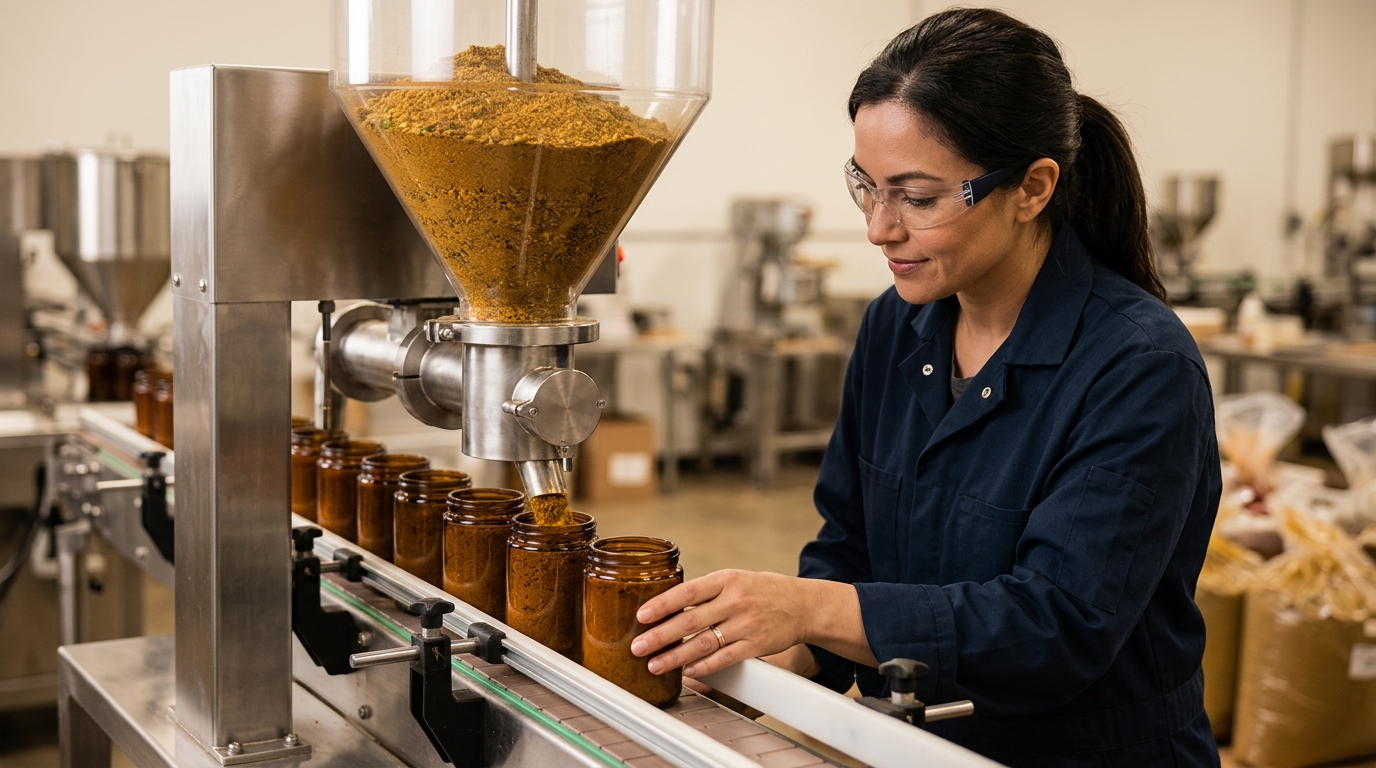
Choosing the right filling machine for spices requires balancing product flowability with container geometry. An auger filler is the standard solution for free-flowing and semi-free-flowing powders, ensuring precise volumetric or gravimetric dosing. This guide covers how to evaluate spice flowability and select the appropriate filling technology for pouches and bottles. For additional details, review the Contact Us JDA Progress.
Auger Filler Machines
An auger filler is a volumetric or gravimetric dosing device that uses a rotating screw to meter product into containers. For spice manufacturers, this technology is preferred because it handles granular and powdered materials with high consistency. The screw rotates at a controlled speed, pushing the product into the filling head and then into the container below. For additional details, review the Service and Parts JDA.
How Auger Fillers Work
The core mechanism involves a motor-driven screw housed within a tube. As the screw rotates, it conveys the spice from the hopper to the discharge point. The volume of product dispensed is determined by the number of screw rotations and the pitch of the screw flights. This linear relationship allows for precise control over fill weight, provided the product density remains stable.
Modern auger fillers often include load cells or optical sensors to monitor the fill process in real-time. This feedback loop adjusts the screw speed or cut-off point to compensate for minor variations in product density. For bottling lines, the filler is typically mounted on a conveyor or a rotary platform, allowing for high-speed, continuous operation.
Auger vs. Piston Fillers for Spices
While piston fillers are excellent for liquids and viscous pastes, they are generally unsuitable for dry spices. Piston fillers rely on pressure to move product, which can cause clumping or inconsistent flow in powders. Auger fillers, by contrast, use mechanical displacement, making them the industry standard for dry goods like spices, flours, and granules.
| Feature | Auger Filler | Piston Filler |
|---|---|---|
| Product Type | Powders, Granules, Spices | Liquids, Viscous Pastes |
| Dosing Method | Volumetric/Gravimetric Screw | Pressure-Driven Piston |
| Flowability Requirement | Free or Semi-Free Flowing | Fluid or Semi-Fluid |
| Best For | Spices, Flours, Powders | Sauces, Oils, Creams |
Spice Flowability Testing
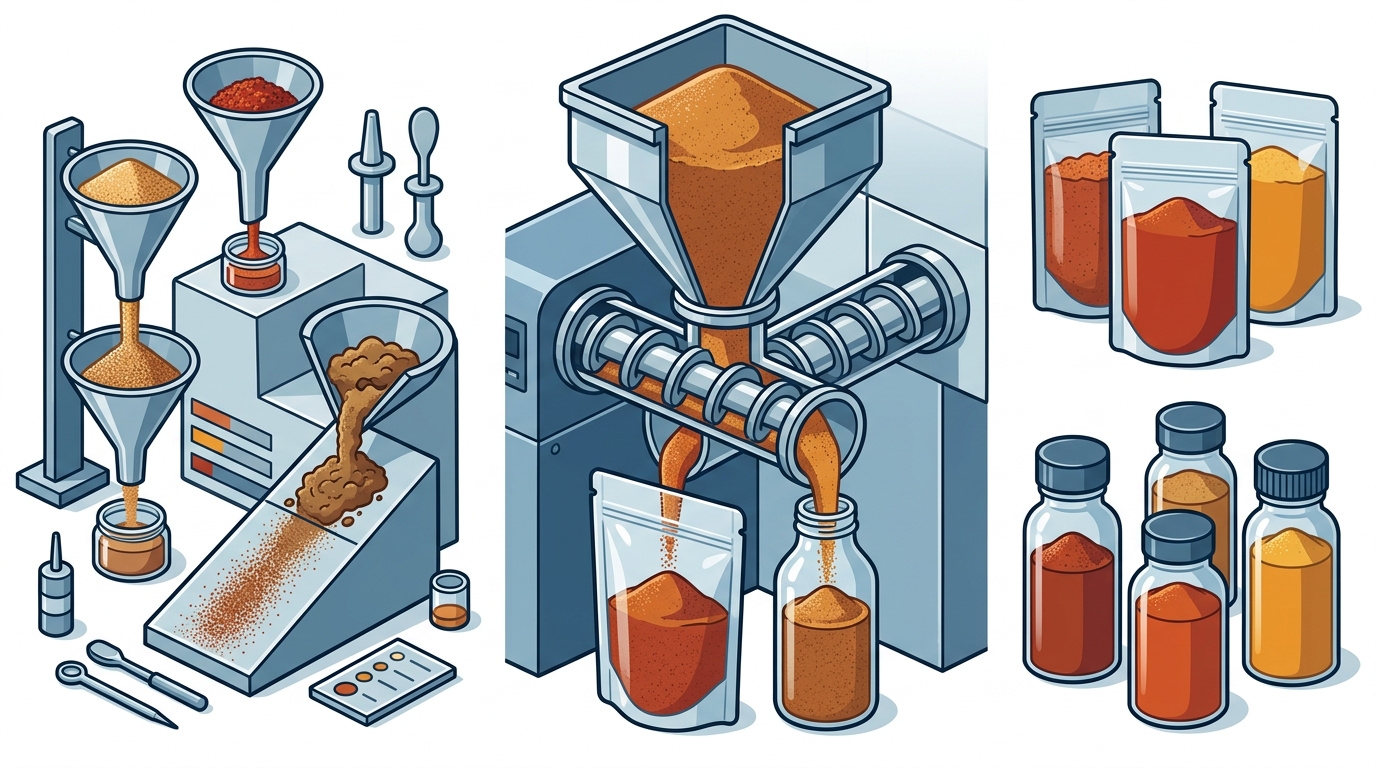
Spice flowability is the measure of how easily a powdered or granular material moves under gravity or mechanical agitation. Testing flowability is a critical step before selecting a filling machine, as it determines whether an auger, piston, or other dosing method will work effectively. Poor flowability can lead to bridging, rat-holing, or inconsistent fill weights.
Why Flowability Matters
Spices vary widely in particle size, shape, and moisture content. These factors directly impact how the product flows through a hopper and into a filling head. A spice with poor flowability may require additional equipment, such as a vibratory feeder or a ribbon blender, to ensure consistent supply to the filler. Understanding these characteristics helps prevent production bottlenecks and quality issues.
Common Flowability Tests
Several standard tests are used to evaluate powder flowability. The angle of repose test measures the natural angle at which a pile of powder rests, providing a quick indication of flow characteristics. The funnel flow test measures the time it takes for a fixed volume of powder to pass through a standardized funnel. These tests provide quantitative data that can be used to compare different spice blends or batches.
For more detailed analysis, manufacturers may use a powder flow analyzer, which measures shear strength and compressibility. These advanced tests provide a comprehensive profile of the material's behavior under different conditions. By conducting these tests, you can determine the optimal hopper design, screw pitch, and feeder configuration for your specific spice product.
Key Takeaways
- Auger fillers are the standard for filling spices into pouches and bottles due to their ability to handle dry, granular materials.
- Spice flowability must be tested before selecting a filling machine to ensure consistent dosing and prevent bridging.
- The angle of repose and funnel flow tests are simple, effective methods for evaluating powder flow characteristics.
- Modern auger fillers often include load cells or sensors to adjust for real-time variations in product density.
- Piston fillers are generally unsuitable for dry spices, as they rely on pressure rather than mechanical displacement.
- Collaborating with a packaging equipment manufacturer can help you select the right machine based on your specific product and container needs.
Frequently Asked Questions
What is the best filling machine for spices?
For most spice applications, an auger filler is the best choice. It provides precise, consistent dosing for both free-flowing and semi-free-flowing powders. The specific model should be selected based on your production speed, container size, and product flowability.
How do I test spice flowability?
You can test spice flowability using simple methods like the angle of repose or funnel flow tests. These tests measure how easily the powder moves and helps determine if it is suitable for an auger filler. For more detailed analysis, a powder flow analyzer can be used.
Can I use a piston filler for spices?
No, piston fillers are designed for liquids and viscous pastes. They are not suitable for dry spices, as they rely on pressure to move product, which can cause clumping and inconsistent fills. Auger fillers are the preferred technology for dry goods.
What factors affect spice flowability?
Spice flowability is affected by particle size, shape, moisture content, and electrostatic charge. These factors can vary between batches, so it is important to test each new batch of spice to ensure consistent filling performance.
How does an auger filler ensure accurate fill weights?
Auger fillers ensure accurate fill weights by controlling the number of screw rotations and using sensors to monitor the fill process. Load cells or optical sensors can adjust the screw speed or cut-off point to compensate for variations in product density.
Where can I find a reliable packaging equipment manufacturer?
JDA Progress is a trusted packaging equipment manufacturer that offers a wide range of filling machines, including auger fillers, for various industries. They provide tailored solutions and support to help you select the right machine for your needs.
Conclusion
Selecting the right filling machine for spices requires a clear understanding of your product's flowability and your production goals. Auger fillers offer the precision and reliability needed for high-quality spice packaging. By testing your spice's flowability and collaborating with an experienced manufacturer, you can ensure a smooth, efficient, and consistent filling process. JDA Progress offers a range of filling solutions tailored to your specific needs, helping you achieve optimal performance and product quality.