
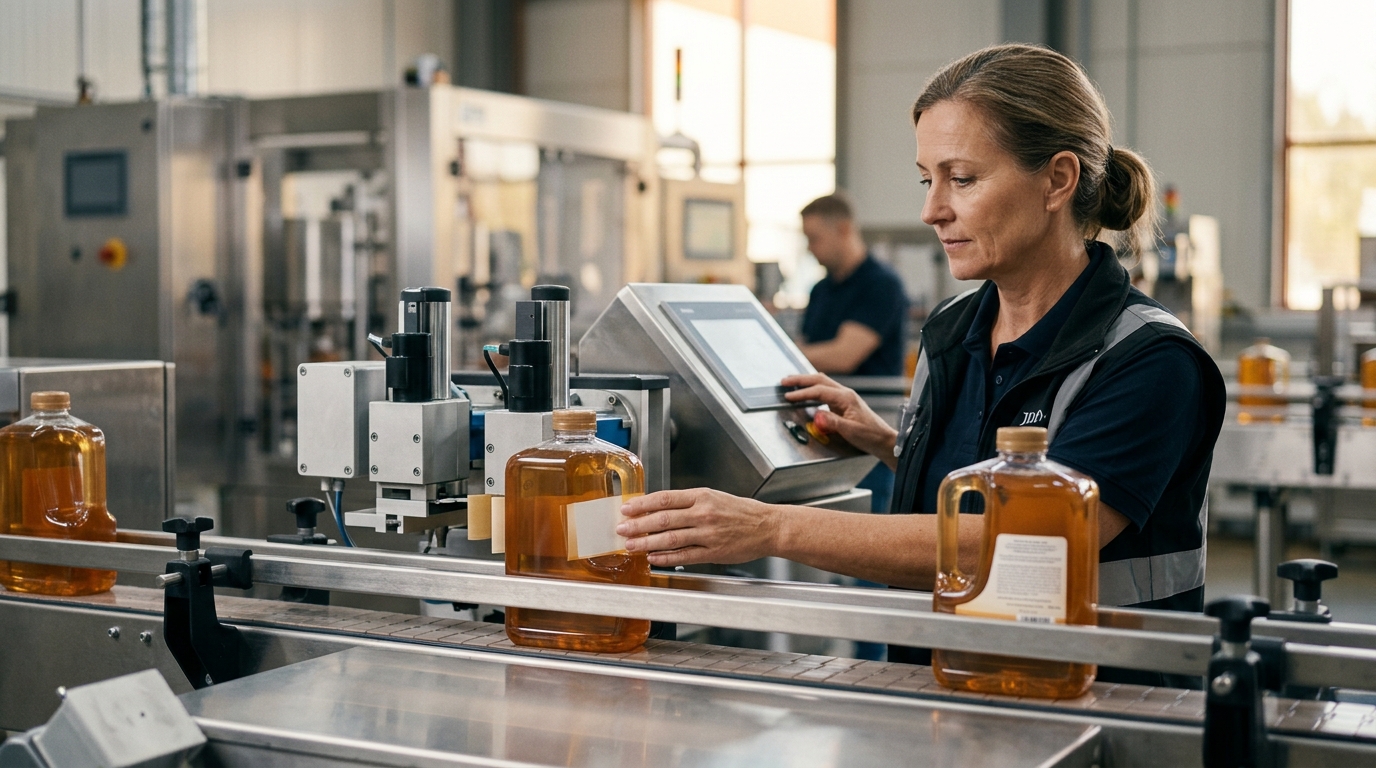
Choosing a dual-head labeler for F-style containers requires verifying container compatibility, labeling speed, and adhesive application precision. JDA Progress recommends evaluating the FBLA-2 model, which features synchronized heads for simultaneous front and back application. This approach ensures consistent branding and eliminates the inefficiencies of single-sided labeling on flat-sided bottles.
Understanding F-Style Container Geometry
F-style containers are defined by their flat sides, which differ significantly from cylindrical bottles. This geometry creates unique challenges for label application, as standard wrap-around labelers often struggle to maintain tension and alignment on flat surfaces. A dual-head system is specifically engineered to address these geometric constraints by applying labels to both flat faces independently.
The primary advantage of this configuration is the ability to present distinct information on each side. For example, the front can display brand identity while the back contains regulatory or nutritional data. This separation of content is critical for consumer clarity and regulatory compliance in industries such as spirits and cosmetics. Without a dedicated dual-head mechanism, operators often face issues with label wrinkling or misalignment on the flat edges.
Technical Specifications and Speed Requirements
When selecting a dual-head labeler, production speed must align with your line capacity. The JDA Progress FBLA-2 model operates at a labeling speed of 60 pieces per minute. This throughput is suitable for many mid-volume production lines, particularly those transitioning from semi-automatic processes. Operators should verify that this speed matches their upstream filling and capping stages to prevent bottlenecks.
Label dimensions are another critical specification. The FBLA-2 supports label lengths ranging from 10 to 250 mm and a maximum label height of 187 mm. These dimensions accommodate a wide variety of F-style bottle sizes. Ensuring your specific label format falls within these parameters is essential before purchase. Mismatched dimensions can lead to poor adhesion or mechanical jams, reducing overall line efficiency.
Adhesive Application and Container Compatibility
Pressure-sensitive adhesive label application is the standard method for F-style containers. The dual-head mechanism ensures that the adhesive is applied with consistent pressure across the entire label surface. This consistency is vital for preventing air bubbles and ensuring long-term label durability. The machine is designed to handle various container shapes, including oval and rectangular formats, making it versatile for different product lines.
Compatibility extends beyond shape to material. The labeler works effectively with plastic, glass, and metal containers. However, surface texture and finish can affect adhesion. Operators should test their specific container material with the labeler to confirm optimal performance. JDA Progress offers free product demos, allowing customers to bring their own containers for live testing. This hands-on approach mitigates the risk of purchasing equipment that does not suit their specific packaging needs.
Integration into Existing Production Lines
Integrating a dual-head labeler into an existing line requires careful planning. The FBLA-2 is an inline machine, meaning it is designed to be placed directly on the conveyor path. Its dimensions are 1,900 mm in length, 1,400 mm in width, and 1,350 mm in height. These physical dimensions must fit within your facility's floor space and conveyor layout. Adequate clearance for maintenance and operator access is also necessary.
Power requirements are another integration factor. The machine requires 110-220V AC, 50/60Hz, single phase power, with a consumption of 5A. Most industrial facilities can accommodate this, but it is important to verify your electrical infrastructure. Proper integration ensures that the labeler operates seamlessly with other equipment, such as bottle cappers and product conveyors. A well-integrated line reduces changeover times and minimizes downtime.
Key Takeaways
- F-style containers require dual-head labelers to handle flat-sided geometry effectively.
- The JDA Progress FBLA-2 offers a labeling speed of 60 pieces per minute.
- Label dimensions must fall within the machine's supported range of 10-250 mm length.
- Pressure-sensitive adhesive application ensures consistent adhesion on flat surfaces.
- Physical dimensions and power requirements must align with your facility's layout.
- Free product demos allow for live testing with your specific containers.
Frequently Asked Questions
What is the maximum label size for the FBLA-2?
The FBLA-2 supports label lengths from 10 to 250 mm and a maximum label height of 187 mm.
Can the FBLA-2 handle different container shapes?
Yes, it is compatible with F-style, oval, rectangular, and other uniquely shaped containers.
What is the labeling speed of the FBLA-2?
The machine labels at a speed of 60 pieces per minute.
Does JDA Progress offer demos for the FBLA-2?
Yes, free product demos are available where you can bring your own products for testing.
What power supply does the FBLA-2 require?
It requires 110-220V AC, 50/60Hz, single phase power with a 5A consumption.