

Common Setup and Configuration Errors in Automatic Round Bottle Labeling
Improper configuration of automatic labeling equipment is the primary cause of production downtime in modern packaging lines. Data from industry maintenance reports indicates that over 40% of labeling errors stem from mechanical misalignment rather than software faults. When a labeling machine is not calibrated correctly, it creates a cascade of defects that reduce overall equipment effectiveness. This guide details the critical setup parameters for round bottle labeling systems to help you minimize waste and maximize throughput. (About JDA Progress Packaging)
Understanding Labeler Types and Applications
Before troubleshooting, it is essential to identify the specific labeling technology in use. A wrap-around labeler is a machine that applies labels to the side of a container by peeling them from a roll and pressing them onto the surface. This is the most common type for round bottles. In contrast, a pressure-sensitive labeler uses adhesive-backed labels that are applied without heat. Understanding the difference is critical because the setup requirements for each vary significantly. (Trusted Packaging Equipment Manufacturer)
JDA Progress manufactures high-quality packaging equipment tailored to these specific needs. Our labelers are designed for plastic, glass, and metal containers. The Model WLA-2 automatic inline wrap around labeler is a prime example of engineering designed for consistency. When configuring these machines, operators must account for the material properties of the bottle and the label stock. (Trusted Packaging Equipment Manufacturer)
Mechanical Alignment Errors
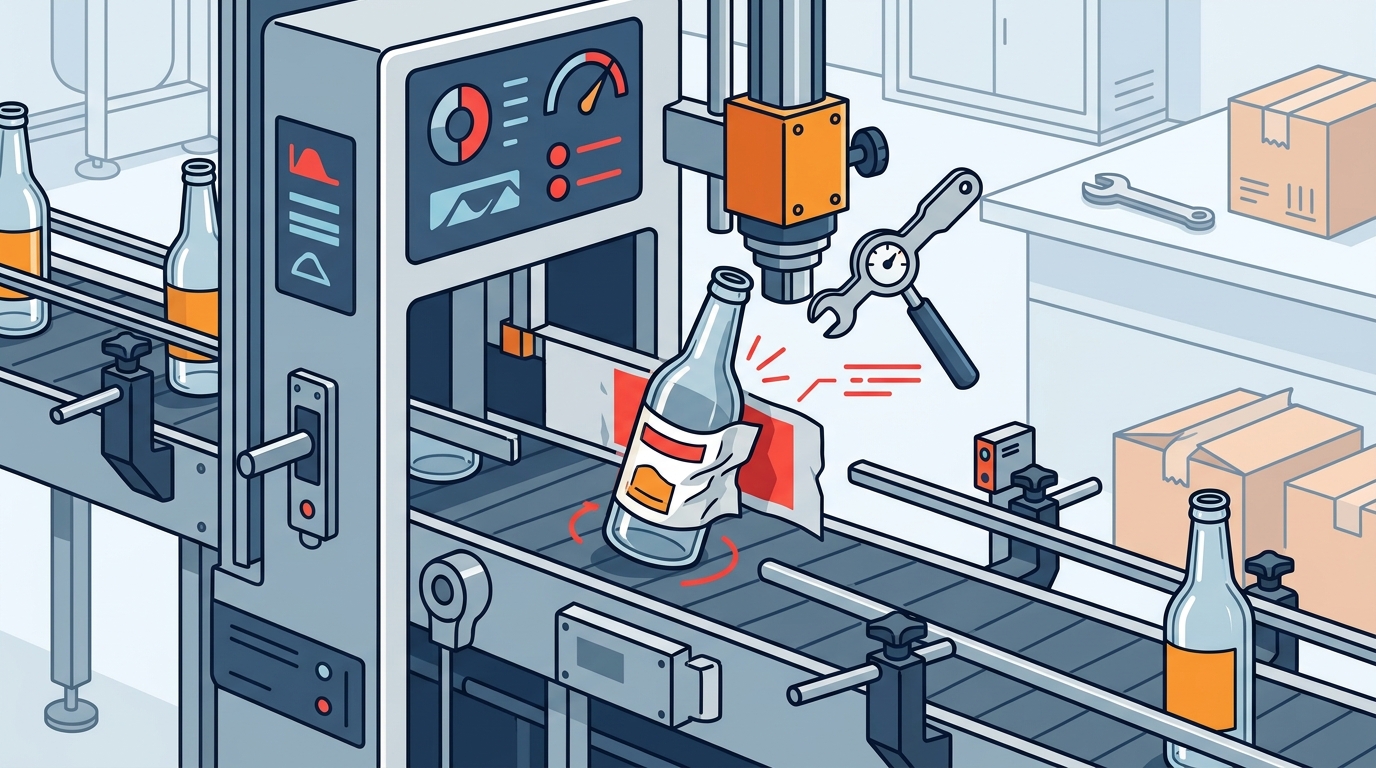
Misalignment is the most frequent cause of poor label application. If the label applicator head is not parallel to the bottle axis, the label will apply at an angle. This error is often exacerbated by worn guide rails or loose mounting bolts. To prevent this, ensure that the bottle guide rails are adjusted to fit the specific bottle diameter tightly. Any lateral movement of the bottle during application will result in a skewed label.
Another common error involves the height of the applicator head. The peel plate must be positioned at the exact point where the label transitions from the roll to the bottle. If the peel plate is too high or too low, the label may not adhere correctly. This is particularly critical when using heavy adhesive labels that have more tension. Regular inspection of the mechanical linkages ensures that the applicator head remains stable during high-speed operation.
Sensor and Control System Issues
Modern labeling machines rely heavily on photoelectric sensors to detect bottle presence and label position. A dirty or misaligned sensor can cause the machine to apply a label to an empty space or skip a bottle entirely. The eye mark sensor, which detects the gap between labels, must be calibrated to the specific contrast of the label stock. If the sensor is too sensitive, it may detect background noise as a gap. If it is not sensitive enough, it may miss the gap entirely.
PLC programming errors can also lead to configuration issues. The timing of the label application must be synchronized with the conveyor speed. If the delay settings in the PLC are incorrect, the label will be applied too early or too late. Operators should verify the PLC parameters against the machine manual. JDA Progress provides comprehensive training on PLC programming to ensure that your team can manage these settings effectively. Visit our demo centre to see how our engineers handle these configurations.
Film and Peel Plate Setup
The condition of the peel plate is vital for smooth label application. A scratched or dirty peel plate can cause the label to tear or stick during the peeling process. This is especially true for thin film labels that are more fragile. The peel plate must be clean and free of adhesive residue. Regular cleaning with appropriate solvents is necessary to maintain performance.
Additionally, the tension of the label roll must be adjusted correctly. Too much tension can cause the label to stretch, leading to misalignment. Too little tension can cause the label to bunch up on the roll. The tension control system should be set to provide a consistent pull. This is particularly important when switching between different label materials. JDA Progress offers in-stock packaging equipment and parts for fast delivery, ensuring that you can replace worn components quickly.
Speed and Synchronization
Running a labeling machine at speeds beyond its design limits is a common configuration error. High speeds increase the inertia of the label roll and the applicator head. This can cause the label to lag behind the bottle, resulting in wrinkles or bubbles. The machine must be synchronized with the upstream and downstream equipment. If the conveyor speed fluctuates, the labeling accuracy will suffer.
Operators should start at a lower speed and gradually increase it while monitoring the label application. This allows for the detection of any mechanical resonance or vibration that may occur at higher speeds. The use of a conveyor with precise speed control is recommended. Our team can help you find the best solution for your packaging needs by analyzing your specific production requirements.
Key Takeaways
- Over 40% of labeling errors are caused by mechanical misalignment rather than software faults.
- Ensure the applicator head is parallel to the bottle axis to prevent skewed labels.
- Calibrate the eye mark sensor to the specific contrast of the label stock.
- Regularly clean the peel plate to prevent label tearing and sticking.
- Adjust label roll tension to prevent stretching or bunching.
- Start at lower speeds and gradually increase to detect mechanical resonance.
- JDA Progress has been in business since 1988, providing reliable packaging solutions.
Frequently Asked Questions
How often should I calibrate the photoelectric sensor?
You should calibrate the photoelectric sensor every time you change the label stock or the bottle type. This ensures that the sensor detects the gap or eye mark correctly.
What causes labels to apply at an angle?
Labels apply at an angle when the applicator head is not parallel to the bottle axis or when the bottle guide rails are too loose. Tighten the guide rails and check the alignment of the applicator head.
Can I use any label stock with my labeling machine?
No, you must use label stock that is compatible with your machine's peel plate and tension control system. Consult the machine manual for recommended label specifications.
How do I fix a label that is wrinkling during application?
Wrinkling is often caused by incorrect tension or a dirty peel plate. Adjust the tension control and clean the peel plate with an appropriate solvent.
What is the warranty on JDA Progress labeling machines?
JDA Progress provides a 1 year warranty on all machines and parts. This covers defects in materials and workmanship.
Where is JDA Progress located?
JDA Progress is located in Vaughan, Ontario, Canada. We have a 15,000 square foot facility with a permanent showroom open to the public.
Do you offer training on machine configuration?
Yes, we offer comprehensive training on machine configuration and PLC programming. Contact us to schedule a session.
Contact JDA Progress
If you are experiencing persistent labeling issues, contact our team of experts. We can help you diagnose the problem and configure your machine for optimal performance. Visit our Contact Us page to request a quote or schedule a demo. Our team is ready to assist you in maximizing your packaging efficiency.