
How Much Production Volume Do I Actually Need My Filling Machine to Handle?
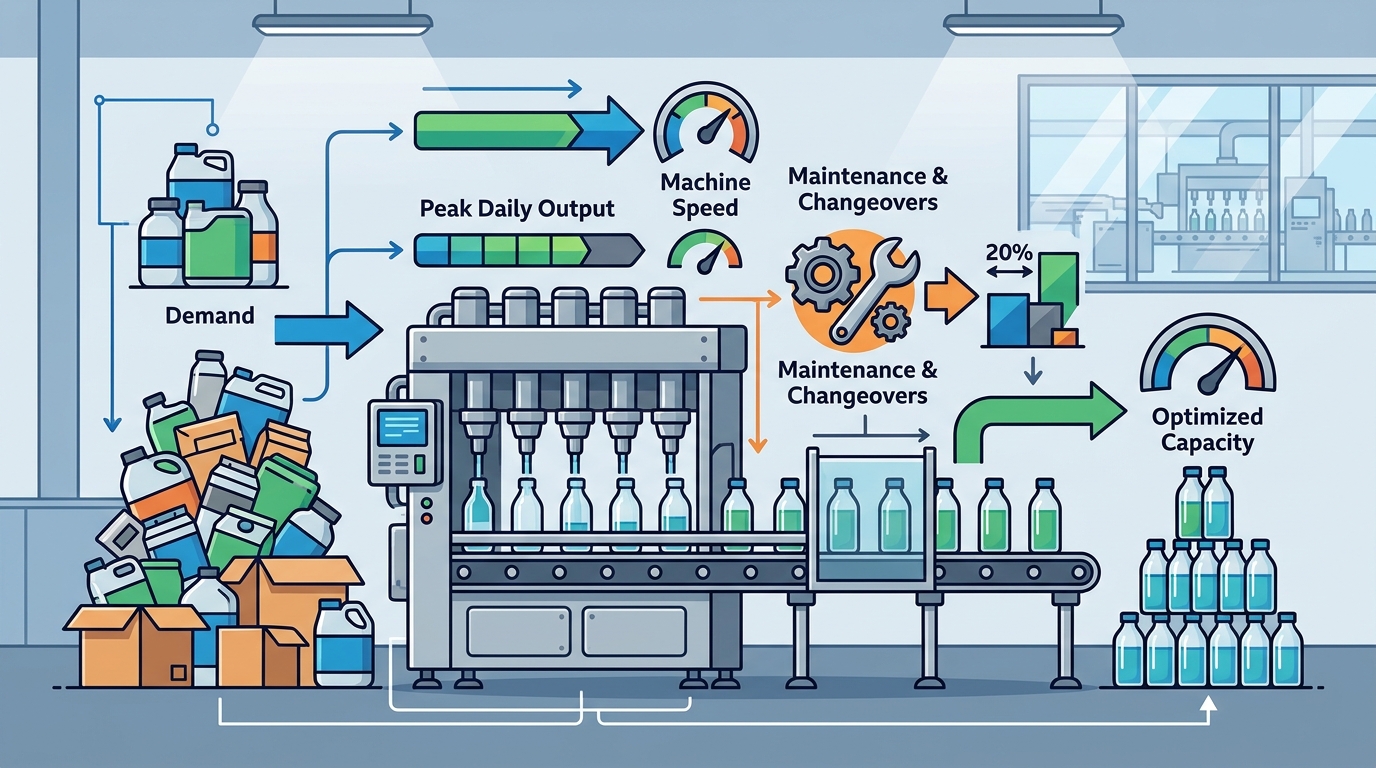
Determine your required production volume by calculating your peak daily output, factoring in machine speed, and adding a 20% buffer for maintenance and changeovers. This approach ensures your equipment meets demand without overpaying for unnecessary capacity. JDA Progress helps manufacturers right-size their filling lines for consistent, high-quality output.
Calculating Your Peak Daily Output
Start by identifying your highest demand period. Production volume is the total number of units your facility must process during peak hours. For example, a beverage company producing 10,000 bottles per day at 120 bottles per minute requires approximately 83 minutes of active machine time. This baseline prevents underestimating your needs during seasonal spikes. For additional details, review the Service and Parts JDA.
Understanding Machine Speed and Efficiency
Machine speed is the maximum number of containers a filler can process per minute. However, real-world efficiency is lower due to cleaning, changeovers, and minor stoppages. A piston filler might run at 150 bottles per minute theoretically, but effective throughput often drops to 80-90% of that rate. JDA Progress designs fillers with consistent torque and flow control to maintain high efficiency across different product viscosities.
Factoring in Changeovers and Maintenance
Changeover time is the duration required to switch between product types or container sizes. If you run three different SKUs, each changeover might take 15 minutes. Maintenance is the scheduled downtime for cleaning and part replacement. Adding a 20% buffer to your calculated machine time accounts for these interruptions. This buffer ensures you meet your daily targets even when unexpected issues arise.
Scaling for Future Growth
Future growth is the anticipated increase in production volume over the next 3-5 years. Buying a machine that only meets current needs can lead to costly upgrades later. Conversely, overbuying ties up capital in unused capacity. JDA Progress offers modular filling systems that can be expanded as your business grows, providing a cost-effective path to scaling production without replacing the entire line.
Right-Sizing Your Investment
Right-sizing is the process of selecting equipment that matches your current and near-term production needs. It balances initial cost with long-term operational efficiency. A small craft bottler might need a tabletop filler, while an industrial facility requires a high-speed inline system. By accurately assessing your volume, you avoid the pitfalls of underpowered or oversized equipment.
Key Takeaways
- Calculate peak daily output to establish your baseline production volume.
- Account for real-world efficiency, which is typically 80-90% of theoretical speed.
- Add a 20% buffer for changeovers, cleaning, and maintenance.
- Consider future growth when selecting machine capacity.
- Modular systems offer flexibility for scaling production over time.
- Right-sizing prevents both underpowered and oversized equipment investments.
Frequently Asked Questions
How do I calculate my required machine speed?
Divide your peak daily output by the number of production hours, then adjust for efficiency and changeover time. This gives you the minimum bottles per minute your machine must handle.
What is a safe buffer for maintenance?
A 20% buffer is generally recommended to account for cleaning, changeovers, and minor stoppages. This ensures you meet your production targets consistently.
Should I buy a machine for my current or future needs?
Aim for a machine that meets your current needs with room for moderate growth. Modular systems allow you to expand capacity as your business scales, avoiding the cost of replacing equipment.
How does product viscosity affect machine speed?
Thicker products like sauces or creams may require slower filling speeds to ensure accuracy. Always test your specific product to determine the optimal speed for your filler.
What is the difference between theoretical and effective throughput?
Theoretical throughput is the maximum speed a machine can achieve under ideal conditions. Effective throughput accounts for real-world factors like cleaning and changeovers, typically resulting in 80-90% of theoretical speed.
How can JDA Progress help me right-size my filling line?
JDA Progress offers expert consultation and live product demos to help you determine the best filling solution for your specific production volume and product type.
Conclusion
Accurately assessing your production volume is the first step toward selecting the right filling machine. By calculating peak output, factoring in efficiency, and planning for growth, you can make a confident investment. JDA Progress provides the expertise and equipment to help you right-size your line for long-term success. to discuss your specific production needs.