
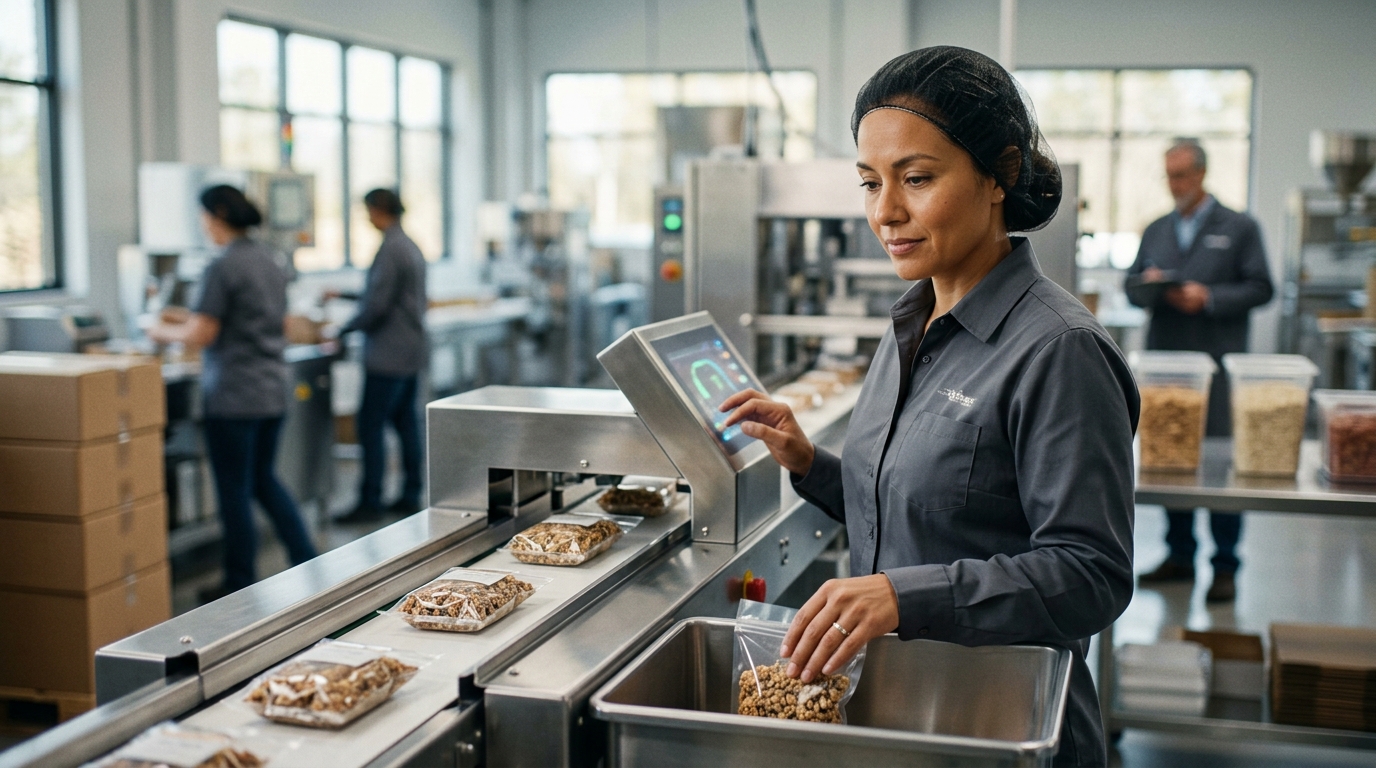
Whether you run a small artisanal food brand or manage a high-volume production facility, your packaging line is where product quality, food safety, and profitability converge. Below is a step-by-step framework for squeezing more value out of every minute and every meter of packaging film on your line.
Step 1 — Audit Your Current Packaging Line
Optimization starts with a clear picture of where you stand today. Walk the floor and document every station — from product infeed through case packing and palletizing. Record cycle times, changeover durations, scrap rates, and downtime events for at least two weeks of normal production.
Collect data on individual equipment centers' performance including uptime, minor stops, and breakdown time. This data-driven baseline is the foundation for every improvement that follows and helps you set priorities for efficiency gains.
Step 2 — Identify and Eliminate Bottlenecks
Every packaging line has a constraint that dictates its maximum throughput. The key is to map each piece of equipment's rated speed and build what packaging engineers call a V-curve. Each piece of equipment further from the bottleneck should be designed to run roughly 5–10 percent faster than the equipment closer to the constraint. This ensures the bottleneck station is never starved for product and never overwhelmed by downstream backup.
For example, if your primary wrapper runs at 240 units per minute, your secondary case packer and tertiary cartoner should each be rated progressively higher. Mapping this relationship exposes hidden mismatches that silently erode overall equipment effectiveness (OEE).
Step 3 — Introduce Targeted Automation
You don't have to automate everything at once. Focus on the stations where manual labor creates the most variability, safety risk, or speed limitation.
Form-Fill-Seal Machines
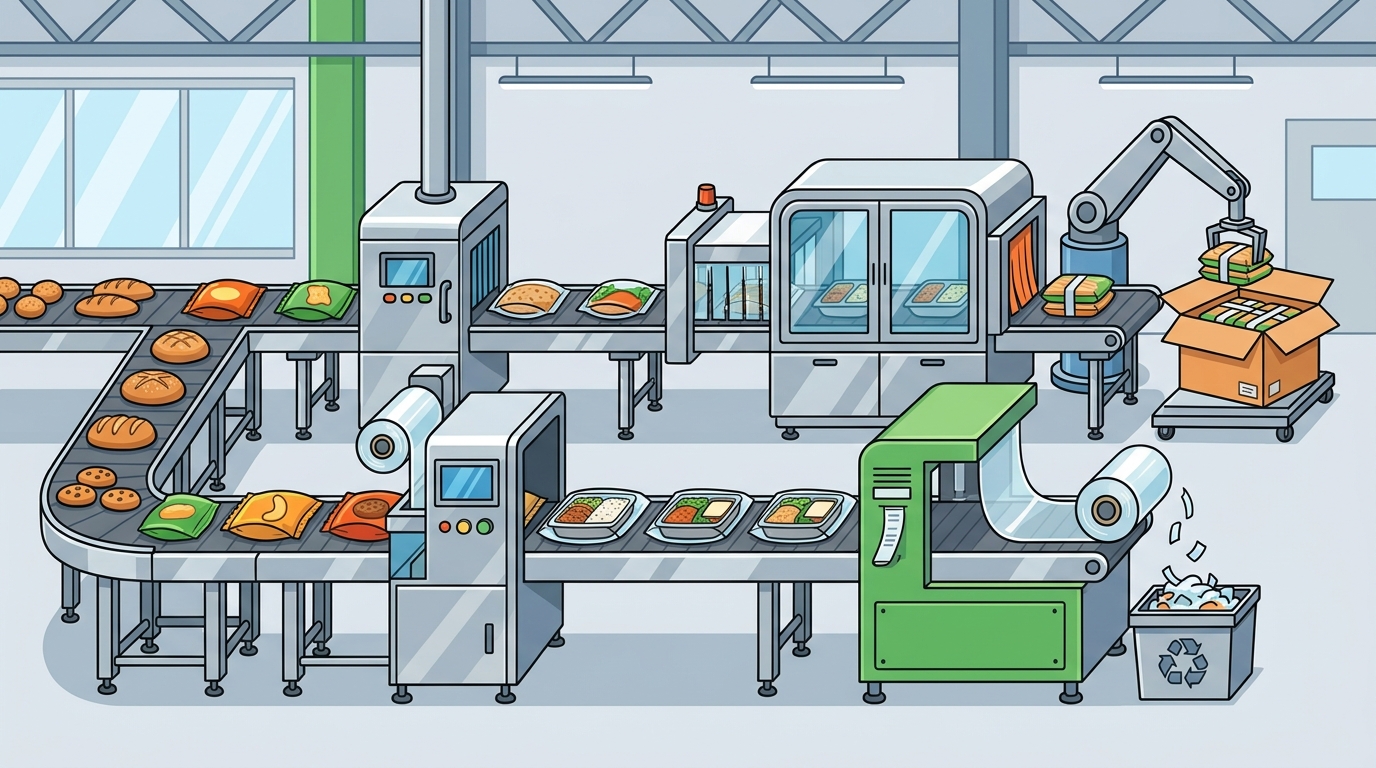
A vertical form-fill-seal (VFFS) machine automatically forms a bag, fills it with product, seals it, and cuts it in one continuous motion. This is ideal for snacks, grains, powders, and many other food products. Modern VFFS machines alert operators when an improper seal is detected, reducing waste and liability. Equipment like the JDA Progress Redeepac series of vertical baggers can handle multiple pouch sizes and styles, giving you the flexibility to serve diverse product lines from a single machine.
Automatic Filling and Capping
Liquid food products — sauces, dressings, beverages — benefit enormously from automated fillers and cappers. A good capping machine applies the same pressure and alignment every single time, eliminating the inconsistencies and contamination risks of manual capping. JDA Progress manufactures automatic inline capping machines that require minimal training and quick changeovers when you switch bottle sizes or cap styles.
Labeling Systems
Automatic labeling machines streamline the packaging process, ensuring accuracy, speed, and consistency in labeling. They are essential for meeting diverse labeling requirements and enhancing compliance with regulatory standards. Whether you need wrap-around labels for bottles, top labels for trays, or pouch labels, an automated applicator eliminates misalignment and keeps your line moving.
Conveyors and Integration
Conveyors are the connective tissue of your packaging line. Tailored conveyor systems — including incline and flighted models — create smooth product flow between machines. When paired with form-fill-seal machines and baggers, they form a seamlessly integrated system that dramatically reduces manual handling.
Step 4 — Optimize Your Packaging Materials
Material selection impacts cost, shelf life, sustainability, and line speed simultaneously.
- Right-size your packaging. Oversized containers waste film, add shipping weight, and increase material cost. Redesigning formats to reduce resin intensity can cut plastic use by up to 50 percent compared to traditional clamshell containers, with up to 25 percent cost savings.
- Consider flexible packaging. Flexible packaging reduces material usage by up to 70 percent compared to rigid containers, lowering transportation and storage costs significantly.
- Evaluate Modified Atmosphere Packaging (MAP). Gas flushing — replacing oxygen with nitrogen — can substantially extend the shelf life of perishable foods, reducing spoilage and returns.
Step 5 — Upgrade Quality Control and Compliance
In the food industry, a single labeling error can trigger a nationwide recall. The FDA continues to warn that undeclared allergens remain a leading cause of food recalls, and packaging mistakes can escalate into costly, reputation-damaging events.
Inline Inspection Equipment
- Checkweighers measure the weight of each product on the line. If a discrepancy is found, the system alarms and can automatically reject the package — preventing overfills and underfills from reaching customers.
- Vision systems read allergens, ingredients, barcodes, date codes, and languages at line speed, verifying that required information appears on every package.
- Metal detectors and X-ray systems scan for foreign matter before finished goods ship.
Traceability
Track-and-trace capabilities link every case to a lot and timestamp, providing detailed records for compliance with regulations such as the Food Traceability Rule (FSMA 204). Integrated coding equipment — continuous inkjet or thermal transfer overprinters — prints batch codes and best-before dates directly onto film.
Step 6 — Implement Preventive Maintenance
Unplanned downtime is the single biggest enemy of packaging line efficiency. Implementing preventive maintenance on a regular schedule, integrated into the control system and guided by runtime and efficiency metrics, keeps equipment in optimal condition and reduces unplanned stops.
Additionally, adding a step-verification system within your batch management process ensures each step is accurately followed, guaranteeing consistency and reliability in the final product. Create a PM plan that addresses all wear parts — sealing bars, film rollers, sensors, belts — and schedule service during planned changeovers rather than unplanned breakdowns.
Step 7 — Leverage Smart Technology and AI
Artificial intelligence is increasingly applied across packaging processes through tools such as machine vision, automated guided vehicles, autonomous mobile robots, and predictive maintenance. According to a 2026 PMMI white paper, knowledge transfer and predictive maintenance are the two technologies expected to have the strongest positive impact on the packaging industry over the next few years.
Smart packaging using IoT devices can also improve food safety by monitoring temperature, humidity, and location in real time during transit and storage. Embedded sensors and labels provide real-time information on product freshness, temperature exposure, and potential contamination — adding a layer of protection that static packaging simply cannot offer.
Changeover Optimization
Optimizing changeovers and training staff on changeover techniques is one of the best ways to improve efficiency on an existing line. Modern machines with advanced motion control allow operators to program multiple set points for different product runs, speeds, or packages, dramatically reducing the downtime associated with switching SKUs.
Step 8 — Build Sustainability Into the Process
Sustainability is no longer optional. The EU's Packaging and Packaging Waste Regulation (PPWR) requires transport packaging to achieve a 40 percent reuse rate by 2030 and 70 percent by 2040. In the United States, states like California, New York, and Washington have banned hazardous substances such as PFAS and heavy metals in food-contact packaging.
Practical steps include:
- Switching to recyclable mono-material films where possible.
- Using reusable packaging containers (RPCs) for distribution — they can be reused over 100 times, vastly outperforming single-use corrugated cardboard.
- Designing packaging systems that maintain consistent uptime, reducing the energy waste caused by frequent stops and restarts.
- Adopting digital printing for labels, which reduces lead times and material waste when regulatory or branding changes occur.
Key Takeaways
- Start with data. Audit every station on your line before investing in new equipment.
- Map your V-curve. Equipment speeds should be balanced around the bottleneck for maximum throughput.
- Automate strategically. VFFS machines, automatic cappers, labelers, and conveyors remove variability and free up labor for higher-value work.
- Right-size materials. Flexible packaging and smart format design cut costs and waste simultaneously.
- Inspect inline. Checkweighers, vision systems, and metal detectors protect your brand and your customers.
- Prevent, don't react. Scheduled maintenance and predictive analytics eliminate costly unplanned downtime.
- Think long-term sustainability. Regulations are tightening globally — early adoption is cheaper than forced compliance.
Frequently Asked Questions
What is the first step to optimizing a food packaging process?
Begin with a thorough audit of your current line. Record cycle times, changeover durations, scrap rates, and downtime for each station. Collecting performance data on individual equipment centers — uptime, minor stops, and breakdown time — gives you a factual baseline to prioritize improvements.
How does a vertical form-fill-seal machine improve food packaging?
A VFFS machine automatically forms a bag from roll stock, fills it with product, and seals it in a single continuous motion. Because everything is automatic, the quantity filled in each bag stays consistent — no overfilling or underfilling. The sealing process is quick and secure, ensuring freshness and reducing product spoilage. Companies like JDA Progress manufacture VFFS machines designed for powders, grains, snacks, and many other food products.
What role does AI play in food packaging optimization?
AI is being integrated into packaging lines to detect defects, optimize packaging materials, and ensure compliance with safety standards. AI-powered cameras and machine learning algorithms analyze products in real time, minimizing waste and enhancing quality control. Predictive maintenance algorithms can also forecast when a component will fail, allowing you to replace it during a planned stop rather than suffering an unplanned breakdown.
How can I reduce material waste on my packaging line?
Flexible packaging can reduce material usage by up to 70 percent compared to rigid containers. Right-sizing containers, switching to mono-material films, and using Modified Atmosphere Packaging to extend shelf life all contribute to lower waste. Semi-automated pallet wrappers also improve the accuracy of film pre-stretching, reducing material consumption during tertiary packaging.
What equipment does JDA Progress offer for food packaging?
JDA Progress designs and manufactures high-quality packaging equipment including fillers, cappers, labelers, vertical form-fill-seal baggers, conveyors, sealers, and complete bottling lines. They are a family-owned business established in 1988, with thousands of machines sold to customers in North America and around the world. Most machines and spare parts are in-stock and readily available, backed by a one-year warranty and comprehensive after-sales support.
Is automation cost-effective for small food producers?
Yes. While the initial investment may be significant, automated packaging lowers long-term costs by reducing labor expenses, minimizing waste through precise measurements, and decreasing the likelihood of errors that can lead to product recalls. Many entry-level machines — such as tabletop labelers or semi-automatic cappers — let small producers start automating incrementally without a massive capital outlay.