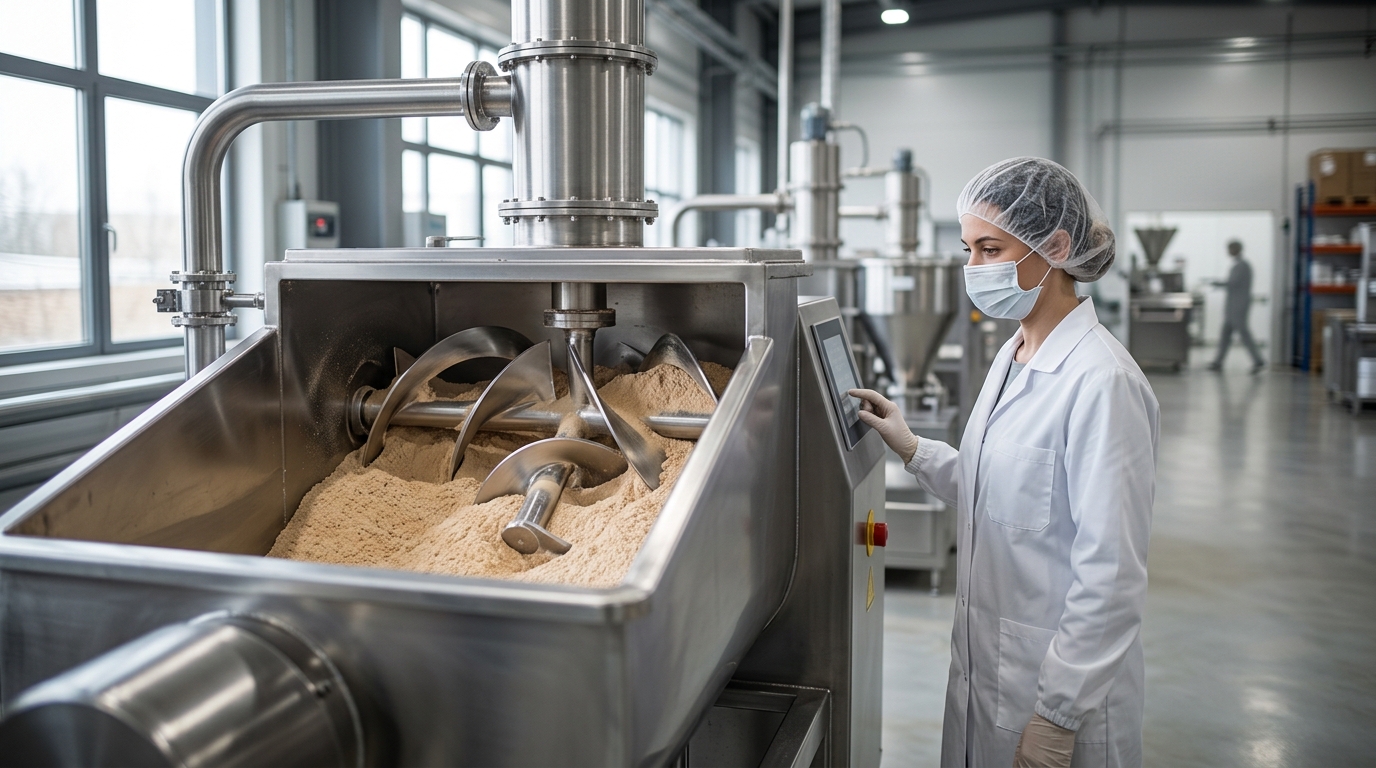
Industrial mixing efficiency directly dictates product consistency and operational profitability. According to recent industry analyses, facilities that optimize their bulk powder blending processes can reduce production downtime by up to 20 percent while significantly improving batch-to-batch uniformity. This performance gain is critical for manufacturers in highly regulated sectors like food and cosmetics, where precise ingredient distribution is non-negotiable. Ribbon blenders have emerged as the dominant solution for these challenges due to their unique mechanical design and versatile handling capabilities. (Trusted Packaging Equipment Manufacturer)
Understanding Ribbon Blender Mechanics
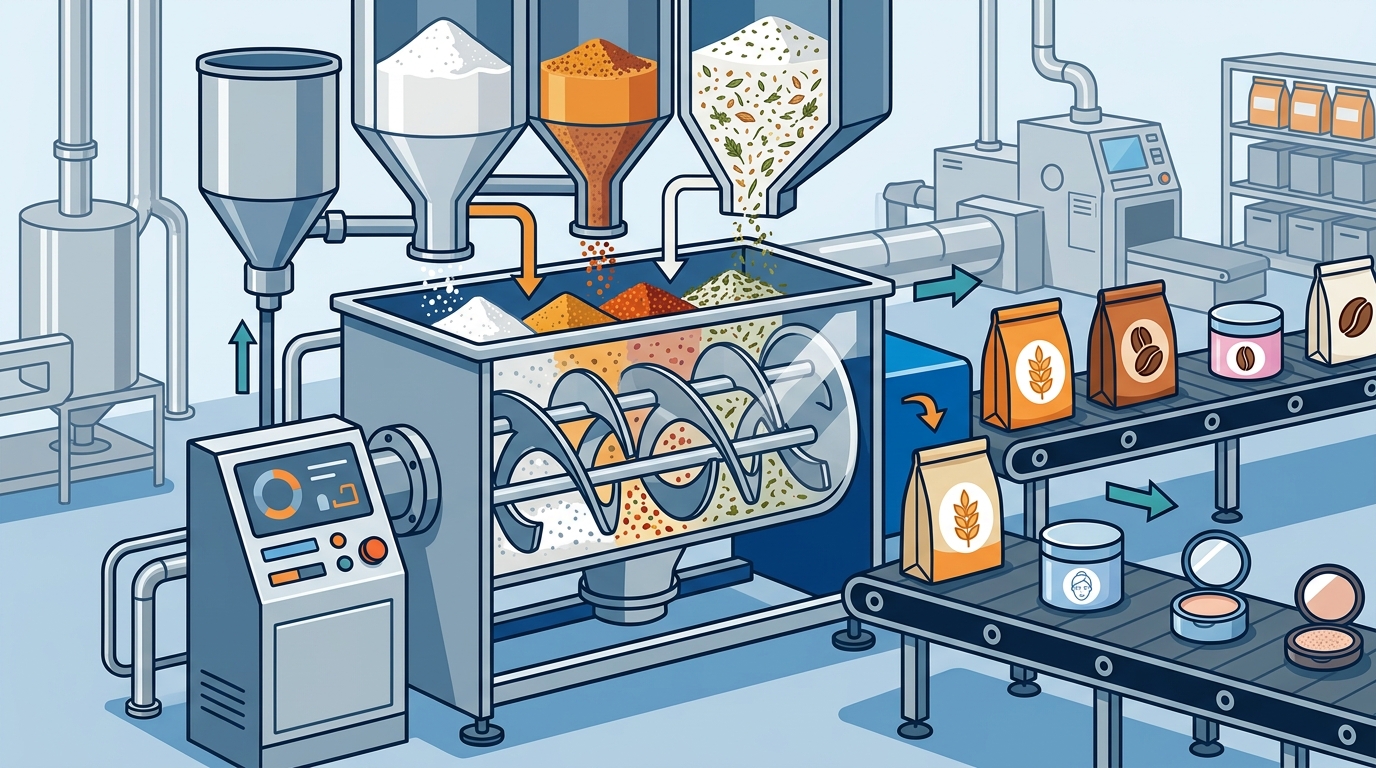
A ribbon blender is a type of powder mixer that uses a U-shaped trough and a double-shafted ribbon agitator to blend dry materials. The inner ribbon winds in the opposite direction of the outer ribbon, creating a complex flow pattern. This design ensures that material is continuously moved from the ends of the trough toward the center, and then back out again. The result is a rapid and thorough homogenization of ingredients.
The efficiency of this mechanism relies on the precise clearance between the ribbon flights and the trough wall. In high-performance models, this clearance is minimized to prevent material accumulation while allowing for thermal expansion during operation. For manufacturers seeking to understand the engineering behind these systems, visiting a demo centre provides tangible insight into how these mechanical principles translate into real-world mixing speeds and consistency.
Unlike paddle mixers or V-blenders, ribbon blenders do not rely on gravity alone for mixing. They actively convey material, making them ideal for cohesive powders that tend to clump. This active conveying capability is what makes them suitable for the diverse range of viscosities and densities found in both food and cosmetic formulations.
Performance in Food Processing
The food industry demands strict adherence to hygiene standards and ingredient integrity. Ribbon blenders are extensively used for mixing dry food ingredients such as spices, flour, sugar, and protein powders. The U-shaped trough design allows for complete discharge of material, minimizing waste and cross-contamination between batches. This is particularly important in facilities that produce multiple product lines daily.
One of the primary advantages of ribbon blenders in food processing is their ability to handle a wide variety of particle sizes. Whether mixing fine cocoa powder with coarse sugar crystals or integrating large chunks of dried fruit into a batter mix, the ribbon agitator ensures uniform distribution without damaging the ingredients. This gentle yet effective mixing preserves the texture and flavor profiles that consumers expect.
Furthermore, ribbon blenders can be equipped with jacketed troughs for heating or cooling. This feature is crucial for processes that require temperature control, such as melting chocolate or cooling baked goods before packaging. The ability to integrate thermal management directly into the mixing process reduces the need for additional equipment and streamlines the production workflow. For more details on our specific blenders and feeders, you can explore our technical specifications.
Applications in Cosmetics
In the cosmetics sector, product consistency is paramount. Consumers expect every jar of cream or bottle of powder to look and feel identical. Ribbon blenders excel in this environment by providing the high-shear mixing necessary to incorporate pigments, talc, and other dense powders into base formulations. The uniform dispersion of these ingredients ensures that the final product meets strict quality control standards.
Cosmetic manufacturers also benefit from the ease of cleaning and maintenance offered by ribbon blenders. Many models feature quick-release mechanisms and smooth internal surfaces that facilitate rapid sanitation between batches. This is essential for preventing cross-contamination of allergens or sensitive ingredients, such as fragrances or active botanical extracts. The about us page highlights our commitment to building equipment that supports these rigorous hygiene requirements.
Additionally, ribbon blenders are versatile enough to handle semi-dry pastes and creams, not just powders. This versatility allows cosmetic companies to use a single piece of equipment for multiple stages of production, from initial powder blending to final paste homogenization. This reduces capital expenditure and optimizes floor space in compact manufacturing facilities.
Equipment Comparison
Choosing the right mixing equipment depends on the specific needs of your production line. Below is a comparison of common industrial mixers to help you evaluate their suitability for your operations.
| Equipment Type | Best For | Mixing Action | Discharge Efficiency |
|---|---|---|---|
| Ribbon Blender | Dry powders, cohesive blends | Active conveying | High |
| V-Blender | Free-flowing powders | Gravity tumbling | Medium |
| Paddle Mixer | Heavy, sticky materials | Shear mixing | Variable |
| Ploughshare Mixer | High-shear wet granulation | High-speed rotation | High |
As shown in the table, ribbon blenders offer a unique combination of active conveying and high discharge efficiency. This makes them superior to V-blenders for cohesive materials and more versatile than paddle mixers for general-purpose dry blending. For a deeper dive into our packaging machines and how they integrate with mixing systems, contact our engineering team.
Key Takeaways
- Ribbon blenders use a double-shafted ribbon agitator to create a convective mixing pattern that ensures rapid homogenization.
- In food processing, they handle diverse particle sizes and can be jacketed for thermal control, enhancing production flexibility.
- For cosmetics, they provide the high-shear mixing needed for pigment dispersion and offer easy cleaning for hygiene compliance.
- JDA Progress has over 35 years of experience manufacturing reliable mixing and packaging equipment for global clients.
- Their Vaughan facility features a permanent showroom where you can witness the performance of their demo centre machines firsthand.
- In-stock parts and equipment are available for fast delivery, minimizing downtime for your operations.
- All machines come with a 1-year warranty and comprehensive after-sales support to ensure long-term reliability.
Frequently Asked Questions
What types of materials can a ribbon blender handle?
Ribbon blenders are designed to mix dry powders, granules, and even semi-dry pastes. They are particularly effective for cohesive materials that do not flow freely, such as flour or certain cosmetic pigments.
How does a ribbon blender ensure uniform mixing?
The inner and outer ribbons move material in opposite directions, creating a continuous convective flow. This action prevents dead zones and ensures that all particles are circulated throughout the trough.
Are ribbon blenders suitable for food-grade applications?
Yes, many ribbon blenders are built with food-grade stainless steel and sanitary designs. They can be equipped with CIP (Clean-in-Place) systems for automated cleaning.
What is the typical capacity of an industrial ribbon blender?
Capacities vary widely, from small laboratory units to large industrial models with volumes exceeding 10,000 liters. The right size depends on your batch frequency and volume requirements.
How do I choose between a ribbon blender and a paddle mixer?
Choose a ribbon blender for general dry blending and free-flowing to cohesive powders. Opt for a paddle mixer if you are dealing with heavy, sticky, or highly viscous materials that require intense shear.
Does JDA Progress offer custom solutions?
Yes, JDA Progress works closely with clients to design custom packaging and mixing solutions. You can contact us to discuss your specific needs.
What maintenance is required for ribbon blenders?
Regular maintenance includes checking the ribbon flights for wear, inspecting seals, and lubricating bearings. JDA Progress provides detailed maintenance guides and spare parts to keep your equipment running smoothly.
Ready to Optimize Your Mixing Process?
Whether you are in the food or cosmetics industry, selecting the right ribbon blender is a critical decision that impacts your bottom line. JDA Progress offers a range of high-performance mixing and packaging equipment designed to meet the rigorous demands of modern manufacturing. Our team of experts is ready to help you find the perfect solution for your business.
Visit our demo centre in Vaughan to see our machines in action. Or, request a quote today to get started on your path to greater efficiency and consistency.